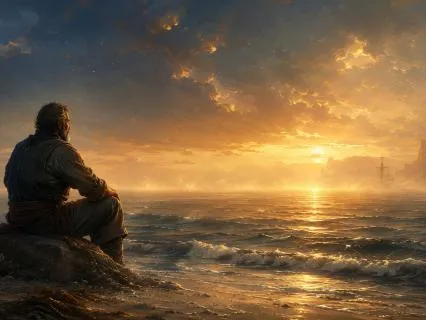
There was a man the sea itself could not let go of.
A king argued over by gods.
A name that's been spoken beside fires for 3,
000 years.
Tonight for the first time on this channel.
We open the door into his story.
The oldest story there is.
Of a way home that takes 20 years to walk.
Hello,
My dear friend.
My name is Jacob.
And I'm here to remind you.
You've done enough for today.
Truly,
It is enough.
Tonight's the night we start something new.
One evening at a time.
I'm going to tell you Homer's Odyssey,
The tale of Odysseus and his long road home from Troy.
Hold the way it was always meant to be told,
Out loud.
In the dark.
To someone who's allowed to fall asleep before it ends.
Tonight belongs to the one he left behind.
A boy grown into a young man.
Waiting in a house that stopped being his the moment his father's ship sailed.
So let your eyes close.
Just settle in.
Sit back.
And let the story of Odysseus fill your dreams.
Sing to me,
O Muse,
Of the man of many ways.
" who wandered long after he had brought down the sacred city of Troy.
Many were the towns he saw.
And many the minds of men he came to know.
And many the nights he lay awake on the open sea.
His heart aching.
Fighting only to bring himself and his men home.
He failed.
He had given everything to bring his men home.
It was his own men who doomed the voyage.
Eating the cattle of the sun god in their foolishness.
And every last one of them was struck down for it.
Odysseus alone survived.
So now,
All who had escaped death in battle or shipwreck had found their way home again.
All except Odysseus.
He wanted nothing more than his wife and his own country.
But the nymph Calypso had him still.
Holding him in her cave on a lonely island in the middle of the sea.
Wanting him for a husband.
Unwilling to let him go.
Years pass this way.
And when at last the gods agreed among themselves that the time had come for him to go home,
One God alone stayed bitter against him.
Poseidon,
Lord of the sea.
Who could not forgive Odysseus for blinding the eye of his son.
The Cyclops.
While Poseidon was away,
Feasting among far-off peoples who still honored him.
The Other Gods Met on Olympus and it was Athena who spoke up for the missing king.
My heart aches for Odysseus,
" she said.
Shut away on that island.
Far from everyone who loves him.
While his own son grows up not knowing whether his father is alive or dead.
And Zeus.
Who had always been fond of the man.
Agreed it was time.
Hermes would be sent to free him from Calypso.
And Athena herself would go down to Ithaca.
To put courage into the heart of a boy who badly needed it.
His name was Telemachus.
And he had grown from an infant into a young man without ever once hearing his father's voice.
In the house that should have belonged to him.
More than a hundred suitors had made themselves at home.
Eating his oxen.
Drinking his wine.
And pressing his mother.
Penelope to give up hope and marry one of them instead.
They sprawled across the great hall on the hides of oxen they'd slaughtered themselves.
Throwing dice.
Playing at drafts on the smooth stone floor.
While servants hurried between them with wine and water and platter after platter of meat that wasn't theirs to eat.
Had gone on so long that the smell of it,
Roasting fat,
Spilled wine.
Too many men in too small a space.
Had simply become the smell of home to Telemachus.
The way a wound stops hurting once you've carried it long enough to forget what it felt like before.
Telemachus sat among them,
Without really being among them.
Turning the trouble of it over and over in his mind.
Picturing,
The way a boy pictures things he's given up expecting.
His father walking back through that door.
And every one of these men scattering before him like crows.
That was the mood he was in when a stranger appeared at the gate.
He didn't know it was a goddess.
Athena had come to him disguised as an old family friend named Mentes.
And Telemachus.
Ashamed that any guest should be left standing outside his own father's house.
Hurried out to welcome her himself.
He led her in past the suitors.
Gave her a good seat away from their noise.
And had her fed before he dared ask her anything at all.
It was only once the meal was done.
And the suitors were caught up in their own music and drinking.
That he leaned close and spoke to her.
Low enough that no one else could hear.
I hope you won't be offended by what I'm about to say,
" he told her.
These men,
They eat and they sing and it costs them nothing.
Because it's all being paid for out of a dead man's bones.
Bones rotting somewhere far from here.
Or grinding to dust in the surf.
If they ever saw my father walk back through that door.
They'd pray for longer legs instead of longer purses.
He looked at her more carefully then.
Tell me who you are,
" he said,
And where you've sailed from.
She told him her name was Mentes.
An old friend of his father's from years back.
And then.
Gently,
She turned the conversation the way she'd meant it to go all along.
There's no fear of your line dying out,
" she said.
Not while Penelope has a son like you.
But tell me.
Is Odysseus really dead?
Or only missing.
I don't believe he's dead.
I believe he's alive somewhere.
Held by force on some sea-washed island.
And I believe a man as resourceful as he is would find his way home even in chains.
Something in Telemachus lifted at that.
Just slightly.
The way a held breath lifts when it's finally let go.
But the stranger wasn't finished.
You're too old now to plead that you're only a boy,
" she told him.
Call the men of Ithaca to assembly.
Tell the suitors.
In front of everyone.
To go home.
And then take a shit.
And go looking for your father yourself to Pelos first.
To Old Nestor.
And then on to Sparta.
To Menelaus.
Who came home last of all the Achaeans and may know something no one else does.
Before Telemachus could even thank her properly.
She was gone.
Out through the door and into the sky like a bird.
And it was only then.
Looking at the empty space where she'd stood.
That he understood a god had been sitting beside him.
He felt braver than he had in years.
He went back inside a changed young man.
The bard was singing.
As bards always did in that house.
Of the bitter homecomings of the Achaeans after Troy.
And upstairs.
Penelope heard the song through her floor and came down weeping.
Asking him to choose something else.
Anything else.
Because the tail cut too close to her own wading.
Telemachus,
For the first time in his life,
Told his mother no.
Go back upstairs,
" he said,
His voice softer than his words.
But with a new weight in it that surprised even him.
Attend to your loom and your servants.
Speech is a man's business here.
Mine most of all.
Penelope went upstairs.
Astonished,
Carrying what he'd said back up to her room like something she'd have to sit with for a long while.
At dawn.
Telemachus called the whole town into assembly,
The first time anyone had been called together since his father sailed for Troy.
And double with age.
Old Egyptius rose first.
Wondering aloud who could have summoned them and why.
He had his own reason to still be grieving that war.
His son Antiphas had sailed with Odysseus to Troy.
And never come home either.
Swallowed.
The old man had heard.
By some monster in a cave on the way.
Though no one in Ithaca could say for certain what had truly happened out there.
Was a story that would find its way back to this island one day.
Fuller and stranger than anyone standing in that assembly could have guessed.
For now.
Egyptius only knew his boy was gone.
And he wept for him without a word.
Even as he called the meeting to order.
Then Telemachus stood.
Staff in hand.
And for the first time in his life.
The whole island turned to listen to him.
Men of Ithaca,
He began.
And his voice held steadier than he expected it to.
It is I who called you here.
And it is I who am the most aggrieved.
I bring no news of an enemy fleet.
I bring only my own house.
Which is being ruined in front of everyone.
And no one has lifted a hand to stop it.
My father is gone,
" he told them.
He was chief among you once.
And he was like a father to every man standing in this crowd.
Not only to me.
Then he looked straight at the suitors.
Seated among the crowd without shame.
And now these men,
" he said,
Are eating my house down to its bones.
They won't go to my mother's father and ask for her honestly.
The way a man is supposed to.
They'd rather sit in my father's hall.
Slaughtering his oxen and his fat goats.
Draining his wine.
Day after day.
Because it costs them nothing and no one has made them stop.
I have no Odysseus to defend this house anymore,
" he said.
And something in his voice cracked open despite himself.
I don't know if I'll ever be half the man he was.
But I know what's right.
And I know this isn't it.
Have some respect.
If not for me.
Than for what people will say of you.
Fear the gods.
Because they're watching this too.
He raised his hands toward the sky.
If my father ever wronged any one of you,
" he said,
Then say so.
And I'll bear it.
But if he never did.
.
.
I would rather you ate me out of house and home yourselves.
Plainly to my face.
Because then.
.
.
At least I could do something about it.
He dashed his staff to the ground and wept in front of everyone.
And no one moved to comfort him,
No one except Antinous.
Who answered with contempt instead.
Blame your mother,
Not us,
" Antonis said.
Amen.
Almost gloating,
He told the whole assembly about the trick she'd played on them for years.
How Penelope had set up a great loom in her room.
And told her suitors she would choose a husband only once she'd finished weaving a burial shroud for old Laertes.
Her father-in-law.
Each day.
She worked at the loom in front of everyone.
Each night,
Alone by torchlight.
She unpicked what she'd woven.
Thread by thread.
Undoing a whole day's work so there would never come a day the shroud was finished.
For three years,
It worked.
A servant betrayed her in the fourth.
Telemachus had no answer for that.
And didn't try to give one.
I won't send my mother from this house,
" he said simply.
But I won't watch you eat it either.
As if in answer.
Two eagles appeared from the mountaintop overhead.
Sailing side by side on the wind.
Before wheeling low over the crowd.
Beating the air with their wings.
Glaring death into the eyes of everyone below.
And fighting fiercely.
Tearing at one another.
They flew off toward the sea.
An old man named Halithur says,
Known for reading omens truly.
Told them plainly what it meant.
Odysseus is not dead,
" he said.
He is close.
And he is coming home to deal out death to every man who has wronged his house.
The suitors laughed him off the way they laughed off everything they didn't want to hear.
But one man in the crowd.
A friend of Odysseus' named Mentor.
Stood and said what none of the townspeople dared to say themselves,
That they should be ashamed.
All of them.
For standing by and doing nothing while one house was picked clean in front of the whole island.
A young suitor named Lyocritus only laughed at him.
It's a hard thing,
" he said,
For one man to fight many over his dinner.
Go home now.
Old man,
And let the boy wait for a father who isn't coming.
It changed nothing.
The suitors went back to feasting.
And the assembly broke up with no decision made at all,
Except the one Telemachus had already made for himself.
He walked down to the sea alone.
Washed his hands in the gray water.
And prayed.
And Athena came to him again.
This time wearing Mentor's face and voice.
And told him what he needed to hear.
You have your father's blood in you.
" She said,
Your voyage won't be wasted.
Go home.
Gather Provisions.
And say nothing to anyone.
I'll find you a ship myself.
And a crew.
And I'll come with you.
That night.
Telemachus went down into his father's storeroom.
Where wine that had waited 12 years for Odysseus' return sat lined up against the wall.
Untouched,
Just in case.
He asked his old nurse.
Eurycleia,
Who had cared for him since he was an infant.
To fill 12 jars of that wine and 20 measures of barley meal.
And to say nothing about it to his mother.
Eurycleia began to cry the moment she understood.
My child,
" she said.
What has put such a notion into your head?
You are the one hope left in this house.
Stay where you're safe.
But Telemachus only asked her to swear an oath.
Not to tell his mother anything for 10 or 12 days.
Not unless Penelope asked first.
Because he couldn't bear the thought of her crying herself sick with worry over him too.
Eurycleia swore.
Weeping the whole time.
And did as she was asked.
Nightfall.
Athena had a ship waiting at the edge of the harbor.
And a crew of young men gathered at her word.
And back at the house.
She'd slipped every one of the suitors into a heavy,
Wine-fogged sleep.
So that not one of them woke to see Telemachus slip out into the dark.
He boarded with his men.
The sail caught a fair wind out of the west.
And the ship carried him away from Ithaca through the whole turning of the night.
Toward Pylos.
And whatever waited for him there.
They reached Pylos the next morning.
Just as the local people were gathered on the beach.
Sacrificing bulls to Poseidon in their hundreds.
Nine long fires burned down the length of the shore.
Smoke rising thick and gray against the morning light.
The smell of the sea mixed with roasting meat carried all the way out to where Telemachus's ship came in to land.
Telemachus hung back.
Suddenly shy.
Unsure how a young man was even supposed to speak to someone as old and storied as Nestor.
Some things.
Athena told him.
Still wearing mentor's shape.
Your own instinct will tell you.
The rest.
The gods will provide.
Nestor's people welcomed them warmly.
Seated them on soft sheepskins.
And once the meal was finished.
The old king asked.
As hosts always did.
Who his guests were and where they'd sailed from.
Finding more courage than he expected.
Telemachus told him plainly.
He was searching for news of his father.
Odysseus,
Who had fought beside Nestor at Troy and never come home.
Nestor's face changed at the name.
You bring back a heavy time,
" he said.
He spoke for a long while of the war.
Of the friends who never made it home.
Ajax.
Achilles.
His own son Antilochus,
And of how the Achaean fleet had splintered apart on the voyage home.
Scattered by a quarrel among their own leaders.
So that half never saw each other again.
Your father and I never differed once.
Neither in the war nor in council.
Nestor told him.
But I sailed one way.
And Odysseus stayed behind with the other half.
And after that,
I know nothing.
Not whether he lives.
Not whether he's dead.
I only know he never came home.
And as far as I've heard.
Neither has anyone else who stayed behind with him.
It wasn't the answer Telemachus wanted.
But it was.
.
.
At least.
An honest one.
Nestor told him instead the one story that seemed to comfort him most,
How Agamemnon the greatest of all the kings who sailed for Troy.
Had come home only to be murdered at his own homecoming feast by his own wife's lover.
Aegisthus,
And how it was Agamemnon's son Orestes who had grown up.
Found his courage.
And taken revenge for his father with his own hands.
That is what a son does.
Nastor said,
Looking at him with something like hope.
You are at all.
Fine-looking young man.
Make yourself a name the way Orestes did.
Before she left him that night.
Athena dropped the shape of Mentor entirely and rose into the sky as an eagle.
Right in front of the whole household.
And Nestor.
Watching her go,
Took Telemachus by the hand in wonder.
You're going to be someone remarkable.
The old king said quietly.
If the gods themselves walk beside you while you're still this young.
When the child of mourning.
Rosy-fingered dawn.
Appeared.
Nestor's household gave thanks to Athena with a heifer whose horns were gilded gold by a smith brought in just for the purpose.
And Telemachus was bathed and dressed by Nestor's own daughter before he sat down to share the feast.
Then Nestor did one more kindness.
He gave Telemachus a chariot.
Fast horses.
And his own son Pisistratus to ride beside him.
All the way to Sparta.
To see what Menelaus might know.
They set out for Sparta.
And traveled the whole day until dusk.
Resting that night at Fire.
When the child of mourning.
Rosy-fingered dawn.
Appeared.
They yoked their horses again and drove on.
And in the course of time arrived at Menelaus' palace.
In the middle of a double wedding feast.
His daughter being sent off to marry Achilles' son.
His own son taking a bride from Sparta.
Music drifted out through the open doors.
A bard's lyre under two tumblers turning through the crowd.
And the whole household seemed lit from within.
Loud and bright and busy with joy that had nothing to do with the two tired strangers standing at the gate.
A servant named Eteoneus ran out to ask his master whether to turn the newcomers away or welcome them in.
And Menelaus.
Hearing the question.
Was almost angry at being asked at all.
Eteoneus,
" he said.
You never used to be a fool.
Take their horses.
And bring them inside.
We've been guests in enough houses ourselves to know better than to turn anyone away.
Telemachus had never seen anything like the inside of that palace.
Bronze,
And gold,
And amber,
And ivory catching the light on every wall.
Its splendor like that of the sun and moon.
And he leaned close to Peisistratus and whispered that it must be what the halls of Olympus themselves looked like.
Menelaus overheard him.
And smile.
And said that whatever wealth he had.
He'd have traded every piece of it to have his friends back.
Especially,
" he said,
The one man he grieved for more than all the rest of the dead combined.
A man who had worked harder and risked more than anyone else at Troy.
A man he couldn't even name without his food turning to ash in his mouth.
He didn't say the name.
He didn't have to.
Telemachus lifted his cloak to hide his face.
And wept without meaning to.
Menelaus saw it.
Hesitated.
Unsure whether to press the boy or let him speak in his own time.
And it was Helen.
Coming down from her rooms just then.
Who settled the question for him.
She looked at Telemachus for a long moment.
Tell me if I'm wrong.
She said slowly.
But I have never in my life seen a man so like another man as this one is like Odysseus.
The hands.
The hair.
The way he holds his head.
I see it too.
Menelaus answered,
His voice dropping.
Even his tears just now were Odysseus' tears.
And Pisistratus spoke up then on his friend's behalf.
Since Telemachus was too moved to say it himself.
You're right,
" he said.
This is Telemachus.
Odysseus' son.
He's come a long way to ask if you have any word of his father.
Menelaus' whole face changed.
Then I'm receiving the son of the dearest friend I have in the world,
" he said,
And told them how he'd always meant to build Odysseus a city of his own once they were both home from the war.
So their families could live side by side for the rest of their lives.
A plan the gods,
It seemed,
Had never meant to let happen.
Everyone at the table wept a little at that.
Even Peisistratus.
Who thought suddenly of his own brother.
Killed at Troy and never coming home either.
While everyone else wept.
Helen slipped a drug into the wine that took the sting out of grief for the rest of the night.
And once it had done its work.
She told her own story of Odysseus.
How?
Near the end of the war.
He had slipped alone into the city of Troy disguised as a beggar.
Covered in wounds he'd given himself to make the disguise believable.
And how she alone had recognized him.
And kept his secret.
And helped him escape back to his own camp with everything he'd learned.
Menelaus answered with a story of his own.
The night the Achaeans hid inside the wooden horse.
Cramped shoulder to shoulder in the dark.
Hardly daring to breathe.
While the whole city of Troy celebrated around them thinking the war was finally over.
Not knowing it was them inside.
Helen walked around the horse three times that night.
Running her hand along its wooden flank.
Calling out in the voices of their own wives.
One after another.
Trying to trick one of them into answering.
Odysseus was the one who kept us silent,
Menelaus said.
One man very nearly called back to you.
Odysseus clapped his hand over the man's mouth and held it there until your voice moved on.
That was the night I understood there was no one else like him.
When the child of morning rosy-fingered dawn.
Appeared.
Menelaus rose and dressed.
And Telemachus finally asked him the question he'd traveled all this way to ask.
Please,
" he said.
Tell me plainly what became of my father.
Don't soften it out of pity for me.
Menelaus's anger flared.
Aimed past Telemachus and straight at the suitors back in Ithaca.
A hind doesn't lay her young in a lion's den and expect it to be safe,
" he said grimly.
If Odysseus comes home,
The man he was.
Those suitors will find that out the hard way.
Then he told the truth as he actually knew it,
Which was stranger.
And harder one.
Than anything Nestor had been able to offer.
On his own long way home from Troy.
Menelaus had been trapped by the gods on the coast of Egypt.
Unable to sail.
His men starving.
Until a sea nymph named Idothea took pity on him and told him the only way out.
The old shepherd of the sea.
Proteus,
Her father.
Knew the answer to every question.
But he would only speak to a man who could catch him and hold him.
So,
Edithea hid Menelaus and three of his men inside stinking sealskins.
Laid them among a herd of real seals on the beach.
And at midday.
Proteus rose from the water.
Counted his seals the way a shepherd counts sheep.
And lay down among them to sleep.
That was the moment.
Menelaus and his men threw off the skins and seized him with everything they had.
Proteus fought back the only way an old sea god can.
He became a lion.
Than a serpent.
Then a leopard.
Then a wild boar.
Then running water pouring straight through their hands.
Then a tree standing rooted on the sand.
Menelaus held on through every shape.
Until,
At last,
Exhausted,
Proteus became himself again and gave up the fight.
Ask what you came to ask.
The old man said.
Menelaus asked about the men he'd left at Troy.
The ones no one had heard from since.
Proteus told him.
Plainly and without kindness.
Because that was the only way he knew how to speak.
Ajax had drowned.
Destroyed by his own boasting.
Agamemnon had made it all the way home.
Only to be murdered at his own homecoming feast by a just this.
His wife's lover.
Cut down like an ox at the exact moment he should have been safest.
Menelaus wept on the sand when he heard that part.
And proteus.
For once,
Showed him something close to mercy.
Don't waste time weeping.
The Old God told him.
Get home while you still can.
But there was one more name Menelaus needed.
And he asked it last.
The way you saved the question you're most afraid of for the very end.
And the third,
" he said.
Odysseus.
Is he alive?
Or is he dead?
Telemachus went very still.
Waiting.
The third man.
Proteus said is alive.
He is on an island.
The old god went on.
Held there by the nymph Calypso.
Against his will.
Weeping.
He has no shit.
No crew.
And no way to cross the sea and come home.
That was the whole of it.
The entire answer Menelaus had carried home from the edge of Egypt.
And kept for eight years without anyone to give it to.
And now.
Finally,
He had given it to the one person in the world who needed to hear it most.
Telemachus sat with the words for a long moment.
Somewhere between grief and something that wasn't quite grief at all.
His father wasn't dead.
He was only far away.
And hell.
Waiting.
The same as everyone he'd left behind.
While Telemachus sat listening in Sparta.
Far away in Ithaca.
A man named Norman happened to ask Antinous,
Quite innocently.
When Telemachus meant to return the ship he'd borrowed.
It was the first the suitors had heard that Telemachus had gone anywhere at all.
Let alone with a full ship and crew.
And the news turned their easy mockery into real fear.
He'll bring us nothing but trouble.
Antonis said,
His eyes dark with anger.
Get me a ship and twenty men.
I'll wait for him in the straits.
And see that he never makes it home to cause us anymore.
You By nightfall,
The ship was in the water.
Oars bound fast with leather thongs.
And it slipped out toward a small rocky island called Asterix.
Set in the narrow channel between Ithaca and Samos.
Where a harper waited on either shore for exactly this kind of waiting.
A servant named Medan overheard the whole plot and carried it straight to Penelope.
She went pale and silent when she heard it.
And when she finally found her voice again.
It broke on the first question she asked.
Why did he leave me?
She said.
What business did a boy his age have?
Sailing off over the sea.
Without one word to me first.
She sank to the floor of her own room.
Her maids gathered around her and wept along with her.
The way people do when grief in one person calls it up in everyone standing near.
It was old Eurycleia who finally told her the truth.
That she'd known all along.
And had sworn an oath of silence.
Because Telemachus hadn't wanted his mother crying herself sick with worry while he was still safe to prevent it.
Wash your face.
Eurycleia told her gently.
Go up and pray to Athena.
She can save him even now.
Before climbing the stairs to her own room.
Penelope Rose.
Washed her face.
And changed into a clean robe.
A basket of barley meal held against her chest.
Hear me.
She prayed.
Scattering the barley and lifting her voice toward heaven.
If ever my husband burned you the fat thigh bones of sheep or heifer.
" Remember it now.
And save my son from these men who mean to kill him.
And the Goddess.
Somewhere far off.
Heard her.
That night.
Once Penelope had cried herself into an exhausted sleep.
Athena sent her a dream in the shape of her own sister,
A saw.
Hovering shape that leaned close and told her not to be so afraid.
Your son has done the gods no wrong.
The dream said.
He will come home to you.
Penelope reached for her in the dream and asked,
Desperately.
Whether her husband was alive too.
But the shape only said there was no use in idle talk.
And slipped away through the crack of the door like smoke.
And was gone.
Even so.
Penelope woke comforted.
More than she had been in longer than she could remember.
Far away from all of this.
Farther than any ship Telemachus had yet sailed.
There was an island ringed by dark water.
Thick with cypress and alder and the low,
Steady call of seabirds.
And on the shore of that island.
A man sat exactly where he sat every single day.
He did not build.
Or hunt.
Or scheme his way toward freedom the way he had at Troy.
He only sat.
Knees drawn up.
Eyes on the horizon where the sea met the sky and gave nothing back.
And let the tears come the way they came every day at this same hour.
His name was Odysseus.
He was not dead.
He was exactly what Proteus had said he was.
Alive.
And hell.
And utterly unable to bring himself home.
Somewhere behind him.
Her cave draped with sweet-smelling wood smoke and soft violet-colored moss.
The nymph Calypso still wanted him for her husband.
Still hope.
After all this time.
That he might one day stop looking at the water.
She could offer him almost anything.
A life without A.
Without war.
Without one more gray morning spent straining his eyes at an empty horizon.
It was never enough.
He never did stop looking.
Every day.
At this same hour.
He walked down to the same rock.
And sat.
And looked toward a home he could no longer be certain was even still waiting for him.
That is where we'll find him again.
Next time.