Welcome to this somatic yin yoga flow for awakening the body.
This practice is designed to be done first thing in the morning.
We'll alternate between flowing movement and holding postures for three minutes.
I'll be moving on a mat,
But you can also do this right from your bed as there are no standing poses in this practice.
For this practice,
You'll need a bolster and a block,
But I'm going to be using a pillow and a rolled up towel in place of the block.
Let's go ahead and get started lying on our back.
If you're in bed,
You may wish to move the pillows and blanket to the side.
Hmm.
And just begin by connecting with the feeling of groundedness and support beneath you.
Connecting to the breath.
In the front of your body.
The breath in the back of your body.
And the breath as it expands the sides of your body.
Seeing if you can invite in more gentleness and ease in this moment.
On your next inhale,
Bring your arms above your head.
And feel that nice morning stretch as you.
REEEEEE far as you can and reaching your toes to the other side.
Ah,
And then softening.
On your next inhale.
Gently guide your arms over to one side.
Then guide your feet to that same side so that you make kind of a c-curve shape with your body.
Call this a banana pose.
Just breathe into the air.
Side of the body that is open.
And then breathe into the side of the body that is contracted.
Today's practice is about tapping into our fascia.
And fascia is the web of connective tissue that brings our muscles,
Bones,
And organs into harmony.
But fascia needs to feel safe in order to unwind.
Which is why we hold poses for a few minutes.
So that the fascia can learn that this is a safe space for it to let go of the tension it is carrying.
If at any point you need to modify the practice.
Please do so.
The intention today is not to push our limits.
Or we won't get the fascia to do what it needs to do.
Go ahead and inhale and guide your body back to the center.
And just taking a moment,
Maybe even softening the elbows down a little bit.
To breathe in the center and noticing if there's a difference between the two sides of your body.
For me,
I'm actually noticing that the side of my hip and thigh is a little bit more activated on the side that was stretched or extended.
And then on your next inhale,
We'll do the same thing on the opposite side first.
Reaching our hands.
And then guiding our feet to meet.
That stretch.
As you stretch in yin yoga,
It's important to know that we don't push our limits.
We actually go to maybe about 50 to 70% of our stretch.
And that's because we're holding the poses for a long time.
As we stretch.
Our body will naturally start to deepen.
So if we go to 100 immediately,
One or two minutes in,
It might feel like we're actually doing too much.
On your next inhale,
Guiding yourself back to the center of your mat.
And just checking in.
Noticing any differences or similarities between both sides of your body.
And then on an inhale,
Guiding your knees up to your chest.
And just giving them a nice hug.
Mmmmm.
Dropping your knees to one side.
Slowly,
Gently guiding them down.
Now there's a couple options depending on how your body is feeling in this shape.
If you'd like the stretch to go deeper,
Bring this hand to just gently press your knees more into the support beneath you.
And if you'd like to be a little less deep,
You can put a bolster or a block underneath these knees just to create some more levity in the spine.
You can also play with how close these knees are to this arm.
So bringing your arms into a T shape.
If you bring them closer,
The stretch is deeper.
If you bring the knees further away from this arm.
The stretch is not as deep.
I'm going to go a little bit deeper just for my body today.
But do whatever feels nice to you.
And you may even wish to look in the opposite direction of your knees.
But again,
That will make the stretch a bit deeper.
Breathing into the lumbar and the thoracic spine.
As you rest in this pose,
Perhaps reflecting on this question,
What do I give permission to come alive in me today?
You on your next inhale.
Guiding your knees back into the center.
Mmm,
Grabbing your knees with your hands.
And softening the legs toward the center of your body.
And then I invite you to play with some knee circles.
And there's two different ways that you can do this.
You can guide the knees.
On their own.
Or you can let the knees go limp and let the hands do the guiding for you.
Seeing if you can really let those legs relax and let the arms take all of the effort.
Switching to the opposite direction.
And then maybe allowing yourself to play a little bit.
Where can we invite more play and ease into our bodies?
Bringing that movement to a close.
And then dropping the knees over to the other side.
Mmm.
Noticing how slow or quick you're moving in between these poses.
An invitation to move.
Slow like molasses.
Bringing our awareness again to the lumbar and thoracic spine.
Breathing into those spaces.
Taking an inhale And guiding your legs back up to the center.
And then softening your feet down to the floor.
Start to windshield wiper your legs from side to side.
And just noticing what is true for you and your hips and your thighs.
Somatic yoga is about tuning into the body from within.
About connecting to the consciousness that animates ourselves.
This is an opportunity to be guided.
Instead of from the mind.
From the information and signals that the body is sending you.
And now the next time you windshield wiper your legs to one side.
Bring your arms above your body again,
Like we did in that.
Banana pose.
I'm going to shift down on my mat a little bit.
And let go.
The legs roll you over to the side.
And then do the same thing going over to the other side.
Letting yourself rock back and forth.
And noticing too,
Are you moving from your upper body?
I just was.
Or are you moving from the legs?
Noticing how that's different.
And the legs go first and your upper body just roll with it.
Now the next time that you roll over,
In this fetal position.
Bring your palms to the ground,
One palm.
And the other palm dragging up to meet it.
And pressing up and looking up into the sky.
Sliding that hand back down.
And rolling over to the other side.
Pressing up.
Looking up to the sky,
Good morning.
Sliding that hand back down as you roll back over.
Noticing to the quality of your movement?
Are you moving with integrity to your body and its capacity today?
And where can you find more play?
Mmm.
And now just.
Softening back to the center.
Hmm.
And then extending one leg down flat.
Rolling over.
Maybe adjusting yourself if you're on a mat.
And sliding your palms one right on top of the other.
And pressing your forehead down into your palms.
Elbows out to the sides.
Breathing into the spacious.
Open back body.
Hmm.
Lifting your head.
As you slide your elbows.
Underneath your shoulders.
Into a Sphinx pose.
If there is too much happening in your lower back,
You can slide the elbows forward.
You can also place a pillow in between the chest and the triceps.
And when you find a position that feels nice for your back body,
Go ahead and soften your shoulders.
And let your head fall.
Turning toward your heart.
And noticing how this motion is an invitation to turn our attention inward.
What does my inner voice want me to know today?
Softening your jaw.
And your neck muscles.
If you want,
You can also place your forehead on a block.
My pillow is handy,
So I may use that.
Soften.
Nyan yoga using supports is Not a cheat.
Actually helping our body to get the most out of this practice.
It's also a lesson for our lives.
Where can we find more ease in our lives if we just asked for support?
Hmm.
Taking an inhale in.
And then exhale to release wherever you may have gone with this pose and this reflection.
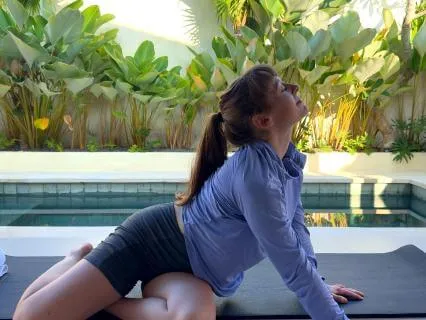
Pressing away from the mat to lift your head.
Maybe gazing up to the sky once more.
Sliding any supports away that you may have used.
Sliding your palms underneath your shoulders in a low cobra.
Tucking your toes.
Pressing up.
Mmmmm.
And then sliding your knees out for a wide leg Child's Pose.
Hmm.
If this pose is too much for your groin,
You can also press back up.
And place a pillow in between like this.
Yeah,
And then lowering down.
Sliding support back out.
And pressing yourself up into a tabletop.
Mmm.
We'll take some cat cows in this tabletop.
So inhaling.
Opening your chest and flaring out your tailbone.
And exhaling,
Tucking the chin to the chest,
Rounding the spine,
And tucking your tailbone under.
Now inhale.
And a cat.
And exhale into cow.
And just noticing from where you are initiating the movement in your body.
Seeing if you can.
Initiate it.
From your pelvis.
Letting it wave up your spine.
And then once you're at the top of cat.
Starting from the top of the spine.
And then guiding all the way to the tailbone last.
Bringing a deep level of awareness to the integrity of the movement.
And returning to a neutral spine.
And I invite you now to play with.
Some circling of the hips.
Just feeling how that feels.
Nice stretch in maybe the sides of your hips and your glutes.
And don't forget to go in the opposite direction as well.
Thank you.
And see if you can invite the motion into your upper body as well,
Maybe circling from your chest.
Our fascia responds to a variety of movements.
Circles and waves.
Spirals.
Tapping,
Pulsing.
And even stillness.
This practice today is about exploring a variety of movement patterns.
To help the fascia to unwind.
Coming back into a neutral spine.
And we'll move into thread the needle.
So inhaling one arm up to the sky.
And exhaling to thread it underneath that other arm,
Stretching it as far as it can,
But don't let it land yet.
Inhaling back up to the sky.
And exhaling just to explore this motion again.
This is that pulsing that's helpful for the fascia.
And on the next one,
We'll go ahead and land it.
If this is too much for you,
You can place a bolster or a block underneath your head and you can guide the supporting hand out long.
And bring your head,
The side of your head,
To look more up to the sky if you can.
Thank you very much.
And as you start to find your pose,
Asking yourself,
Where can I yield more into the ground beneath me?
And release unnecessary effort.
On your next inhale.
Walking that hand closer.
And pressing yourself up to release that extended arm.
Just opening briefly to the sky in a counter stretch.
And placing it back down.
On the mat.
Finding that neutral tabletop once more.
And inhaling the opposite arm to the sky.
And we'll do that pulsing once more.
Inhaling up to the sky,
Another pulse.
And on your last one.
Go ahead and land that arm.
Extending that arm forward again if you did last time.
You can also guide this hand behind your back.
For more of a deeper stretch,
But I'm going to keep it extended.
Remembering to breathe into the areas of contraction.
Shoulder.
Also breathe into the areas of expansion,
The places of the body that are more open.
Remembering with each breath.
To yield more into the support.
When we can release.
The fascia redistributes the tension that it is holding in one part of our body to the rest of the body.
Bringing us more into a unified whole.
Woo!
You on your next inhale.
Walking that extended arm.
Back closer to the shoulder.
Pressing yourself up.
Extending that arm to the sky.
Wiggling the fingers.
And pressing your hands back down.
Into a tabletop.
From tabletop.
Send one leg out to the side.
So that your foot is parallel to the top of the mat.
And then lower yourself back as though you're going into a child's pose.
Your range of motion may not be significant,
And that's OK.
And then see if you can circle around.
Bringing that knee over the foot.
Creating that circle in the body once more.
Remembering to move with the range of motion that is safe for your body.
We're just opening the groin and the outer hips.
And then pressing back as though you're going into a child's pose.
And bending at the elbows as though you're an animal drinking water from the lake.
And noticing how that changes the sensation in your groin and your outer glute and hip.
And then guiding that knee back down into tabletop.
And we'll do the same thing on the other side.
Bringing that foot parallel to the front of the mat.
Lowering back in Child's Pose and circling around.
Yeah.
Remembering to breathe.
And then coming back.
And bending at the elbows and lowering yourself to the mat.
Remembering to find freedom.
And play in this posture.
And then bringing that movement to a close.
Walking your hands over toward the bent leg.
And lowering yourself down.
And now your knee should be in a pretty good 90 degree angle.
You'll probably need to fix this leg.
And now we're in a 90-90 or a deer pose.
This target area of this pose is the hip flexors and the quads.
Outer glutes.
The inner thighs and the groin.
And so in order to play with how we're accessing the target area,
You can move your upper body in half circles from the knee that's in front of you into the space between your heel and your knee.
And immediately,
When I move this way,
I'm feeling it more in that front leg.
Oh,
And that outer glute.
But then when I'm coming up to sit,
I'm feeling it more in the back leg.
And that hip flexor and quad.
It's just such an interesting.
Because we can change where we're feeling it.
Depending on how we move our body.
Now,
If all of this is too much for you,
Close the distance between these two.
Making it a little bit less of a 90 degree angle.
Or you can bring this one this way as well.
And it gets just a little bit less of a stretch that way.
Just allowing yourself to play with that.
Whatever is true for your body.
And now.
To soften into this pose.
If this is enough for you,
You can stay here.
But for me.
.
.
I would like to lower down.
Have to come out of it a little bit because my bolsters.
Go ahead and place that over the front leg.
Lower yourself down.
For me,
This is still a little too much work.
I'm really holding myself up with my hands.
So this is an opportunity to bring the block or the pillow.
Towel.
And create even less distance.
For you to fall down onto.
Just play.
Sometimes you can do something like this as well.
Mmm,
This is perfect for me today.
Remembering that.
Somatic yoga is an opportunity for us to come into our truth.
Our expression.
What is unique about our body,
Our vessel for exploration in this lifetime?
Mmm.
And the more that you practice,
The more freedom and ease you'll find in your body.
On your next inhale,
Releasing the supports that you may have,
But keeping them nearby because we're going to go right into the other side.
Guiding your legs just over oh Look at that.
We're already on the other side.
I didn't keep them close enough.
Before you settle into.
The other side.
Just playing once again with that waving and pulsing motion.
And you might find that the two sides are different.
They're different for me.
So.
.
.
Giving yourself some compassion.
You don't have as much freedom of motion in one side.
As you do in the other.
And when you're ready,
Bringing in any supports that you're using.
And settling into.
Posture.
And just noticing what is true for you and how you respond.
Challenge or limitations in your body.
What helps you to find more compassion and ease.
Is it thoughts?
Is it movement?
Noticing what is true for you.
How can we meet the challenges of life?
With more ease.
Acceptance.
Understanding.
And compassion.
Taking an inhale in.
Lifting yourself back up.
Removing the support.
And then guiding yourself back.
Into a seated.
Position.
I will go ahead and.
.
.
Turn toward you.
As we close out the practice with a little meditation.
Taking this meditative moment to sense your internal body experience.
Do you feel a sense of openness?
What is true for your body today.
Embracing the possibilities.
And inviting in more compassion.
For your experience.
Wherever that compassion is needed.
Allow yourself to.
.
.
Be with the thoughts.
Emotions and sensations.
That are arising.
As you travel your inner landscape.
You to close out the practice.
Bring the soft part of your wrists to touch.
And extend your hands forward as you rotate,
Keeping that connection of the wrists.
And then bringing them back into the body,
Rotating around.
The arms are.
Connected to our heart through the fascia.
And as we do this motion,
It's an invitation to ask ourselves.
What are we receiving?
From the world into our hearts.
And what are we giving back?
In return.
Bringing this motion to a close.
And setting an intention for the day.
May we choose well-being.
In every action we take.
Thank you so much for practicing with me today.
If you enjoyed this practice.
Don't forget to follow or subscribe for more.
Namaste.