Welcome,
My name is Hanna and I'm happy to guide you through a calming pranayama sequence.
Pranayama means we want to connect to our breath and we will practice three different techniques.
I want to just briefly explain those techniques.
The first technique that we are going to practice is called yogic breathing.
And yogic breathing is very simple.
The only thing we want to do is we want to inhale into our abdomen and then in our chest.
And when we exhale,
We want to exhale from the chest and then from the abdomen.
So we want to use our abdomen and chest in each and every breath.
This will help us to reach the more calming state,
The more parasympathetic state.
The second technique that we are going to practice is called Anuloma-Veloma or maybe you know it as alternate nostril breathing.
In the Anuloma-Veloma,
The only thing we need to do is we take the right hand,
We bring the index finger and middle finger towards the inside of the palm.
We bring the right thumb onto the right nostril and the right ring finger onto the left nostril.
And what we want to do is we want to always press one nostril and close it and then changing the sides.
But I will guide you through that practice.
The last technique that we are going to practice is called Brahmari or Humming Bee Pranayama.
And in the Brahmari what we want to do is we want to take the hands,
We want to bring all the four fingers from the index finger to the pinky finger onto our eyes and we want to use the thumb to close the ear.
So we want to press that little cartilage to close the ear so that we can really hear that humming,
That vibration.
So what we want to do is after we close the eyes and the ears.
We take a deep inhale and while exhaling calmly and slowly we apply the humming.
So we want to make a mmm sound.
So these are the three techniques that we are going to practice together now.
First of all,
Find a comfortable seat.
You can take a pillow or a blanket under your sitting bones.
You can sit in a simple cross-legged position.
Your hands can be resting on your knees or your thighs,
Palms facing up or down.
And you can gently close your eyes.
Relax the muscles of your face.
Relax your jaws.
And in order to relax the shoulders with the inhalation,
Pull your shoulders up to the ears as much as possible.
And exhale,
Release the shoulders down.
Two more times.
Inhale,
Bring the shoulders up to the ears.
And exhale.
Last time.
Inhale,
Bring the shoulders up to the ears.
And exhale.
Release the shoulders back down.
And then find your comfortable upright position.
Feel your shoulders relax.
And before we start.
.
.
Breathing techniques.
Simply bring your awareness towards your breath.
Observe how does your breath feel today.
You can observe the depth.
Or the length of each and every inhalation and exhalation.
Maybe the pause between each and every breath.
The pause after the inhalation before the next exhalation starts.
Pause after the exhalation before the next inhalation starts.
And from here we want to start with the first technique.
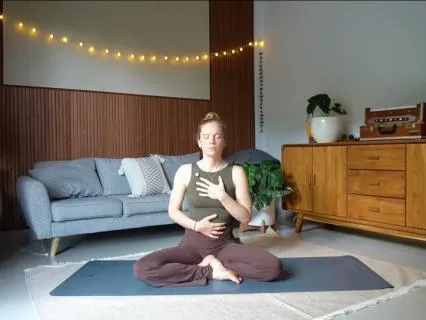
If you want you can bring one hand on your abdomen,
One hand on your chest to really feel the movement.
First of all just feel the movement of your abdomen.
And chest when you inhale.
And feel your chest and abdomen moving back down and in when you exhale.
Inhale,
Your abdomen is moving out,
Your chest is lifting up.
And exhale,
Your chest is moving back down,
Abdomen is moving back in.
I will count for you for a few rounds.
We want to count to 4 while inhaling and to 4 while exhaling.
Take one preparatory inhalation.
And exhalation.
Inhale to four.
Three.
Too.
One.
Exhale,
Four.
Three.
To One.
Inhale 4… Three.
So.
.
.
One.
Exhale four.
Three.
Soon.
One.
Inhale for.
.
.
Three.
Chill.
1,
Exhale 4.
3,
Ciao.
One.
Inhale 4.
.
.
Three.
Tchoo!
One,
Exhale four.
Three.
So.
.
.
One.
One more round.
Inhale,
Four.
Three.
Two.
1,
Exhale 4,
Three.
To and 1.
You can release your hands down.
And breathe in your natural rhythm.
Allow your breath to flow freely.
Observe the changes in your breath,
In your body,
In your mind.
Maybe you can feel your breath longer and deeper.
Your mind a bit more quiet and calmer.
And for the next technique,
We want to practice the alternate nostril breathing,
Analoma-Veloma.
As I mentioned at the beginning,
Bring your right hand towards your nose.
We want to bring the right thumb towards the right nostril,
The right ring finger towards the left nostril.
We start with closing the right nostril and then inhale through the left to four,
Three.
So.
One,
Close the left,
Open the right,
Exhale four.
Three.
Tchoo!
One and head to the right for Three.
Two.
One,
Close the right,
Open the left,
Exhale four.
Three.
Tchoo!
One and head through left,
Four.
Three.
Two.
One,
Close the left,
Open the right,
Exhale four.
Three.
So.
.
.
One and head to the right four Three.
So.
.
.
One,
Close the right,
Open the left,
Exhale four.
Breathe.
So.
.
.
One,
And head to the left four times.
Three.
Sue?
One,
Close the left,
Open the right,
Exhale four.
Sorry.
Too.
One,
And hand to the right,
Four.
Three.
Two.
1,
Close the right,
Open the left,
Exhale 4.
Three.
Ciao.
One,
One more round and head to the left for.
.
.
Three.
So.
One,
Close the left,
Open the right,
Exhale four.
Three.
Too.
One and head to the right four Three.
Sue?
1,
Close the right,
Open the left,
Exhale 4.
Three.
Choo!
And 1 and then release.
Keep your right hand down,
Relax your right shoulder,
Your right arm.
Feel the sensation at the tip of your nose after this practice.
Feel the sensations on your body.
And for our last practice,
We want to practice the brahmari pranayama,
The humming bee.
So we bring all of our fingers onto our eyes and the thumb will go towards our ears and you just close your ears and then start by yourself six rounds of humming,
Inhaling and when you exhale long slow exhalation with the humming.
Release your hands down whenever you finish the rounds of the humming of the Brahmari Pranayama.
You can remain in a sitting position for a couple of minutes,
In a meditation.
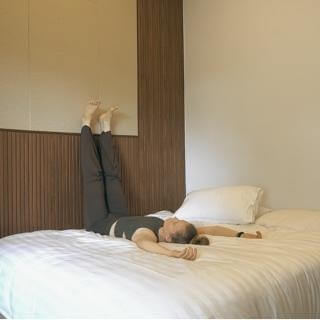
Or directly lie down on the ground into a shavasana or maybe even in your bed.
I say thank you to you for joining me today for this calming meditation.
Quick panayama practice for your evening.
Thank you.