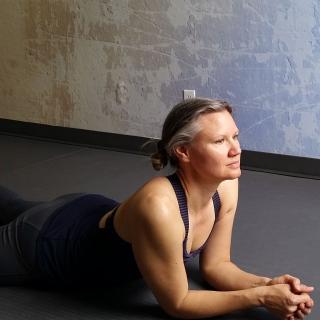
Welcome.
We're going to go over a couple of different breathing techniques.
All right.
Breathing into your belly.
Is key for getting that connection down into your pelvic floor.
Depending on what your body's gone through,
The tendency is we breathe up through here.
We have this ribcage breath and our belly doesn't do too much.
So we want to find that connection down into the belly for a belly breath.
So we're going to break it into a few different parts.
I want you to play with this.
Okay?
Sometimes you'll be able to play with it and focus on it for a couple of breaths.
Maybe you can stretch that out into a couple of minutes,
But I want you to make it about curiosity,
Not I have it.
We have to do this.
Okay,
We want to have that level of curiosity and exploration about Paying attention to our body,
Right?
So Belly breath.
First,
Find yourself in a comfortable position.
You can do this next breath laying down or sitting up.
We're going to do a couple of breaths that do work a little bit better sitting up.
But this one.
You can do it anytime.
Really,
It's just about finding this inhale into your belly.
And if you watch my belly.
It sticks out.
It's almost as though when I inhale,
Especially when I'm seated,
You can feel how your belly drops and then you exhale.
Okay,
So it's an inhale and the belly just drops.
You can play with that a little bit more where you're controlling it.
If you had something,
Especially if you're laying down and you had like a magic bag or a kitty cat laying on your tummy,
Those can give you some really good feedback to breathe down there.
Okay,
You can probably feel if you put one hand on your rib cage,
You can feel how that upper inhale happens and you can kind of avoid the belly breath.
So let this rib cage feel fairly soft and see if you can get the belly.
Just the belly,
Okay?
What ends up happening when you inhale,
Ideally if you're using that belly breath,
You have this diaphragm and it's like an upside down balloon and those muscle fibers contract so that that balloon flattens,
Right?
When that happens,
There's actually a reverse pressure system in your lungs and that's what draws air in.
You're not actually sucking in air and then it's moving.
Know when I first learned this it kind of blew my mind as well.
But what happens is that muscular system?
Draws that half balloon down it creates that negative air pressure or lower air pressure I should say and then our air comes in which Completely explains why if you go hike up to Mount Everest and there's a very low air pressure system and you go to inhale not much comes in because there's now a more equal balance between the air pressure that's in your lungs when you try and inhale versus your surrounding environment.
Anyways,
I could go on,
But you probably know that.
We're going to talk now about the exhale.
Now,
This one does work a little bit better when you're sitting up.
However,
You can also do it when you're laying down.
And what we're going to do is a quick exhale,
Like you're being punched.
Okay.
Now this one,
I'm going to try and do it through my nose so that it sounds a little bit louder.
It's a quick exhale.
Your inhale is just going to fall in.
Okay.
So if it's a,
It's like being punched.
Right,
That quick exhale.
And then your belly relaxes and that helps draw your inhale back in.
Okay,
So it's more of a forceful exhale.
Okay,
You're using your abdominal muscles a little bit more.
So instead of using that upside down balloon diaphragm,
Now you're using these abdominal muscles to push the breath out.
And then that just drops back down,
That inhale we practice.
Now do practice these separately.
All right,
Practice that inhale in your belly,
And then take a few minutes and then practice the exhale,
Right?
It's just a quick.
Just like that.
And you only really need to do a few because you can get lightheaded.
All right.
I don't want you to sit there for like 10 minutes and do that.
Just like go for seven breaths.
That's what we're looking for,
All right?
So that's your exhale.
Now ideally then we start putting them together.
Not that we have that quick exhale but that we use this belly breath and I will explain why.
When you inhale and you use that belly breath,
These organs get some pressure from your diaphragm.
That's what happens.
That upside down balloon comes down,
Puts pressure on your organs,
Which is why we have that,
What we call a belly breath.
Clearly you don't have lungs in your belly,
Okay?
But you've got this belly breath because you're getting that pressure.
That pressure can move all the way down to your pelvic floor.
All right?
So when you're thinking of inhaling,
I want you thinking that this moves all the way down to your pelvic floor.
Pelvic floor,
If you have some awareness there,
Then relaxes.
Now.
Your exhale,
We're going to do the reverse.
Instead of a quick punch in the gut,
What you're going to do is think of moving from your pelvic floor and there's this lift all the way up as you exhale.
So what ends up happening,
Your diaphragm,
Your respiratory diaphragm,
And your pelvic floor diaphragm,
Because it is kind of like a diaphragm that sits in your pelvis,
They start dynamically connecting.
This isn't something that I want you to think about all the time,
Okay?
Because that takes a lot of brain power.
But if you can practice a couple minutes here and a couple minutes there,
That's what's gonna help connect these two points.
So your inhale.
Let's that pelvis relax.
It lets it sink.
We get this belly.
Okay,
Your exhale right from the bottom.
Imagine you're lifting and exhaling all the way up.
Then inhale.
Exhale.
Inhale.
.
.
Exhale.
Now you can keep going with that breath.
That one is a good one to do to find some relaxation,
To find some calm,
To find some grounding.
Not an easy thing to do,
But like I mentioned,
Try for just a couple minutes,
Even if you just work on it for three rounds of your breath,
Even if you can't quite feel it,
But you can kind of visualize how that works.
That's where I want you to work.
But watch because breathing is involuntary,
Which is a good thing.
It just happens no matter what.
When we breathe,
Especially when we are stressed,
We get into the habit of breathing up here.
With this right which can keep our back moving if you take a nice big inhale in your rib cage it helps draw the shoulders back but you probably know posture's not everything right However,
Getting this deeper belly breath helps connect you into these abdominal muscles,
Helps connect you into the pelvic floor diaphragm,
Which is always a good thing.
And helps you bring in a deeper breath.
Which also helps your mind.
So practice that and let me know how it goes.