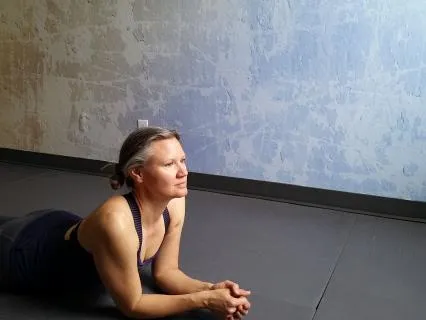
Find a comfortable position.
This is your practice.
You're going to be laying there or sitting there and I want you to scan your body.
You're gonna scan your body and you're gonna notice where you feel that discomfort,
Where you have a sensation.
Remembering,
We're not trying.
To allow the brain to constantly flip into the pain world.
Or the visual of what an image or scan or a doctor might have said.
It is,
And this is the sole part of the practice.
Being able to scan your body.
Notice a sensation.
And just acknowledge it.
Not analyze it,
Not fear it,
Not criticize,
Not anything,
Not change it.
All we're doing.
Is noticing.
And acknowledging.
That's it.
This practice is outcome independent.
That means that as you lay there or sit there or stand there,
It doesn't matter if the sensation gets stronger.
Or goes away.
It is just there.
Now I want you to pay attention to your breath.
I want you to find how your exhale allows the body to feel grounded.
I want you to feel.
Connection you have.
To whatever you're sitting or laying on.
And I want you to use your exhale to soften.
Into that.
That's all.
Your exhale just allows you to feel more grounded.
To feel a little heavier.
Taking a few more breaths,
Pay attention to your exhale.
Now,
Paying attention to that exhale,
We want to find a balance and the balance comes in with our inhale.
So I want you to notice your inhale first in your belly.
This isn't the easiest place to breathe in,
Especially if you hold tension in your core because you believe you need a strong core.
I need you to find that belly breath.
Practice it.
Whether you practice it first thing in the morning when you're laying in bed and you just wake up.
Whether you practice it at the end of the day while you're laying in bed ready for sleep.
Whether you practice it when you're sitting in front of the TV.
I want something you do to trigger a habit of paying attention to your belly breaths.
With your belly breath.
I want you to feel how you can inhale into your belly,
But it also starts to expand up through your side ribs.
Not necessarily the front of the rib cage,
But the side ribs.
Find a little bit of expansion.
Your inhale brings in a sense of space.
It brings in an idea of lightness in the body.
These ideas start to create ease of movement.
We're not at the movement phase yet.
We're only at.
The paying attention phase.
I want you to notice.
How as you inhale,
It creates some space,
Some lightness.
We're gonna scan the body again.
We're gonna move through slow.
And I want you to be able.
To notice any sensations that are in the body that you come across.
And I just want you to notice.
If it's your exhale that allows that sensation to feel acknowledged or safe.
Or if it's your inhale.
The idea that you can allow for some space around it or lightness that allows that sensation to feel acknowledged or safe.
Not necessarily changing it.
We're outcome independent.
That means if the sensation gets stronger or less strong,
Doesn't matter.
We're just acknowledging it.
Whether you're sitting or standing,
I want you to now bring your awareness to your feet.
Feel the bottoms of your feet.
Notice the space in between your toes.
Notice the space on the tops of your feet.
Maybe even moving into your ankle joints.
Whether there's a sensation there or not,
Notice.
How does it feel to connect to your exhale?
How does it feel to connect to your inhale?
We're going to move up through the lower leg.
Noticing the front of your shin.
Noticing your Achilles,
Your calf.
Notice if your breath connects to it in any way.
I want you to move into your knee joints.
I want you to pay attention to your breath.
Your exhale.
Your inhale possibly allowing for this idea of space in the knee joint.
Not compression.
But space that allows for ease of movement.
It might not be full range ease of movement,
But there's a bit,
There's a small part.
Of ease and movement in your knee joint.
Moving up into the thighs.
Fronts of the thighs,
The quads,
The above the knee.
The hamstrings and the backs of the legs,
Even the sides of your thighs.
Okay,
Those IT bands,
The ad doctors.
There's a lot of strong muscles in the thighs.
Use your exhale.
Can you feel that softening?
Use your inhale.
Can you visualize some space?
And just being curious about how your breath affects different parts of the body.
We're gonna move into the hip sockets.
I want you to just visualize,
Whether you're seated or standing or laying down,
How your hip socket just connects.
And there's that ease of movement.
Even if you're just visualizing it,
There's an ease of movement in the hip socket,
So there's less tension.
You can use your exhale to find that softness.
You can use your inhale.
To visualize a little bit of space if you have.
A visualization of something from an imaging or a doctor's words in your head.
How can you right now use your breath?
To create.
A better connection,
A better image,
A healthier image.
Even if there is something in your hip.
How can you work towards acknowledging?
And creating that curiosity and connection.
Into your hip socket.
Moving into your pelvis.
Pelvis can be a big area.
I want you to have that same awareness,
Feeling how your exhale can allow for that connection,
That sensation of feeling grounded,
Especially if you're sitting or if you're laying down and you can feel the back of your pelvis on the ground.
So it's your inhale.
Help you find some lightness in your pelvis,
Whether it's your pelvic floor or your glutes or your SI joints.
Can you connect to your breath.
Which breath?
Gives you a better acknowledgment.
And sense of safety.
To your pelvis.
Moving up into your lower back.
Same thing.
If you have a visualization.
A memory of an image.
How can you use your breath right now?
Be curious,
Does your exhale give you a sensation of stability or release of lower back muscles?
Your inhale.
Can it give you a sense?
Of space.
Of ease of movement,
Even though there's not much movement in the lower back,
There is some.
Can you connect that to your inhale?
Moving up through your spine into the ribcage area.
Noticing any sensations.
If it feels pretty good.
Can you find a little deeper breath?
Remembering when we're working on deepening the breath or doing movement,
We're always listening for whisper edges.
We don't need to push through to a screaming edge.
We're looking for whisper edges.
Excellent.
Can you find that space through the sides,
The back of your ribcage?
Can you find that softness with your exhale as you let the ribcage soften into the ground?
Or if you're standing,
You're letting those lower ribs to soften down.
Not trying to move the body anywhere.
Not trying to force a position.
Just being curious.
Moving into your neck.
Kind of the same as your lower back.
I want you to notice as you exhale.
Does your head feel balanced if you're standing or seated?
If you use your inhale,
Can you visualize that there's a bit of space through your neck?
We're not pulling the jaw back.
This isn't about finding a perfect posture.
It's about acknowledging.
If a breath.
Does bring in the sense of safety or the sense of awareness into your consciousness.
As you notice your neck,
I want you to move out through to your shoulders.
We've got the collarbones,
We have the shoulder blades,
We have the shoulder joints.
Here's where I want you to pay attention to your inhale a little bit more.
Where you can take the very end of your inhale,
Bring it right up under your collarbones.
As you exhale.
Just let your shoulders soften.
They don't need to be in any position.
It doesn't matter if one's a little higher than the other.
Right now.
We're just acknowledging.
Noticing.
Connecting to our breath.
We are outcome independent.
You can move out through your arms.
Notice your biceps,
Your triceps.
Notice your elbow joints.
Notice your forearms.
And moving into your hands,
Wherever your hands are resting right now,
Whether you're on the backs of your hands or you feel the palms of your hands.
Use your exhale to notice that softness.
Use your inhale to just visualize that space between your fingers,
Even the lightness of touch.
Then moving back up to your neck.
I want you to notice the base of your skull,
Your jaw.
Allow your jaw to be soft.
Base of your skull just has some space to it maybe,
Or if you're laying down,
You can feel how your skull,
The back of your head just softens.
Into the ground,
The ground maybe even comes up.
To support the back of your head.
Then using the same breath,
Moving up to the crown of your skull.
Moving through your ears.
Feeling your eyes sitting in their sockets.
Do you feel like there's space there?
Do you feel like they want to just settle in?
Moving to your sinuses,
Noticing space.
Noticing now the ease of your breath.
Feeling your exhale,
Allow your body to soften.
Allowing your inhale to find that lightness.
And just noticing how your inhale transitions to your exhale.
And your exhale transitions to your inhale.
And allowing for this moment of stillness.
The mind will wander and that's okay.
But every so often,
You'll connect.
To this brief moment of stillness.
Taking a few more breaths.
Scanning your body again.
Just acknowledging any sensations,
Not analyzing them.
Just allowing that sensation to have a sense of safety.
You can start wiggling your body.
Toes,
Your fingers,
Your shoulders,
Your pelvis,
Your wrists,
Your nose,
Wiggling your head around.
Gently waking yourself up.
Coming back into the outer world.
Taking a breath.
That is your somatic tracking practice.
The more you practice that,
The easier it will be.
When you're moving through your day and something happens even if you need to take 30 seconds to jump into that practice.
You have that connection.
Because you always have your breath.