Hello my friend,
Welcome to humorously dull history for sleep.
My name is Stephen Dalton,
And it is my hope that as I tell you lots of different facts about particular periods in history tonight,
You find me so incredibly boring that you fall asleep very quickly,
And maybe even with a smile upon your face.
It is humorous history after all.
Tonight I'll tell you the humorously dull history of cats.
Gods.
From cautious little hunters Lingering near the first grain-stores to modern celebrities with six million followers.
And no discernible qualifications.
The cut has spent thousands of years improving its position.
While carefully avoiding any increase in responsibility.
So,
Just before we get started,
Allow yourself to settle into this moment.
Leave the day that was behind.
Feel the support.
Of whatever you lie upon.
If your eyes aren't closed yet.
Allow them to close.
Whatever has been.
Has been.
It's history now.
Whatever will be.
Will be.
All you have is this moment.
And my voice.
So allow your curiosity to be a part of this pleasant experience,
As I tell you.
The humorously dull history.
Part one.
In which a small wildcat notices that humans have invented grain.
Mice.
And conveniently warm roofs.
For most of human history.
The cat has behaved as though it has done us an enormous personal favor.
Merely by being.
Present.
It enters the room.
Without explanation.
Examines the available furniture.
Rejects the expensive cushion.
And settles instead.
Upon a folded newspaper.
Or the one garment that has just been cleaned.
It accepts food.
With the expression of a minor aristocrat.
Receiving an overdue tax payment.
It may allow itself to be stroked.
But only until the precise moment at which it decides that the arrangement has become undignified.
Then.
Without warning.
It leaves.
This attitude has led many people to assume That cats were once worshipped as gods.
And have never forgotten it.
That idea is often repeated.
Usually by someone who's cut.
Has just knocked a glass of water from a table.
While maintaining direct eye contact.
The true beginning of the relationship.
Between cats and humans.
Is quieter.
Slower.
And far more concerned with rodents.
There is no known afternoon.
On which an ancient human points towards a wild cat.
And announces that This particular animal shall henceforth live indoors.
Sleep for 16 hours a day.
And object loudly whenever a door is closed.
The cat does not appear to have been domesticated.
Through an organized human program.
There are no ancient committees,
No careful breeding records.
And no early clay tablet entitled Proposed Regulations Concerning the Household Cust.
Instead.
Humans begin growing crops.
Crops.
Produce grain.
Grain.
It tracks.
Nice.
And mice.
A truck.
Cuts.
The Cut.
Having studied the situation.
With the calm attention for which its descendants remain famous,
Concludes that these new human settlements.
May be worth visiting.
Humans,
Meanwhile.
Notice that a small predator has begun eating the creatures that are eating their food.
Neither side.
Signs anything.
Neither side.
Admits dependence.
The Arrangement simply begins.
The animal at the centre of this slow agreement is generally known as the Near Eastern Wildcat.
A lean,
Sandy-coloured hunter.
Related to the wildcats still found across parts of North Africa.
And Western Asia.
It does not look dramatically different.
From many modern domestic cats.
There is no great transformation from birth.
Hulking beast.
To Fireside Pet.
As there is with some other domesticated animals.
A person.
Seeing one from a distance.
Might simply assume that somebody's tubby.
Has wandered quite far from home.
The wildcat is cautious.
Solitary.
And well suited to hunting small animals.
Especially at dawn.
And dusk.
It does not naturally seek the company of humans.
But it is capable of tolerating them.
When conditions are favourable.
And the first farming communities.
Provide very favorable conditions indeed.
Around.
10,
000 years ago.
People in parts of the Near East.
Begin settling for longer periods.
Cultivating cereals.
Storing grain.
And discovering.
That a permanent food supply creates a permanent pest problem.
A sack of grain is useful to a human.
But it is also excellent news for a mouse.
Several sacks of grain.
Stored together in a warm building.
Amount to a mouse civilization.
There are meals.
Shelter.
Opportunities for courtship.
And very little reason to move elsewhere.
The mic.
Multiply.
The cats arrive.
A bolder wildcat may approach the edge of a settlement at night.
Follow the sun.
And movement of the rodents.
And discover hunting grounds more reliable.
Than this scrub land beyond.
A slightly calmer cut.
Has an advantage over one that flees.
At the first sound of a human voice.
It can hunt closer to the houses and grain stores.
Humans may tolerate it.
Then encourage it.
Perhaps by leaving scraps?
Or by simply deciding.
Not to chase it away.
Over many generations.
The cats most capable of living near people.
Remain.
Near people.
They produce kittens that are,
On average,
A little more comfortable with the Strange uprice animals who store wheat.
Drop food.
And occasionally make unnecessary attempts at affection.
In this way.
The Cut.
Edges into domestic life.
While preserving the firm belief.
That the entire measure was its own idea.
One of the most interesting early clues comes not from Egypt.
As many mice expect.
But from the island of Cyprus.
Now,
Cats are not native to Cyprus.
Which means that any ancient cat found there.
Must have arrived with human assistance.
Presumably by boot.
This raises a pleasing image.
Of a very early sea journey in which someone attempts to persuade a wild cat to remain inside a basket around.
7,
500 BCE.
A cat is buried.
Near a human.
At a settlement called Shiluru Kambos.
Forgive the pronunciations if it's not quite right,
Cypriots.
The cut lies in its own small grave.
Close enough to the person.
To suggest that the animal may have held some special significance.
We cannot know precisely what the relationship was.
The human may have valued the cat as a hunting companion.
A useful controller of mice.
A creature.
With spiritual importance.
Or simply an animal of which they had grown fond?
Archaeology can reveal where bones were placed.
But it cannot tell us whether the cat used to sleep on the person's chest.
And make breathing difficult.
The burial tells us that Cats and humans are already connected.
Thousands of years.
Before the great cat-loving civilisation of ancient Egypt reaches its height.
It also tells us that someone considers a cat valuable enough to transport across water.
This is not a minor undertaking.
Early boats are not.
Cruise ships.
There is no.
Private cabin.
No quiet corner with a bowl of water.
And no member of staff offering fish.
The journey may have involved a small wooden vessel.
A restless animal.
And several people learning for the first time that a cat,
Which does not wish to be held,
Possesses a surprising number of sharp ends.
Yet somehow.
The island of Cyprus.
They remain there.
Reproduce.
And become part of human settlement.
The Practical Partnership is already deepening.
Cats protect food stores.
Humans provide access to abundant prey.
And relative safety from larger predators.
Each side gains something,
Though the cat presumably behaves as if it has accepted the arrangement only after considerable thought.
The Early Domestic Cut does not immediately become the soft,
Varied,
Household companion familiar today.
For a very long time.
Cats remain close in appearance and behavior.
To their wild ancestors.
This is partly because humans do not need to alter them very much.
Cattle are bred for milk.
Me.
Strengths.
And temperament.
Are shaped by generations of selection for wool.
And manageable behavior.
Dogs are bred to hunt.
God.
Hurt.
Retrieve.
Carry.
And perform a growing list of tasks that eventually includes sitting patiently while wearing a birthday hat.
The cats already perform their main task extremely well.
They are small enough to live near human homes.
Quiet enough not to disturb a settlement.
And perfectly designed.
To catch rodents.
Their bodies are flexible.
Their hearing is sharp.
And their paws allow them to move with very little noise.
Their eyes work well in low light.
Although not in complete darkness.
Despite the suspicious ease with which a cat can locate a person's ankle.
At three in the morning.
Their whiskers help them judge narrow spaces.
Their claws can be drawn back when not required.
And their ability to wait motionless for long periods.
Makes them efficient hunters.
And unusually convincing ornaments.
There is little reason for early farmers.
To produce a larger gut.
A shorter cut.
Or a cat with a particularly dramatic coat.
A cat that catches mice is sufficient.
Indeed,
For much of its history.
The domestic cat occupies an uncertain position between wild animals.
Working animal.
Neighbour.
And companion.
It may live beside people without entirely belonging to them.
It enters buildings.
Hunts in fields and storerooms.
Accepts food.
And leaves when it chooses.
Even today.
A domestic cat,
A loud outdoors.
Can move between these roles with ease.
At breakfast.
It is a cherished family member.
By mid-morning.
It is a small predator.
Crouching beneath the hedge.
At noon.
It is asleep in a patch of sunlight.
By evening.
It is standing beside an empty bowl,
Claiming through repeated cries that it has not been fed in several years.
This may be the central fact of cat history.
The relationship develops.
Without either species surrendering very much.
Humans do not fully control cats.
And cuts.
Do not fully abandon.
The independent habits.
That once carried them through dry grasslands,
And rocky country.
They adapt.
Just enough.
The cat becomes more tolerant of company,
More willing to live in crowded places,
And increasingly skilled at communicating with humans.
Humans become more willing to share food,
Shelter,
And eventually beds.
With an animal that contributes little to household work.
Once the mice are gone.
The partnership spread.
Because it is useful.
But usefulness.
Is only the beginning.
People watch cats hunt.
Groom themselves.
Raise kittens.
Stretch beside fires.
And sleep in positions that appear medically inadvisable.
Familiarity.
Grows into attachment.
A creature first welcomed because it removes pests.
Gradually becomes a presence people miss.
When it is absent.
In these earliest settlements.
The future importance of the cut.
Remains impossible to foresee.
No farmer stacking grain in a mud-brick storehouse.
Can know that.
Thousands of years later.
Humans will.
Photograph cuts.
Cuts.
Write poems about cats.
Give cats elaborate names.
And purchase special furniture.
That the cats will ignore.
In favour of the cardboard packaging.
For now,
There are only villages,
Fields,
Grain.
Nice.
And a sandy little hunter.
Waiting at the edge of the firelight.
It does not approach too quickly.
It does not trust without reason.
It watches.
It listens.
And when the settlement has grown quiet.
It steps softly.
Towards the place where the mice have gathered.
Beginning one of the longest.
And well.
Strangest friendships.
In human history.
Part two.
In which the Egyptians discover that cats are useful.
Beautiful,
And quite willing to accept the credit.
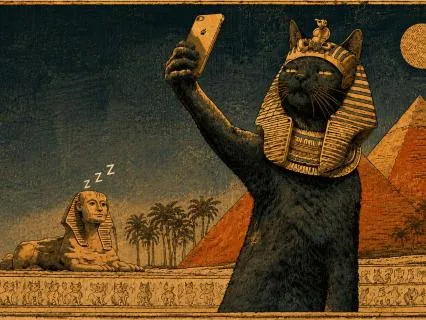
Ancient Egypt is often presented as the point at which the cat finally receives the recognition it has always felt it deserves.
By the second millennium BCE.
Cats are appearing in Egyptian homes.
Paintings.
Hunting scenes.
And religious life.
Having moved beyond their original position as useful visitors near the grain stores.
They are now sitting beneath chairs.
Wearing colours.
Accompanying families and generally behaving as though the entire civilization Has been constructed to provide them with warm floors and regular meals.
You see,
Egypt is particularly well suited to cats.
The farming system produces large quantities of grain.
The grain attracts pests,
And the pests attract small hunters.
Who are prepared to work irregular hours.
Without requesting wages,
Holidays,
Or a chair of their own.
Humans quickly appreciate this arrangement.
A cat can protect stored food while requiring relatively little management,
Provided one ignores the food,
Shelter,
And constant rearrangement of household objects.
That the caste itself considers necessary.
It does not need to be.
Driven to a field,
Attached to a cart,
Or persuaded to carry anything,
It simply appears.
Performs its duties privately.
And later sits in a prominent place.
Looking as though it has personally secured the annual harvest.
This is an ideal working relationship from the cat's point of view.
The humans do the farming.
The building,
The carrying,
The accounting,
And the paying of taxes.
The Cass patrols one storeroom at dusk and is immortalized on a wall.
Cuts become visible in Egyptian domestic art.
Which tells us that they are no longer merely hanging around outside.
And hoping nobody notices.
They sit beneath the chairs of their owners during meals.
And social gatherings.
Often close to women of the household.
This position beneath the chair has been interpreted in several ways.
It may indicate affection.
Protection.
Fertility.
Or simply the ancient Egyptian version of keeping the cat near enough.
To be admired.
But far enough away that it cannot place its entire body upon the bread.
Some cats are shown wearing colors.
Which suggests that people value them as individual animals.
Rather than regarding them as interchangeable pest-control equipment.
They may even have been given names.
Although,
Very few of those names survive.
This is unfortunate.
Because one would like to know whether Egyptian families chose dignified names connected with the gods.
Or weather.
After several thousand years of human progress?
They eventually arrived at names such as Mr.
Pickles The painting's show cuts.
Calmly occupying the household.
As if this Has always been there,
Right?
They are not shown asking permission to enter.
No Egyptian artist.
Appears to have painted the moment.
When a family debates whether the cut should be allowed on the furniture.
Perhaps because.
.
.
By the time the discussion begins.
Vicar?
Is already asleep on it.
There are also hunting scenes,
In which cats appear among the reeds.
Helping flush birds into the air.
Or joining their owners on small boats.
Scholars continue to debate.
Whether these cats were trained hunting animals.
Or whether Egyptian artists were taking a generous view of events.
Anyone familiar with cats will understand the problem.
A dog.
May be trained to retrieve something because it wishes to please its owner.
A cat may retrieve something because it happens to be going in that direction.
The most famous religious connection is with Bastet.
Although the familiar explanation that Egyptians worshipped cats as gods is much too simple,
And,
More importantly,
Gives modern cats ideas.
Bustet begins as a powerful lioness goddess.
Associated with protection.
And Royal Strengths.
Over centuries.
She becomes increasingly connected with the domestic cat.
And is often represented.
As a woman with a cat's head.
Usually standing upright.
And holding objects of religious importance.
With considerably more discipline than an adult.
Actual cash could be expected to show.
She is associated with the home.
Motherhood.
Music.
Celebration.
And protection.
Making her an unusually busy deity.
With a broad range of responsibilities.
Her main center of worship is Bubastis in the Nile Delta.
Where large festivals are held in her honour.
People travel there by boat.
Playing music.
And stopping along the river.
To exchange remarks with people on the banks.
Herodotus describes these gatherings as lively affairs involving enormous crowds.
Which suggests that a festival dedicated to cats was not necessarily quiet.
Orderly.
Or particularly interested in an early night.
Worshippers by Bronze Figures and other offerings connected with Bastet.
Craftsmen produced them in large numbers.
Traders sell them.
Officials supervise the temples.
And priests manage the ceremonies.
Thus,
Around a sacred animal.
There develops the usual human structure of devotion.
Commerce.
And somebody checking the receipts.
The ordinary household cat.
Benefits from its link with Bastet.
But this does not mean that every cat is treated.
As the bodily form of a goddess.
An Egyptian family.
Probably does not stop cooking.
Whenever a cat enters the room.
They admire the animal.
Associated with divine qualities And may treases with exceptional care.
But this is different from.
.
.
Worship.
Although the distinction becomes less obvious.
When one observes a modern person.
Opening a forest tin.
Because the first three have been rejected.
When cats die in ancient Egypt,
Some are mourned and mummified.
And it is here that Egyptian affection becomes organized.
On a truly professional scale.
According to Herodotus,
Members of a household may shave their eyebrows after the death of a cat.
It is difficult to know how widely this was practiced.
But it is an extraordinary tribute.
Many people today.
Are deeply attached to their pets.
Yet few would respond to bereavement.
By voluntarily removing a major facial feature.
The dead cat might be wrapped in linen.
Placed in a small coffin and taken to a cemetery.
And are buried as cherished companions.
Foreign visitors become fascinated by Egyptian attitudes towards cats and dogs.
And stories begin to circulate.
About the severe consequences of harming one another.
Some later accounts claim.
That even an accidental death could provoke public anger.
And serious punishment.
Exporting cuts may also have been restricted.
Though the evidence is less straightforward than popular histories sometimes suggest.
The Egyptians certainly regard the animals as valuable.
And cats spread gradually through trade and travel,
Despite any effort to keep them within the country.
Sailors carry them aboard ships.
Where they protect supplies.
And discover that a vessel provides many small enclosed spaces.
In which to disappear.
Just as somebody needs to leave port.
Traders take them around the eastern Mediterranean.
Households in other lands.
Begin to notice their advantages.
The Egyptian Cat is therefore moving towards a wider career.
But for now.
.
.
It remains most closely associated with the Nile.
The household.
And the goddess busted.
In Egypt.
It has completed a remarkable rise.
It begins as a practical visitor.
Attracted by human food stores,
And becomes a family companion,
Artistic subject,
And a religious symbol.
Very few animals have managed such advancement.
Without learning to carry a person,
Guard a gate,
Or come when called.
The cart achieves it.
Mainly by being attractive.
Useful in moderation.
And emotionally unavailable.
Humanity confronted with this combination Never really.
Stands a chance.
Part three.
In which the cat leaves Egypt.
Encounters a Greek weasel.
And discovers that not every country has been properly briefed.
After its considerable success in Egypt.
The cat begins to travel around the Mediterranean.
Presumably expecting the rest of the ancient world.
To have heard the news.
In Egypt.
It has been painted on Tomb Wars.
Connected with a major goddess?
Wrapped respectfully after death,
And represented in bronze,
It has acquired admirers.
Religious significance.
And it therefore arrives in ancient Greece.
With what can only be described as an excellent resume.
Unfortunately.
The Greeks already have someone doing the job.
For generations.
Many Greek households have relied upon weasels and similar small animals.
To discourage household pests.
These creatures are quick,
Effective,
And already familiar.
Though they lack the cat's particular talent for making usefulness look like a personal favour.
The newcomer is therefore entering.
An established market.
It cannot simply walk into Athens,
Sit beneath a chair,
And expect.
Immediate divine status.
The position has been filled.
There is no vacancy.
The household weasel has seniority.
Local experience.
And,
Very possibly,
A cousin in management.
The cut must begin again.
The bottom.
Cuts do appear in Greek art.
And gradually become known as domestic animals.
But they do not occupy anything like the position they enjoyed in Egypt.
Greek writers devote their attention to war,
Politics,
Philosophy.
Tragedy.
And the alarming behavior of the gods.
The Ordinary Cut receives comparatively little discussion.
This feels like an oversight.
Socrates spends a great deal of time.
Asking what makes a person good.
But nobody appears to ask why a cat demands that a door be opened.
And then remains.
Seated in front of it.
Reconsidering the whole proposal.
Plato writes about ideal forms.
But leaves no surviving dialogue on the ideal temperature of a windowsill.
Aristotle.
Carefully studies animals.
Government.
And logic.
Yet the central philosophical question of whether the cut is inside outside.
Or somehow dissatisfied with both conditions,
Remains unresolved.
It is possible that the Greeks observe cats.
And decide that.
Further inquiry will only encourage them.
The animal appears in homes,
Workshops and ports.
Slowly gaining ground.
Without producing a manifesto.
This is generally.
How cuts prefer to advance.
They do not overthrow the existing system.
They wait.
Until everyone has grown tired of maintaining it.
Then occupy.
The warmest part.
The Romans are more practical about the matter.
They encounter cuts through trade,
Travel,
And contact with Egypt and the eastern Mediterranean.
And they recognise the animal's usefulness.
Without feeling obliged to construct a temple.
Every time one enters a storeroom.
Rome admires efficiency.
Roads are built.
Water.
Is carried over long distances.
Armies are supplied across enormous territories.
And taxes are collected.
From people who had hoped the Romans might overlook them.
A quiet animal that reduces household nuisances.
Without requiring a salary.
Fits comfortably.
Into this arrangement.
The Romans call the cat.
Feelers.
Although the word may initially refer more broadly.
Two small hunters of this kind.
Gradually.
The domestic cut.
Becomes more familiar.
It lives around farms.
Houses.
And military settlements.
It is not usually the most celebrated Roman pet.
Dogs receive inscriptions praising their loyalty.
Birds are kept for their songs.
And wealthy citizens collect unusual animals.
Because nothing demonstrates sound judgment.
Quite like importing a creature that requires six servants.
And dislikes the climate.
The cut continues its work.
With little public recognition.
This suits it perfectly.
Public recognition often leads to additional duties.
A Roman cuss is unlikely to be dressed in armor or officially enrolled in a legion.
Though it travels wherever Roman soldiers.
Merchant.
And settlers go.
Grain stores.
Food suppliers.
And ships.
Provide plenty of reason for cuts to accompany human movement across the empire.
They reach Newport.
River Towns.
And distant settlements.
Including parts of Western and Northern Europe.
No single Roman official.
Appears to organize this expansion.
There is no decree from the Emperor.
Announcing that.
Cuts shall now be distributed.
Throughout the provinces.
Was too assigned to Gaul,
And a further shipment delayed near Carthage,
Due to adverse weather.
The cats simply move along the same routes as everyone else.
Same boardships.
Others remain near military camps.
Or trading centers.
A few presumably enter carts without permission.
And discover,
Several miles later,
That they have made a serious administrative error.
Yet the species spreads with remarkable success.
Human empires require armies.
Roads,
Laws,
Officials,
And a great many men stamping objects with seals.
The cut requires one boat on which nobody is paying close attention.
There is something wonderfully appropriate.
About the way cats establish themselves across Europe.
Dogs earn their place through visible service.
They guard homes.
Hunt beside people.
Herd animals.
And display loyalty with such enthusiasm.
That songs are written about them.
Horses carry riders.
Poor vehicles.
And alter the course of wars.
Cattle provide strengths,
Milk.
And food.
The car turns up near a warehouse.
Removes a few inconveniences during the night.
Sleeps through most of the following day.
And is eventually invited indoors.
It has found.
The minimum level of effort required.
For permanent accommodation.
And refuses to exceed it.
By the later Roman period.
Cats are no longer an Egyptian curiosity.
They have become.
Quiet residence of an empire stretching across several climates and countless households.
They travel with sailors,
Traders,
Farmers and soldiers.
But belong completely to none of them.
When Rome eventually weakens.
Divides.
And begins the long,
Untidy process Of falling apart,
The cut remains.
It does not attempt to save the Empire.
It has seen the accounts.
And considers the matter beyond repair.
Instead?
It settles beside the ruins.
Closes its eyes.
And way.
For the next civilization.
To begin.
Feeding it.
Part four.
In which Rome collapses.
Monks acquire cats.
And one of them walks across a manuscript.
The collapse of the Roman Empire is a complicated subject.
Involving economic pressure.
Political instability.
Military failures.
Disputed six sessions.
And a large number of men declaring themselves emperor.
Before being murdered by their own employees.
The cut contributes nothing to the crisis.
It does not defend a frontier,
Reform the currency.
Or suggest that Rome might benefit from having fewer emperors at the same time.
When the Western Empire finally breaks apart during the 5th century.
The cut simply continues living in houses,
Farms,
Ports and storehouses showing the same calm indifference it would later display during family arguments and minor kitchen fires.
Governments disappear,
Roads deteriorate,
Towns shrink.
Tax systems collapse.
Remains employed.
This is because.
.
.
Even when a civilization can no longer maintain an aqueduct.
It can generally still produce a sack of grain.
And something determined to eat it.
Across early medieval Europe.
Cuts continue their old work in barns Medals.
Kitchens and storerooms.
Their social position is not grand.
Nobody is building them temples now.
The Egyptian years are over.
And the cut.
Has been forced to accept.
A more modest arrangement.
Involving cold floors and rural employment.
Is adapts admirably.
An animal that once sat beneath the chair of an Egyptian noblewoman.
Can when required.
Sleep perfectly well upon a heap of rope.
Cuts are particularly useful in monasteries.
Where monks spend long periods.
Copying religious and scholarly texts by hand.
A monastery contains food stores.
Warm rooms.
Khandos.
Parchment.
And men who have taken vows,
Preventing them from leaving whenever the building becomes inconvenient.
It is excellent accommodation.
The cut protects supplies.
And helps keep small pests away from valuable manuscripts.
Though its respect for literature.
Has limits.
Medieval books occasionally preserve the physical evidence of cuts moving through the workplace.
Paw prints appear across pages.
Where an animal has stepped into wet ink.
And then continued walking.
Presumably convinced that the manuscript required editing.
Centuries later.
Historians examine these marks with great interest.
Tracing the root of a medieval cut.
Across a document.
That may have taken a scribe months to produce.
The monk's own response.
Was probably less scholarly.
There is also a famous 15th century manuscript In which a scribe complains.
That a cat has urinated on a page during the night.
He draws pointing hands around the damaged area.
And records the incident for future readers.
Adding a curse upon the animal responsible.
The cat's name is not given.
Which is understandable.
It had already made its position clear.
The scribe then continues his work.
Because.
.
.
Parchment is expensive.
And medieval customer service.
Offers no replacement paid.
Refund.
Or a small voucher as an apology.
Not every monastic cut is remembered only through vandalism.
A 9th century Irish poem.
Describes a monk.
Working beside his white cat.
The monk searches for meaning in his books.
While the cat searches for something beneath the furniture.
And each takes pleasure in his own specialised task.
It is one of the warmest glimpses of ordinary companionship.
From the early Middle Ages.
A quiet room.
A scholar concentrating on his work.
And to cut.
Concentrating on.
Something it has no intention of sharing.
The poem survives.
Because the monk writes it into a manuscript.
Perhaps during a pause from more serious study.
This means that the cut from the poem achieve something denied to most medieval kings bishops and military commanders.
He is remembered.
Fondly.
Without having invaded anywhere.
He does not commission a cathedral.
Issue a law.
Or marry a neighbouring kingdom for strategic reasons.
He sits near a monk.
And catches mice.
Wisely recognizing that This is already more useful than much of medieval politics.
Writes a poem about him.
The Little Cats fame lasts for over a thousand years.
The names of countless officials who considered themselves extremely important.
Have vanished completely.
There is a lesson in this.
Though not one that officials generally enjoy.
Cuts also acquire a measurable financial value.
Medieval law codes in parts of Europe.
Include.
Payments or penalties connected with cuts.
Particularly animals proven to be good hunters.
In Medieval Wales.
The laws traditionally associated with will to die.
And excuse my terrible pronunciation of Welsh.
Describe the value of a cut at different stages of its life.
A young kitten is worth relatively little.
Until it can see.
Catch prey.
And demonstrates that it is.
Not merely consuming resources.
Once capable of doing useful work.
Its price.
Rises.
This is an unusually honest assessment of a kitten.
Modern owners may describe a kitten as delightful.
Affectionate.
And full of personality.
A medieval Welsh administrator.
Looks at the same animal.
Climbing a curtain.
And asks when it expects to become financially productive.
A good cat is expected to have sound senses,
Working claws,
An ability to rear kittens,
And enough commitment to the household.
To remain there.
If the animal fails certain standards.
Its value may be reduced.
One imagines a solemn inspection involving several officials.
A table.
A reluctant cat.
And a growing awareness that nobody presents.
Has any control over the proceedings?
The laws also establish compensation.
If someone kills or steals a cat.
Indicating that these animals matter economically.
As well as personally.
The household cat is property.
Worker.
And companion.
Though it is unlikely to accept any of these descriptions without first reviewing the terms.
By the later Middle Ages.
The cut is thoroughly established across Europe.
But its reputation.
Has become complicated.
It is admired for cleanliness.
Independence and skill.
Yet those same qualities make some people uneasy.
The cat moves quietly.
Sees well in dim light.
Disappears for hours.
And refuses to explain where it has been.
In an age when almost everything unusual happens.
Can be interpreted as a message.
Warning.
Or personal attack from forces beyond ordinary understanding.
This is not ideal public relations.
Cuts begin appearing in stories.
And religious imagery.
In less.
Flattering Rules sometimes linked with deceit.
Disorder.
Or people suspected of behaving improperly after sunset.
Black cats suffer particularly from associations that humans invent.
Confidently blame upon the cats.
Yet the idea that medieval Europe conducts one continuous organized campaign against all cuts is an exaggeration.
Many people continue keeping them.
Valuing them.
And living beside them.
Farmers require them.
Sailors welcome them.
Monks write about them.
Families feeds them.
A society can be suspicious of cuts in theory.
While still needing one in the kitchen.
A contradiction medieval people manage without difficulty.
They are also suspicious of foreigners.
Doctors.
Comets.
Unusually shaped vegetables.
And several neighboring villages.
So the cut is not being singled out.
As much as it might appear.
Answer.
The medieval cat occupies an uncertain but secure position.
It is useful enough to protect Independent enough to mistrust.
Affection is enough to mourn and destructive enough.
To be mentioned in the margin of a book.
It sleeps beside fires.
Patrols barns.
Follow sailors onto ships.
And settles.
In monastic rooms.
Where serious men attempt serious work.
Occasionally.
It places a paw into an inkpot.
And contributes directly to the historical record.
It has lost the sacred status it once held in Egypt.
But this may come as a relief.
Being sacred.
Involves ceremonies.
Expectations.
And an alarming amount of embalming.
Medieval life.
Offers fewer statues.
But more freedom.
The cat can now pursue the arrangement.
It has been seeking all along.
Regular meals.
Useful employment,
No direct supervision,
And complete immunity from criticism.
When the monk objects to the poor prince.
The cat does not apologize.
It has reviewed the manuscript.
And found it.
Improve.
Part Five In Which the Cat Finds Work in Shops goes to sea.
And gradually stops working altogether.
As Europe moves out of the Middle Ages.
And into the early modern period.
The cat discovers that Human civilization has once again changed its mind about it.
This has happened before.
In Egypt.
The cat is associated with a goddess.
And treat it with considerable admiration.
In medieval farms and monasteries.
It is valued as a practical employee.
Though one with a poor attitude towards wet ink.
Now.
Across parts of Europe.
It becomes linked with witchcraft.
Secret meetings.
And various activities for which there is remarkably little paperwork.
The cat has not altered its behavior.
It still sleeps,
Hunts.
Disappears after dark.
And looks at people as though they have misunderstood something obvious.
The change occurs entirely within the human imagination.
Which is often where the more serious trouble begins.
Fortunately for the cat.
Human imagination is rarely consistent for very long.
The same people who tell uneasy stories about cuts after dark.
Continue feeding them in kitchens.
Keeping them in barns.
And allowing them to sleep beside the fire.
Practical needs of a way of interrupting dramatic beliefs.
A household may regard the cat as mysterious at eleven o'clock in the evening.
And extremely useful at six the following morning.
When something has been nibbling the flower.
This creates the usual compromise.
The cat is treated with caution.
Affection.
And regular meals.
Sometimes by the same person within a single afternoon.
It learns that human opinion changes rapidly.
But supper.
Usually arrives at about the same time.
This is enough stability for most cuts.
As European towns grow.
The cat finds new opportunities.
Houses stand closer together.
Shops store food.
Markets produce scraps and warehouses offer dry shelter.
Bakers need cuts.
Brewers need cuts.
Innkeepers need cats.
Printers,
Merchants.
And anyone storing anything edible.
Eventually discover.
That a cut is cheaper than replacing half the stock.
The cut,
Therefore,
Moves into commercial life.
Without attending an interview.
It arrives.
Sits near the premises.
And begins behaving as though a position has already been discussed.
A sensible shopkeeper accepts this.
An unsensible shopkeeper.
Attempts to remove it.
Then spends the following week listening to movement behind the walls.
And reconsiders his management style.
Printing shops are especially suitable for cats.
They are warm.
Busy and filled with paper,
Shelves,
And men becoming irritated over small errors.
The printer spends hours arranging individual pieces of type.
Inking presses.
And checking pages for mistakes.
The cat watches this careful process.
And decides the most useful contribution.
Is to lie across whatever is required next.
It may settle upon a stack of paper.
Occupy the compositor's chair.
Or place one paw directly on a page.
That has taken all morning to prepare.
And this way.
The cut enters the history of publishing.
Many books owe their existence To patient printers working by hand,
Many delays owe their existence.
To a cut.
That has found the warmest part of the press.
Cuts also become familiar figures in inns and taverns.
And in.
Is full of smells.
Footsteps.
Dropped food.
And travellers.
Who do not know where anything is.
The resident cat.
Knows exactly where everything is.
And regards this as private information.
It moves between tables.
Inspects luggage.
And selects the guest most likely to provide meat.
This may not be the kindest guest,
The richest guest,
Or even the guest who likes cuts.
It is simply the one whose place has been left nearest the edge.
The cat understands hospitality as a system.
In which strangers arrive carrying supplies.
And leave before making any long-term demands.
It is almost the perfect arrangement.
Travelers often remember in cats.
Because they offer a small point of familiarity.
In an unfamiliar place.
Roads are slow.
Rooms are cold.
Beds are unpredictable.
And supper.
May consist of something described confidently as you.
A cat near the fire gives the room a settled feeling.
It has survived the stew,
And therefore provides a useful recommendation.
If the cat refuses to enter the dining room.
The traveler may wish to ask further questions.
If it sleeps beneath the table.
Matters are probably acceptable.
This is one of the earliest forms of customer review.
Though the rating system is limited to whether the animal remains in the building.
In wealthier homes,
Cats begin to move further from practical employment and closer to companionship.
They appear in portraits and domestic paintings.
Sometimes sitting beside women.
Children.
Or elderly men.
Who have sensibly concluded that Conversation is optional.
A cut in a portrait.
Can represent comfort.
Independence.
Affection.
Or the fact that the painter has been waiting two hours for it to face the correct direction.
Cats are poor models.
They do not understand.
Composition.
Symbolism.
Or the client's schedule.
They sit perfectly still until painting begins,
Then turn around and wash themselves.
If placed on a cushion,
They leave the cushion.
If allowed to choose their own position.
They select the darkest corner of the room and close their eyes.
The wealthy begin keeping cats.
Not merely because they are useful.
But because they enjoy them.
This is a major development in the cat's career.
Until now.
It has generally been expected to make some contribution.
By the 17th century.
Certain cuts are beginning to achieve the modern ideal.
Being supported.
Almost entirely on the strength of their personality.
They still catch pests when the mood takes them.
But their juices are becoming.
Less clearly defined.
A cat may spend the morning asleep.
Inspect a cupboard in the afternoon.
And be praised at dinner.
For keeping the house free of trouble.
It has moved from.
Labour.
Into consultancy.
This gradual promotion is assisted by the cat's talent for appearing decorative without making any effort.
A dog may need grooming.
Trainings.
And supervision.
A cat simply sits on a chair and improves the room.
It curls into a neat shape.
Closes its eyes.
And becomes what humans describe as elegant.
Minutes earlier.
It may have been running sideways through a doorway.
For reasons known only to itself.
Elegances.
Largely a matter of timing.
Writers also begin noticing cuts more often.
Some admire their independence.
Others complain about their habits while clearly allowing them to remain nearby.
This becomes a lasting literary tradition.
A writer describes the cat as disruptive.
Demanding.
And impossible to control.
Then gives it the best cheer.
And mentions it in three letters.
Cats are particularly well suited to writers,
Because both prefer quiet rooms,
The regular hours,
And the belief that ordinary household rules do not apply to them.
A cat can sit beside a desk.
For an entire morning.
Without interruption.
Provided one does not count walking across the page.
Sitting on the paper.
And requesting entry through a door that is already open At sea,
Cats continue their practical work aboard ships.
Food must be protected during long voyages.
And a small hunter,
Able to move through narrow spaces.
Is valuable.
Cats travel with merchants,
Sailors and naval crews.
Becoming familiar members of shipboard life.
They do not require a cabin,
Though they may take one.
They do not demand a ration.
Though they expect several.
They do not appear on the crew list.
Yet somehow gain access to every part of the vessel.
A ship gives the cat an extraordinary selection of sleeping places.
Folded sails,
Coils of rope,
Warm corners,
Officers' coats,
And any chart currently needed by the navigator.
A chart spread carefully across a table is almost impossible for a cat to resist.
It is flat.
Important.
And surrounded by men who would prefer it remain visible.
These are the three main qualities a cat looks for in a bed.
A captain may be attempting to determine the ship's position,
While the cut occupies the coastline of Portugal.
The crew must then decide.
Whether to move it.
Or sail around.
Sailors grow attached to ship cuts,
Particularly during long voyages.
When the company is limited.
And every story has already been told The cut does not repeat itself.
Borrow tobacco.
Or explain at length why the captain is wrong.
It listens without judgement.
Mainly because it is asleep.
A sailor may speak to us about home,
Family,
Or the behavior of another sailor.
The cut receives this information.
With the calm expression of an animal.
That is heard worse.
And intends to disclose nothing.
Cats also become unofficial mascots.
Crews give them names.
Feed them scraps.
And regard their presence as part of the ship's identity.
A cut may belong to no individual sailor.
And yet be cared for by everyone.
This is useful.
Because individual sailors can be transferred.
Dismissed.
Or lost to another vessel.
While the cut remains.
Until it notices a better ship in port.
Naval loyalty has its limits.
The Fish Merchant.
Tying up beside the key.
Can undo years of service within seconds.
Through trade and travel.
Cuts spread to more parts of the world.
They arrive in new ports.
Settle near warehouses.
And repeat the arrangement that began thousands of years earlier.
Humans store food.
Small pests arrive.
Notice.
The entire history of feline expansion.
Can be explained by humanity's repeated decision.
To place large quantities of grain in one location.
And then act surprised when this attracts attention.
By the end of the 17th century.
The cut has successfully moved through another period of human uncertainty.
It remains useful in farms,
Shops,
Ships and warehouses,
But is also becoming a companion,
Whose value cannot be calculated entirely by work performed.
People keep cuts because they enjoy their presence,
Their habits,
And perhaps their refusal to behave like servants.
The cat offers affection.
Without obedience.
Company.
Without enthusiasm.
And loyalty.
Without any guarantee that it will be present when required.
It has travelled from Egyptian temples to medieval monasteries.
From market-towns to merchant-ships.
And it has done so.
Without carrying luggage.
Or learning a second language.
It has survived changing religions.
Governments.
Fashions.
And economic systems.
By maintaining a simple policy.
Remain near warmth,
Food,
And people willing to tolerate a certain amount of inconvenience.
This policy.
Has proved more durable.
Than several empires.
The cut now stands on the edge of a new age.
Soon it will enter drawing rooms.
Literature.
Scientific study.
And eventually organized cut shows.
Where humans will gather in large halls.
To compare animals who have no interest in being compared.
For the moment,
However.
It is content beside the fire.
That has completed its work.
Or has decided that it has.
From the cat's perspective.
These are the same thing.
Part six.
In which the cat is judged at the crystal palace,
Given a pedigree,
And presented with food from a tin.
During the 19th century.
Humans begin.
Organizing cuts.
This is an ambitious project.
And one which the cats themselves have not requested.
Until now,
Most cuts have been identified through practical details,
Such as where they live.
What they look like.
And whether they are currently under the table.
A household may have a black cat.
And ginger cut.
Or the cut that belongs to the baker but spends most afternoons elsewhere.
Gradually,
However.
People become interested in distinguishing breeds.
Recording ancestry.
And deciding which shape of head is preferable.
The cat.
Which has spent thousands of years reproducing without written supervision.
Is suddenly surrounded by committees.
Standards are drafted.
Categories are created.
Serious adults begin discussing the correct distance.
Between a cat's ears.
Civilization has reached a very advanced stage.
In 1871,
Harrison Weir organizes a major cat show at the Crystal Palace in London.
The cats are brought into a vast exhibition building.
And examined according to their coats,
Markings,
Size,
And general appearance.
The event attracts considerable public interest.
People arrive to see the animals they could previously have observed free of charge in almost any alley,
Kitchen,
Or coal-shed.
The important difference is that these cats now have labels.
Once an animal has a number beside it,
And a judge holding a clipboard,
The experience becomes educational.
The cuts sit in pens.
While strangers lean towards them.
Discuss their faces.
And award prizes.
A cut which has never shown the slightest concern about public opinion may now be declared the finest example of its kind.
It accepts this honour by turning around and facing the wall.
Cat breeding becomes increasingly formal.
Clubs are founded,
Pedigrees recorded,
And particular features encouraged.
Some owners give their cats long ceremonial names.
Often involving estates,
Titles,
Or suggestions of ancient nobility.
The animal may be registered as Augustus Marmaduke of Bellwether Hall,
Though at home it is called Gus,
Because nobody has the afternoon free.
Pedigree documents trace several generations of ancestry,
With more care than many families devote to their own relatives.
A breeder may know the name of a cat's great-grandfather,
While remaining uncertain about an uncle living in Birmingham.
The cat itself recognises no inherited obligation.
Its ancestors may have won twelve prizes.
It still becomes frightened by a cucumber.
The same period brings more organized veterinary treatment for household animals.
Cuts are increasingly taken to professionals,
Rather than being expected to recover privately beneath the cupboard.
This is undoubtedly an improvement.
Though the caste does not always recognise it as such.
A veterinary examination involves being carried to an unfamiliar building,
Removed from a basket,
And handled by someone who claims to be helping.
From the cuts perspective,
The evidence is weak.
Thermometers appear.
Ears are inspected.
Teeth are discussed openly.
The owner then pays money and apologises to the person who has just been bitten.
Medical science advances,
But relations remain delicate.
Commercial pet food also begins to change the cat's daily arrangements.
Instead of relying entirely upon household scraps,
Hunting.
Or whatever can be obtained through sustained staring.
Cuts are gradually offered specially prepared food.
By the 20th century.
Tins and packets make feeding more convenient.
And give cuts an entirely new activity.
Rejecting meals manufactured specifically for them.
A person may open a tin,
Place the contents neatly into a bowl,
And watch the cat smell it once.
Before walking away.
Five minutes later.
The same cat attempts to eat something found beneath a garden chair.
Nutrition is a science.
Appetite.
Remains personal.
By the early twentieth century,
The cut has acquired prizes,
Pedigrees,
Doctors,
And commercially prepared dinners.
It has become the subject of clubs,
Rules and official records.
It remains entirely unimpressed by administration.
Humans now know more than ever about its ancestry.
Health and diet.
They still cannot persuade it to come inside before bedtime.
Progress has been considerable.
Though not necessarily in the direction originally intended.
Part 7.
In which the cat conquers the internet.
Acquires several pets.
And continues sleeping in the box.
By the late 20th century.
If the domestic cat has achieved a position its wild ancestors could never have imagined.
It lives indoors.
Receives medical care.
Eats food developed by nutritionists,
And is permitted to sleep on furniture once reserved for important guests.
In many homes it no longer has any practical responsibility at all.
It is not expected to protect grain.
Patroller warehouse.
Or accompany sailors across an ocean.
Its role is simply to be there.
Preferably somewhere inconvenient.
A person may spend several thousand pounds furnishing a house.
Only to discover that the best seat belongs to an animal weighing four kilograms and contributing nothing towards the mortgage.
The cat occupies the chair without embarrassment.
Embarrassment is generally felt by the person who briefly considers moving it.
And then decides to sit somewhere else.
Thousands of years earlier.
Cats approach human settlements.
Because they contain reliable food and shelter.
The arrangement has now matured.
The food is served in ceramic bowls.
The shelter has central heating.
And the human sleeps against the edge of the bed to avoid disturbing the cat's legs.
Modern cats are surrounded by possessions.
They have beds,
Blankets,
Climbing towers,
Scratching posts.
Tunnels.
Toys.
Drinking fountains.
And small pieces of furniture designed to resemble human furniture.
Presumably because the ordinary furniture has proved insufficiently expensive.
The cat receives these objects with caution.
A new bed is placed in a warm corner,
And introduced with great optimism.
The cat smells it,
Steps inside,
Leaves immediately.
And spends the next six months sleeping on a grocery bag.
Owners attempt to improve the bed by moving it.
Washing it.
Or placing a familiar blanket inside.
The cat watches these adjustments with the expression of a property developer observing a failed shopping centre.
Nothing can save it.
The bed was purchased for the cat,
And that alone has made it unusable.
The Cardboard Box,
By contrast.
Remains one of the great successes of feline design.
It is inexpensive.
Plane.
Generally arrives containing something much more costly.
The owner removes the costly item.
Assembles it carefully,
And places it beside the box.
The cat enters the box.
This process has been repeated in millions of homes and has yet to produce widespread learning.
People continue buying elaborate structures containing platforms,
Hammocks,
And little fabric caves.
The cat sits in the packaging and looks pleased.
Minutes earlier it may have refused a specially padded bed on the grounds that one corner felt morally uncertain.
The box has no padding at all.
Comfort is largely a matter of refusing what has been offered to you.
Food has become another area in which the modern cat exercises considerable authority.
Earlier cats eat what they can catch.
Or what happens to be available.
The modern cat is offered a menu.
There are tins.
Trees.
Pouches.
Biscuits.
And carefully labelled recipes involving fish that the owner could not afford to eat every day.
The caste develops preferences,
Then changes them without notice.
A particular food may be accepted enthusiastically on Monday.
Tolerated on Tuesday.
And treat it as an insult by Wednesday morning.
The owner.
Having purchased twenty-four tins during a sale.
Is left with a small commercial stockpile and no customer.
A new variety is introduced.
The cat eats it once.
Encouraged.
The owner buys more.
The cut has been waiting for this moment.
And never touches it again.
Humans try to interpret these decisions.
Perhaps the texture is wrong.
Perhaps the bowl is too deep.
Perhaps the food was served at an unfavourable temperature.
Perhaps the cut is experiencing a complex emotional response to summon.
Articles are read.
Bows are replaced.
Meals are warmed slightly,
Then cooled slightly.
Then stirred with the concentration of a laboratory technician handling unstable material.
The cat eventually eats a dry leaf from the floor.
Months of dietary research.
Conclude beneath the radiator.
Water is treated with similar seriousness.
A simple bowl is no longer considered enough for an animal once content to drink from a muddy footprint.
Cuts are now offered filtered fountains in which water circulates quietly throughout the day.
Replacement filters are ordered.
Pumps are cleaned.
Instructions are consulted.
The cat drinks from the bathtub.
And complains when it is turned off.
The owner turns it on again and waits.
The cat watches the water for some time.
The leaves.
This is not thirst.
It is governance.
The relationship between cuts and doors has also survived every stage of technological progress.
Humans can now unlock houses with phones.
Speak to devices.
And control heathing from another country.
Yet they cut.
Remains unable to decide which side of a door contains the better life.
It asks to go out.
Pause is at the opening.
And studies the garden.
As though the terms have changed.
Cold air enters the house.
The human waits.
The cut lifts one paw,
Lowers it.
And sits down.
After several minutes.
The door is closed.
The cat immediately asks to go out.
Civilization has produced satellites.
Vaccines.
And international air travel.
The door situation remains unresolved.
The automatic cat flaps attempt to solve the problem by recognising a tiny device attached to the cat's collar.
The flap opens for the correct animal.
And excludes unwanted visitors.
This is excellent in theory.
In practice?
The cut approaches.
Here is a small click.
And decides that the entrance has become haunted by engineering.
It sits outside and looks through the glass.
Until a human opens the main door.
Technology has worked perfectly.
The cut has rejected the findings.
The Cuts' refusal to cooperate has not prevented people from introducing more devices into its life.
Modern owners can purchase.
Automatic feeders.
Cameras.
GPS trackers.
Activity monitors.
And toys controlled through mobile phones.
A person at work may open an app and check whether the cat has moved recently.
The answer is often no.
This does not indicate technical failure.
The cat has been sleeping since ten past nine.
And has no plans to justify the subscription fee.
The owner may speak through the camera.
A distant voice emerges in the room.
The cat looks toward it briefly.
Concludes that the human has somehow become trapped inside a small box.
And returns to sleep.
Rescue operations are not considered.
Some cameras dispense treats when activated remotely.
This allows a person hundreds of miles away to feed the cat while watching on a screen.
It also allows the cut to discover that food occasionally falls from a machine without warning.
The animal then spends portions of the day staring at the machine,
Waiting for reality to resume its duties.
A human may describe this as enrichment.
The caste considers it.
A slow restaurant.
The greatest change of all,
However.
Arrives with the Internet.
Cuts have always attracted attention.
But the internet removes the previous limits on how much attention can be given.
A photograph that once might have been shown to three visitors.
Can now be displayed to several million strangers before breakfast.
Cuts appear in videos,
Photographs.
Drawings,
And short films.
They wear hats,
React to cucumbers,
Four from shelves.
Interrupt meetings.
And sit inside containers.
Clearly too small for them.
The person can spend an entire evening Watching Cats Encounter ordinary household objects.
And regard the time as unexpectedly well used.
The Cut is perfectly suited to online fame.
Because it combines dignity with frequent physical miscalculation.
It walks along a narrow ledge with the confidence of an acrobat.
Then steps into an empty laundry basket and disappears.
It prepares to jump onto a table,
Pauses to calculate the distance,
Leaps,
Misses completely,
And behaves afterwards as though it had intended to inspect the floor.
The owner records the incident.
Millions watch it.
The cat's reputation survives because.
.
.
Confidence unlike accuracy.
Photographs well.
Owners photograph their cats constantly.
Often while the cat is asleep.
The resulting phone.
Contains hundreds of images that appear identical to outsiders.
And entirely distinct to the owner.
And one.
The cat's left paw is extended.
In another.
The paw is slightly less extended.
And a third The cat has opened one eye.
Creating an image of grace emotional importance.
Storage warnings appear.
Other files are deleted.
The seventeen photographs of the cut on the grey blanket remain,
Because each captures a different mood.
None of which the cuss remembers having.
And so,
To sum up.
The cut arrives in the modern world.
Having achieved something close to total victory.
It began beside early farms,
As a useful visitor attracted by grain stores.
It passed through Egyptian homes,
Greek ports,
Roman settlements,
Monasteries,
Markets,
Ships,
Printing shops,
And Victorian exhibitions.
It became worker,
Companion,
Simple traveller.
Pedigree.
And celebrity.
It now sleeps beneath electric blankets,
Drinks from filtered fountains,
And appears online to an audience larger than the population of ancient Egypt.
Humans provide the food,
Clean the bowls,
Buy the toys,
Arrange the medical appointments,
Take the photographs,
And apologize when the cut is inconvenienced.
In return.
The cat offers warmth,
Company,
Amusement.
And the occasional dead insect placed somewhere difficult to ignore.
The agreement remains unwritten.
This is probably wise.
No human lawyer would advise signing it.
Yet,
Beneath all the modern equipment and attention,
The gut remains remarkably close to the animal that first watched human settlements.
From the edge of the fields.
It still listens for small movements.
Sleeps through much of the day.
And approaches affection on its own terms.
It still prefers warmth,
Safety,
And a clear route to the door.
It has adapted to apartments.
Central heating and social media.
Without accepting that any of them require a change in attitude.
A modern cat.
May have a microchip.
And Instagram account.
A monthly delivery of premium food,
And a name containing three titles.
At two in the morning,
It still runs from one end of the house to the other.
Stops suddenly in the hallway and looks behind it,
As though pursued by consequences.
History has given the cut.
Almost everything.
An explanation.
Was never included.