Hello my friend,
Welcome to humorously dull history for sleep.
My name is Stephen Dalton and it is my hope that that as I tell you lots of different facts about particular periods in history tonight,
You find me so incredibly boring that you fall asleep very quickly.
And maybe.
.
.
Even with a smile upon your face.
It is humorous history after all.
Tonight I'll tell you.
The humorously dull history.
Of a day in Tudor London.
Yes a day in Tudor London It's 1595.
And we'll spend the day with Thomas.
A London shoemaker.
Who has never received a text message.
An email.
Or a single notification in his life.
Unfortunately he's married to Joan.
Who has found a way to deliver all three in person.
Usually before he's even got out of bed.
So,
Just before we get started,
Allow yourself to settle into this moment.
Leave the day that was behind.
Feel the support.
Of whatever you lie upon.
If your eyes aren't closed yet.
Allow them to close.
Whatever has been.
Has been.
It's history now.
Whatever will be.
Will be.
All you have is this moment.
And my voice.
So allow your curiosity to be a part of this pleasant experience as I tell you.
The humorously dull history.
Of a day in Tudor London.
Part one.
In which Thomas wakes up in Tudor London.
And immediately regrets it.
It is exactly.
37 minutes past five in the morning.
On Tuesday.
The 16th of September.
In the year 1595.
We are in Bishop's Gate.
London.
Thomas,
Whose family we will be spending the day with.
Does not know it is 37 minutes past five.
Because he does not own a clock.
But he knows it is far too early to be awake.
And on this particular subject.
He considers himself something of an expert.
Unfortunately.
His wife Joan has been awake for some time.
And she is about to share the news that the day has begun.
Thomas would have preferred to be consulted.
In this time.
Queen Elizabeth I has been on the throne.
For nearly 37 years.
William Shakespeare is alive.
And working in London.
Although Thomas has never heard of him.
England is at war with Spain.
And the price of food is becoming an increasingly unpleasant subject.
But Thomas knows very little of thee.
Wider political situation this morning.
His immediate concern is considerably more pressing.
He needs to get out of bed.
And he has absolutely no desire to do so.
Thomas is a shoemaker.
A respectable trade in Tudor London.
And he lives with Joan.
And their three children.
In a modest timber-framed house.
With a workshop at street level.
There is Ned.
Aged 12.
Who is already developing the talents necessary for a successful career.
In avoiding responsibility.
There is best.
Aged eight.
Who has an excellent memory.
Particularly when recalling something embarrassing her father said.
Several weeks earlier.
And there is will.
Aged four.
Who has spent nearly his entire life being told to stop touching things.
So far.
The instructions have had very little effect.
The family lives above and behind the workshop.
In rooms considerably smaller than those most people would expect.
Of a modern family of five.
Thomas and Joan have a bed.
The children sleep close by on simpler bedding.
Privacy is limited.
And everybody knows when anybody.
Is at a particularly troublesome night.
This is unfortunate for Thomas.
Who apparently spent some time snoring.
With such enthusiasm.
That Joan briefly considered waking him.
To ask whether something was wrong with the furniture.
A tutor house like theirs.
Might be built with a framework of oak timbers.
But the spaces between.
Filled using plastered materials.
Such as Wato and Doob.
The roof protects the family from the worst of the weather.
Although it does not provide quite the reassuring separation from the outside world that Thomas would prefer.
There are gaps through which cold air can find its way.
There are noises from neighbouring houses.
And somewhere in the building.
There is a persistent creaking sound.
That Thomas has been promising to investigate.
Since Easter.
Joan has stopped asking.
She is now waiting to see whether the house will solve the mystery itself.
At half past five.
The room is still dim.
Candles are valuable enough.
That nobody sensible leaves them burning throughout the night.
Joan has no intention of wasting one.
Simply so that Thomas can enjoy.
A more theatrical awakening.
She moves towards the window.
And opens the wooden shutter.
Cool morning air enters the room.
So does the smell of London.
Tudor London is often described as if the entire city existed.
Inside one enormous overflowing toilet.
That is rather unfair.
Londoners did clean their houses.
They washed clothing.
Swept floors.
Maintained street.
And argued with neighbours about rubbish.
The city authorities had regulations.
Intended to prevent people from making complete nuisance of themselves.
The fact that these regulations were needed.
Tells us that some Londoners required more encouragement than others.
There were gutters.
And drainage channels.
Privies and cesspits.
And people whose work included carrying away waste.
Unfortunately.
There were also horses.
Workshops.
Crowded streets.
Food scraps.
Smoke.
And approximately a thousand opportunities for somebody to dispose of something where it did not belong.
The result was a city that could smell of baking bread in one direction.
And something deeply regressible in another.
Thomas.
Still lying in bed.
Makes a noise.
June turns.
Are you awake?
No.
Joan considers this.
When you are.
There's work to be done.
Thomas opens one eye.
Marriage.
In 1595.
You reflect.
Is remarkably similar to marriage yesterday.
And tomorrow is showing no particular promise of improvement.
Eventually.
He sits up.
Before doing anything else.
You must get dressed.
Tudor clothing is rather more complicated than simply pulling on a pair of jeans.
Thomas wears a linen shirt next to his skin.
Hollowed by woollen clothing appropriate to his trade and income.
His legs are covered by Who's?
And to where is it doublet?
Fitted upper garment that has somehow managed to make ordinary dressing and exercise.
Involving fastenings.
Adjustments.
And occasional complaints.
Clothing is expensive enough to be cared for.
Men did.
And worn repeatedly.
A respectable London craftsman.
Cannot simply decide that his entire wardrobe is looking a bit tired.
And order seven identical shirts.
He must look after what he owns.
June certainly does.
Has already noticed that Thomas has managed to loosen a fastening she repaired only last week.
How did you do that?
I don't know.
You were wearing it.
Yes.
And it broke.
Apparently.
Joan examines him with the expression of someone investigating a crime committed by an unusually unhelpful suspect.
Thomas has been married long enough to understand that silence is probably his best defence.
Unfortunately.
He has never been especially good at using it.
Downstairs.
The Family's Working and Living Arrangements are closely connected.
There is a hearth.
Table.
Stools.
Storage chest.
Cooking vessels.
And the various useful possessions accumulated over the years.
Nothing is particularly Luxurious.
Even so.
Thomas and June.
Are not among London's very poorest inhabitants.
Thomas has a skill to trade.
They have somewhere to live and work.
Their own tools.
Clothing.
And household goods.
Their security depends on maintaining that trade.
Keeping customers satisfied.
Finding enough money to meet their expenses.
It is a recognizable kind of life.
Thomas has bills.
Is customers.
Is children who need feeding.
And he has a wife who knows exactly how much money is in the house.
Down to the last penny.
Thomas himself generally knows.
Approximately how much money is in the house.
This difference has occasionally caused difficulties.
One of the most inconvenient things about living in Tudor London.
Is that water does not arrive.
Through a tap.
Or force it.
Simply because somebody has turned a handle.
London has wells and public conduit.
Supplying water.
And some wealthier properties have more elaborate arrangements.
But for an ordinary household,
Obtaining and storing water.
Is a regular task.
The family keeps containers for this purpose.
And Joan is already considering how much they will need today.
Water is needed for drinking,
Washing,
Cooking and cleaning.
Country to a popular idea.
Tudor people did not regard every drop of water.
As deadly poison.
And spend their entire lives drinking beer.
They certainly drank ale and beer.
Including weaker varieties.
But they also drank water.
When suitable supplies were available.
The difficulty.
Was getting it.
Carrying it.
And keeping it reasonably clean.
These are three separate activities.
Each capable of becoming annoying.
Joan looks across the room at Ned.
Who has now appeared from the sleeping area.
There it has the slightly vacant expression.
Of someone who has woken up.
And is hoping that nobody notices.
There's water to fetch.
Joan tells him.
Mad Nuts.
He continues standing where he is.
Joan,
Wait.
Ned looks towards the doorway.
Joan looks at Ned.
It is becoming an unusually quiet confrontation.
Finally.
Jones says.
Today,
Ned.
And just like that.
Negotiations conclude.
Net picks up the containers.
At 12 he is already expected to help his family.
Tutor childhood certainly included play and affection.
But it also included responsibilities.
Especially in working households.
Ned's contributions are useful.
His enthusiasm is less consistent.
He heads out into the street.
Carrying the water vessels.
With the solemn air of a man leaving for a military campaign.
Thomas watches him go.
He'll make a good worker one day.
Joan looks at her husband.
I hope so.
He takes after you.
Thomas is quite pleased by this observation.
Until he notices that Joan does not appear to be smiling.
Meanwhile.
.
.
Eight-year-old Bess has begun helping with the morning preparations.
She's already more interested in the household activities than Ned.
Partly because she enjoys being useful.
And partly because being involved gives her access to information.
Bess is an enthusiastic collector of information.
Your members' conversations.
Disagreements and promises.
Thomas finds this particularly unsettling.
Only yesterday she reminded him.
That he had promised to fix a loose board.
Before the end of August.
When Thomas explained that he had been busy.
Bess pointed out that August had finished more than two weeks earlier.
There are few things more humiliating.
Than being held accountable by an eight-year-old.
Who cannot yet reach the top shelf.
Will,
The youngest,
Is awake too.
He has discovered a wooden spoon.
This is his first achievement of the day.
He is now using it to strike the leg of a stool.
This is his second.
Joan removes the spoon.
Will looks deeply betrayed.
It is extraordinary,
Really.
How much injustice a person can experience before breakfast.
When they are four and breakfast.
When it finally arrives.
Is a fairly simple affair.
The main substantial meal for many Tudor households.
Is dinner.
Eaten around the middle of the day.
Rather than in the evening.
Breakfast can be a smaller meal of bread.
Perhaps cheese?
And something to drink.
This morning.
Joan cuts bread.
And sets out a little cheese.
Thomas sits down with the relief of a man.
Who has already endured a difficult morning.
Despite having been awake for less than half an hour.
London bread is a subject of considerable importance.
Grain prices matter enormously to ordinary families.
And the 1590s are proving difficult years.
Poor harvests are putting pressure on food supplies and prices.
Making Household Budgeting.
Increasingly troublesome.
Joan is well aware of this.
She portions out the bread carefully.
Thomas notices.
Is that all?
John looks at his piece.
I've got a long day ahead.
Certify.
Thomas considers pointing out that he will be making shoes.
For paying customers.
But Joan has already dressed three children,
Organized breakfast,
Arranged for water to be collected.
And identified several household problems before Thomas has successfully fastened his doublet.
He wisely decides to concentrate on his bread.
Outside.
London grows louder.
The city is expanding rapidly.
Drawing people from towns and villages.
Across England and beyond.
There are merchants.
Servants.
Apprentices.
Labourers.
Shopkeepers.
Porters.
And craftspeople.
Goods arrived by river and road.
London's markets supply an enormous variety of necessities and luxuries.
And almost everyone seems to be trying to get somewhere at once.
Horse-drawn carts compete for space with pedestrians.
Street sellers call out their wares.
People argue over prices.
Debts and deliveries.
Somebody is already complaining about a neighbor.
It is barely six o'clock.
Thomas finds this reassuring At least he is not the only person whose day has begun badly.
Then comes a knock from below.
It is not a polite knock.
It is the sort of knock delivered by somebody.
Who believes that their problem should immediately become everybody else's problem.
Thomas freezes.
Joan raises her eyebrows.
Are you expecting someone?
No.
The knocking comes again Thomas puts down his bread.
He is a shoemaker.
Or more precisely a cord wiener.
A craftsman.
Who makes shoes from new leather.
In London.
The distinction between a cord wiener and a cobbler.
Who repairs old footwear matters to the trade.
Thomas is proud of his skill.
It can cut leather,
Stitch and shape footwear.
And produce shoes suitable for customers with very different requirements.
What he cannot do is persuade certain customers that shoes will wear out.
If they insist on walking everywhere in them.
He has spent considerable time explaining this.
The explanation has not always been well received.
The knocking continues.
Joan looks at him.
Well?
Thomas stands.
Repcel go away.
They're knocking at your shop.
Yes.
Where you sell shoes.
Yes.
To people.
Thomas size.
It is becoming increasingly difficult to defend his position.
He makes his way downstairs towards the workshop door.
Where a man is waiting outside with one shoe in his hand.
And an expression of considerable disappointment.
Thomas recognises him immediately.
It is Master Fletcher.
Who purchased a pair of shoes several weeks ago.
And has apparently developed an intense personal grievance against the left one.
Thomas.
The man announces.
Holding up the offending article.
We need to talk about this.
Thomas looks at the shoe Then he looks at the man.
And looks at the stairs where Joan is standing just out of sight.
He has been awake for perhaps 40 minutes.
He has eaten half his breakfast.
One of his children has gone missing on a perfectly ordinary errand involving water.
Another is keeping a mental record of his failures.
And now a grown man has arrived at his door before sunrise.
To complain about footwear.
Thomas takes a long breath.
Good morning Master Fletcher.
And with that,
Another perfectly ordinary day in Tudor London.
Is well underway.
Part two.
In which Joan goes shopping and discovers that London has always been full of people.
Getting in the way.
It is now seven minutes past seven on the morning of Tuesday the 16th of September.
1595 Thomas is downstairs making shoes.
Which is what he is supposed to be doing.
Although Joan suspects that a considerable amount of the morning Will be spent discussing shoes.
Rather than actually making them.
June,
Meanwhile.
Is going shopping.
She has brought her eight year old daughter,
Bess.
Because best is useful Observant.
And still small enough to carry a basket.
Without being expected to express an opinion about it.
Together they step out onto the streets of Tudor London.
And what a city it is!
London is growing at an astonishing rate.
By the end of the 16th century.
Its population is approaching 200,
000.
Perhaps more.
Depending on exactly where one draws the boundaries.
People arrive from across England looking for employment.
Others come from the Netherlands and France.
Including Protestant refugees.
Escaping religious persecution.
The streets are crowded with different accents.
Unfamiliar faces.
And people confidently giving directions.
To places they have never visited.
In this respect.
London has changed very little.
Joan and Bess make their way towards Leadenhall.
One of the city's great markets.
The streets around Bishop's Gate are lined with timber-framed buildings.
Many with upper floors projecting over the pavement below.
These overhanging floors.
Known as jetties.
Allow householders to gain extra space.
Above a narrow street.
It is a clever arrangement.
Although if everybody continues extending their houses outwards Future Londoners may eventually have to travel through the city sideways.
Below the upper stories.
Are shops.
And workshops.
Often open to the street.
The tailor displays clothing.
A baker has bread for sale.
A man carrying an enormous bundle of firewood.
Appears to have completely misjudged the width of the passage ahead.
You get stuck.
Another man offers advice.
A third man explains that the advice is wrong.
Within moments.
A small committee has assembled.
Joan walks around them.
London has already invented the traffic jump.
And this particular one.
Appears to have formed around a man carrying sticks.
Sharp signs hang over the streets.
Sometimes depicting the goods sold beneath them.
These are especially useful in a society where many people cannot reach.
You can recognise a tavern by its sign.
Or find a particular shop by the picture hanging outside.
The system works reasonably well.
Until you needed to remember whether the merchant you visited was beneath the red lion.
The white lion.
Or as a golden lion.
Computer marketing has not yet discovered the importance.
Of making your business name.
Sufficiently different from everybody else's.
A card.
Loaded with barrels approaches.
And Joan moves Bess safely to one side.
There are no traffic lights.
There are no marked pedestrian crossings.
There is certainly no help for electronic voice.
Informing people that it is safe to cross.
Instead.
The accepted method involves looking carefully.
Judging the intentions of an approaching horse.
And hoping the driver has noticed that you exist.
The particularly important-looking gentleman comes past on horseback.
He wears a fine doublet.
And an elaborate starched ruff around his neck.
Ruffs have become fashionable among the wealthy.
And some are astonishing constructions.
Carefully arranged linen.
The gentleman's collar is so large.
That Joan wonders whether he can see his own feet.
Best stairs.
Why has that man got his head on a plate?
Joan pulls her along before the gentleman can hear.
It is an excellent question.
A fine ruff is rather like wearing a very expensive white suit.
To a children's birthday party.
Its primary purpose is to demonstrate that somebody else is responsible for cleaning it.
Soon they reached Leadenhall.
London becomes a glorious confusion of trade.
There are butchers.
Poetry Sellers.
Merchants dealing in butter and cheese.
People selling vegetables.
And customers examining everything with intense suspicion.
Goods arrive from the countryside surrounding London.
Sometimes after long journeys by cart.
Others arrive through the city's river trade.
London consumes staggering quantities of food.
And much of the country around it is involved in the complicated business of keeping its inhabitants fed.
The Thames River is essential to this operation.
It carries grain,
Fish,
Fuel,
And imported goods into the capital.
Joan has never travelled particularly far.
But the things sold in London's markets Connect her to places she may never see.
Spices can arrive through international trading networks.
Dried fruit comes from warmer countries.
Fish reaches London from Britain's coasts and beyond.
For a city whose inhabitants spend so much time complaining about foreigners.
London is remarkably enthusiastic.
About eating things that foreigners have brought.
Joan stops at a store selling vegetables.
The seller is a woman called Margaret.
Whom Joan has known for years.
They exchange greetings.
Followed immediately by complaints about the cost of food.
This is practically a civic ceremony.
The 1590s are difficult years for English households.
As I said earlier.
A succession of poor harvests.
Has pushed grain-prices upwards.
And families who spent much of their income on food.
Are feeling the pressure.
Joan examines the vegetables.
Margaret announces a price.
Joan looks at the vegetables again then at the wooden store behind them.
As they include this door.
She asks.
Margaret explains that everything is more expensive now.
Joan explains that she has noticed they begin negotiating.
This watches closely.
Receiving a practical education in economics.
There are no price comparison websites in Tudor London.
But Joan possesses an impressive mental database.
Of what Margaret charged last Thursday.
Margaret insists that the vegetables are excellent.
John points out that one appears to be suffering from a personal problem.
Eventually they agree.
Neither woman looks particularly pleased.
Which usually means the negotiation has been successful.
Now,
London's authorities take food markets very seriously.
In this very year.
1595 The city's rulers publish regulations governing market behavior.
Among the offences they wish to prevent.
Is something called forestalling.
This involves buying goods before they reach the market.
Often with the intention of controlling the supply or profiting from resale.
It is essentially Tudor ticket scalping.
Except instead of buying every ticket to a concert.
Somebody has bought all the butter.
The authorities also tried to prevent traders from selling stale food.
Cheating customers.
And using dishonest weight.
Butter,
For example.
Is supposed to be sold by weight.
An excellent idea.
Because without this rule Certain traders would undoubtedly announce that their butter weighed a pound.
While holding approximately three spoonfuls of it.
Joan watches a seller measure out her purchase.
She watches very carefully.
Thomas has occasionally described his wife as suspicious.
Joan considers herself experienced.
They continue through the market.
Passing food stores.
Where ready-cooked meals can be purchased.
London has cook shops.
Which provide hot food for people without the time,
Space or equipment to prepare everything themselves.
You can buy pies.
Cooked meat.
And other prepared dishes.
There are also street sellers.
Offering things such as fruit.
Gingerbread.
End.
Rather less temptingly to modern ears.
Oiled sheep's feet.
The Tudors have invented takeaway food.
They simply haven't yet decided that all the ingredients need to be recognisable.
A delicious smell drifts from a nearby store,
Selling hot pies.
Best steps.
Joan continues walking.
Bess remains exactly where she is.
This is not accidental.
I haven't asked anything.
You were going to.
Beth looks offended by this extraordinary invasion of her privacy.
She catches up.
A few moments later they pass a merchant selling fashionable imported goods.
Here.
Joan sees fine fabrics.
Expensive accessories.
And other items intended for people whose household accounts are considerably more cheerful than hers.
London is a city of enormous differences in wealth.
A prosperous merchant may live in a fine house.
Employ servants.
And were a costly imported cloth.
A poor laborer may struggle to earn enough to eat.
And the two might pass each other in the same street.
One worrying about the price of bread.
And the other,
Wondering whether his new color is sufficiently large.
In Elizabethan England.
Clothing is a public statement of status.
There are even laws restricting certain luxurious garments and materials.
According to social rank.
The government is interested.
In what you wear.
Imagine receiving a letter.
Informing you that your trousers are above your station.
Thomas would probably welcome such legislation.
If it prevented his customers.
From requesting expensive shoes.
They had no intention of paying for.
By half past eight.
Joan has bought what she needs.
Bess is carrying a basket.
Joan has mentally calculated what remains of their money,
What can be cooked later,
And how far their provisions must stretch.
They turn towards home.
Then Bess suddenly points across the street.
Joan follows her daughter's gaze.
There.
Standing outside a cook shop.
Isn't it?
Ned is holding a pie.
Mad.
Who was sent out earlier to fetch water.
Ned,
Who should have returned home long ago.
Who has somehow discovered that the journey between a water supply and his parents' house.
Purses through an establishment selling hot food.
He sees Joan.
He stops chewing.
Joan approaches.
Where is the water?
Ned looks down at the containers beside his feet.
And what are you doing?
Eating.
Joan allows this answer to settle.
Bye.
Ned considers the question carefully.
Because I was hungry.
It is an explanation of such magnificent simplicity.
That even Bess seems impressed.
Joan looks at her son.
Is pie.
And the water.
That has apparently been waiting patiently.
For him to finish breakfast.
In 400 years.
Children will be able to send their mother's messages.
Saying they are nearly home.
When they've not yet left the house.
For now.
Joan must discover the truth.
By physically catching them in the street.
Come along Ned.
Ned picks up the water.
Bess grins at him.
And the three of them head back towards Bishop's Gate.
Where Thomas has absolutely no idea.
That his wife has already completed a morning's shopping.
Investigated the price of food.
Conducted several financial negotiations.
And recovered a missing child.
It is just approaching nine o'clock.
And Joan.
Still has most of the day ahead of her.
Part three.
In which Thomas discovers that Tudor customers are just as annoying as modern ones.
It is half past nine on Tuesday,
The 16th of September.
1595.
And Thomas has decided to deliver a pair of shoes.
He is made to them himself.
Which is fortunate because he is a shoemaker.
His wife Joan watches him prepare to leave.
Try not to spend money before you get home.
Thomas is offended by this suggestion.
Largely because he has already been considering doing precisely that.
Thomas belongs to the worshipful company of Cordwainers.
One of London's established trade organisations.
These companies regulate craft.
Maintain standards.
And protect their members' interests.
In some ways.
They resemble modern professional associations.
Except that if somebody makes a terrible pair of shoes.
The company can actually do something about it.
As Thomas walks towards Cheapside.
He passes apprentices learning their traits.
An apprenticeship commonly lasts seven years.
Imagine telling a modern teenager that they must train for seven years before being allowed to make choose independently.
They would immediately ask whether there was an app for it.
And during those seven years,
Apprentices often live with their masters.
Obey their rules.
And perform household duties.
It is essentially an internship with compulsory accommodation.
And absolutely no possibility of working from home.
Soon Thomas reaches St Paul's Cathedral.
This is not the famous domed building we know today.
That will come much later.
The Tudor Cathedral is a vast medieval structure.
And its great spire was destroyed by lightning in 1561.
34 years later.
It still hasn't been replaced.
Thomas suspects the builders are waiting for somebody to approve the quotation.
Inside the cathedral.
Something extraordinary is happening.
People are conducting business.
Exchanging gossip.
And discussing politics.
The central nave is famous for an activity.
Called Paul's Walk.
Where Londoners gather to hear news and meet acquaintances.
It is essentially social media.
Except everyone has to put on trousers and go to church.
And remarkably.
The quality of the information is often just as questionable.
Newbie.
Booksellers sell printed books and pamphlets.
Printing has made information easier to distribute.
Including information that would probably have been better left undistributed.
Thomas delivers his shoes to a bookseller.
The man puts them on.
Walks across the floor and frowns.
The left one feels different.
Thomas examines them.
That's because your left foot is different the bookseller considers this.
He walks another few steps.
Finally,
He pays.
Thomas leaves.
Pleased to have completed a transaction without either party mentioning a refund.
Outside.
London is getting even busier.
Carts rumble through narrow streets.
Merchants shout Apprentices hurry between workshops.
Somewhere.
A man is arguing loudly about the price of something he has already purchased.
Thomas smiles.
400 years may change the buildings.
The closing.
And the technology.
But apparently.
Humanity will never produce a pair of shoes that everyone agrees fits properly.
Part four.
In which Thomas visits London Bridge.
And discovers that someone has built houses on top of it.
It is fourteen minutes past twelve on Tuesday the 16th of September,
1595.
And Thomas has just finished his dinner.
Yes.
In Tudor England,
Dinner is generally eaten around the middle of the day.
With a lighter supper in the evening.
If you invited Thomas to dinner at seven o'clock.
He would probably arrive at noon.
Eat everything in your house.
And spend the afternoon complaining about your timekeeping.
Joan has a job for him.
The household needs more firewood.
And she wants him to collect some from a merchant near the Thames.
Thomas suggests that perhaps Ned could go instead.
Joan suggests that Thomas might accompany him.
Thereby ensuring that both the wood and Ned return home on the same day.
It is a sensible precaution.
And so father and son set off towards the river.
As they approach the waterfront.
The noise of London changes.
The clutter of carts gives way to the creaking of ropes,
The calling of boatmen,
And the thump of heavy cargo being unloaded.
The Thames is the great highway of Tudor London.
Without it.
The city would struggle to feed itself.
Hate itself.
Or trade with much of the outside world.
Ships arrive carrying wine,
Timber,
Grain,
And goods.
From across Europe and beyond.
Other vessels leave with English cloth and other exports.
Larger ships often anchor in the river.
Where smaller cargo boats transfer their goods to the quays.
These boats are operated by men called Lighter Men.
Their job involves moving extremely heavy loads across moving water.
While surrounded by other vessels operated by men.
Who are equally convinced they have the right of way.
Essentially they are delivery drivers,
Working in a city where the roads occasionally move sideways.
Ned watches a group of men unloading barrels.
What's in those?
Wine burp.
Says Thomas.
Are they all full?
I should imagine so.
Ned considers this.
How do they know?
Thomas gives his son a suspicious look.
It is the sort of question that suggests Ned has already begun thinking about a career in customs fraud.
And customs are a serious business here.
The authorities have designated particular waterfront locations as official places for imported goods.
To be unloaded and assessed for duties.
The Queen's government is very interested in foreign trade.
Especially the part where somebody hands over money.
Thomas can sympathize.
He has a similar arrangement with his customers.
Although his is considerably less successful.
Ahead of them.
Arises one of the most extraordinary sights.
In Elizabethan London.
London Bridge.
And it looks almost nothing like the bridge we know today.
The Great Medieval Stone Bridge.
Is covered with houses and shops.
Some several stories high.
People live here.
People work here.
People raise children here.
There are shopkeepers.
Merchants.
Servants and families.
All going about their business on top of a river.
It is essentially a shopping street built across the Thames,
With apartments upstairs.
And a potentially fatal plumbing problem downstairs.
Ned stares at the buildings.
Who lives up there.
People.
Says Thomas.
Why?
Thomas considers this.
He has never really thought about it.
Because they have houses there.
Net knots.
His father has once again provided an answer that contains almost no useful information.
London Bridge is the only bridge across the Thames in central London.
So it carries an enormous amount of traffic.
Cards.
Voices.
Pedestrians and goods.
Must or squeeze along the narrow roadway between its buildings.
Crossing can be painfully slow.
In fact.
One of the quickest ways across the river.
Is often to hire a boat.
This is a wonderfully English achievement.
The city has spent enormous amounts of money.
Maintaining a bridge.
And people are now paying somebody else to avoid using it.
The bridge also contains a remarkable building called None such house.
Completed in 1577.
It was made in the Low Countries.
Transported to London in sections.
And assembled above the bridge.
Its elaborate timber construction reportedly used no iron nails.
It was,
In effect.
A 16th century flat pack building.
Except instead of taking six hours to assemble in your living room.
While arguing with your wife about a missing wooden peg.
It required transporting an entire house across the sea.
And putting it together over the Thames.
And once assembled.
The owners had to live with the knowledge that their home was sitting above rushing water.
Imagine the estate agent's description.
Magnificent riverside property.
Excellent transport links.
Water feature beneath every room.
Slightly unsuitable for nervous buyers.
The Water Beneath London Bridge presents its own problems.
The bridge's massive stone piers restrict the river.
Forcing the tide through narrow openings.
The resulting currents can be extremely dangerous.
Experienced watermen sometimes attempt to take boats through the arches a manoeuvre known as shooting the bridge.
Passengers who value their continued existence may prefer to get out and walk.
Thomas has no intention of trying it.
He is not particularly adventurous.
And he considers drowning an excessive price to pay for saving ten minutes.
But the rushing water.
Has also inspired a remarkable piece of engineering.
In 1582,
A Dutch engineer named Pieter Maurice installed water-powered pumping machinery at London Bridge.
Using the force of the river to raise water into pipes supplying parts of the city.
This is genuinely impressive technology.
The Tudors have found a way to harness the Thames to deliver running water.
Unfortunately,
The Thames is also receiving considerable amounts of London's waste.
So the city has made tremendous progress in delivering water to people's homes,
While leaving several important questions about what might be in it.
Thomas explains the water wheels to Ned.
Who seems impressed.
Could we have water brought to our house?
That will cost money.
Could we have a bigger house?
That would cost more money.
Could we have a boat?
Thomas stops walking.
Is there anything you would like that doesn't cost money?
Ned thinks carefully.
Another pie?
Thomas looks at him.
He is beginning to understand why Joan wanted him to come along.
At the timber merchant's yard,
Thomas purchases the agreed quantity of firewood.
Wood remains an important household fuel.
Although London is also increasingly using coal brought by sea.
Particularly from north-eastern England.
Code is used for.
But its smoky fumes are already causing complaints.
London has managed to develop an air pollution problem several centuries before anyone has invented the motor car.
Thomas and Ned prepare to carry the wood home.
Thomas takes the heavier bundle.
Ned takes the lighter one.
Ned immediately asks whether they might stop and rest.
They have travelled approximately six feet.
Thomas refuses.
Behind them.
The Thames continues its extraordinary work.
Currying food.
Fuel.
Merchandise.
And passengers.
Through the heart of one of Europe's busiest cities.
It is an impressive sight.
Thomas would probably enjoy it more if he were not carrying half a tree.
And as the two make their way back towards Bishop's Gate,
Thomas reaches a conclusion that fathers have presumably been reaching since the beginning of civilization.
Taking your son along to help with a job.
Is an excellent way of discovering.
That you now have two jobs.
One is carrying the firewood.
The other is getting your son to carry the firewood.
Part 5.
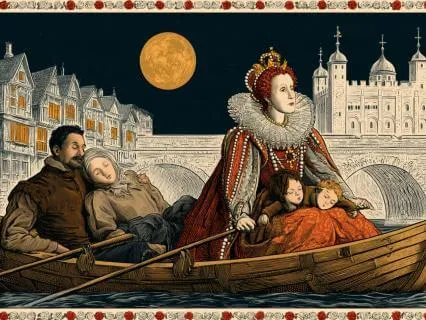
In which Thomas passes the Tower of London.
And discovers that the Queen as a rather unusual zoo.
It is 23 minutes past two.
On Tuesday,
The 16th of September.
1595 and Thomas and his son Ned.
Are making their way through the eastern part of London.
They've reached Tower Hill.
Were one of the most extraordinary buildings in England.
Rises above the surrounding street.
The Tower of London its thick stone walls,
Enormous towers and imposing gates,
Make it clear that whoever built this place was not particularly interested in receiving unexpected visitors.
The tower has stood here for more than 500 years.
Its oldest and most famous building.
The White Tower.
Was begun in the reign of William the Conqueror.
Over the centuries.
The fortress has served as a royal residence.
An armory.
A treasury.
A prison.
And a place for storing some of the most valuable possessions in England.
It is rather like Buckingham Palace.
The Bank of England.
And a maximum security prison being combined into a single building.
Which is convenient.
Because if a royal official steals the money.
.
.
He doesn't have very far to travel.
Ned stops to admire the walls.
Does the Queen live there?
Not usually.
Thomas explains.
By 1595.
Queen Elizabeth I.
Prefers other royal residences.
Including Y-tool enrichment.
Elizabeth is now 62 years old.
And has ruled England for nearly 37 years.
She is one of the most recognizable women in Europe.
Although most of her subjects will never see her in person.
Instead.
They encounter her image on coins.
Official portraits.
And other representations of royal authority.
In an age without television or photography,
A monarch's portrait is an important political tool.
Elizabeth's image is carefully managed.
Particularly as she grows older.
Her portraits increasingly present an almost timeless queen.
Adorned with jewels.
Elaborate clothing.
And the sort of complexion that suggests She has never had a disappointing Tuesday.
Modern celebrities spend fortunes on lighting.
Makeup.
And digital retouching.
Elizabeth simply employs a court painter.
Who understands that the Queen is not interesting in looking sixty-two.
Ned asks whether she has ever visited the tower.
Thomas Nod.
She has.
And this is where the history becomes rather extraordinary.
In 1554.
When Elizabeth was just twenty years old.
She was imprisoned here by her half-sister.
Queen Mary the First.
Mary suspected Elizabeth of involvement in a rebellion against her government.
Elizabeth denied wrongdoing.
And after several weeks in the tower.
She was released into house arrest.
Five years later.
In January 1559.
Elizabeth returned to the tower.
But this time.
She was Queen of England.
Preparing for her coronation procession.
It must have been a remarkable experience.
Imagine being imprisoned somewhere by your family.
Only to return five years later.
As the owner of the entire establishment.
The guards who once prevented you from leaving.
Are now expected to bow as you arrive.
It is possibly the most satisfying family reunion in English history.
But the tower has another royal function that interests Ned considerably more.
It contains.
Lions.
Actual lions.
The Kings and Queens of England.
Have kept exotic animals at the tower.
Since the 13th century.
When Henry III received several large cuts as diplomatic gifts.
Over time,
The collection became known as the Royal Menagerie.
Lions were housed near the western entrance.
In an area known as the Lion Tower.
Ned is delighted.
So.
.
.
The queen as lions.
Yes.
How many?
I don't know.
Can we have one?
Thomas turns to look at his son.
We live above a shoe shop.
Ned waits.
Where would you suggest we keep it?
Ned considers this carefully.
The workshop.
Thomas has spent the morning dealing with difficult customers.
But he is fairly confident at introducing a lion.
Would be an excessive response.
The animals are a symbol of royal prestige.
Foreign rulers have long exchanged extraordinary gifts.
And presenting somebody with a lion.
Is certainly one way of making an impression.
Nowadays a diplomatic gift.
Might be an expensive watch.
An elaborate piece of porcelain.
Or a ceremonial sword.
In medieval England.
Somebody might arrive at the palace.
And announce that the King of France has sent an elephant.
And the English king.
Must presumably stand there smiling.
While sinking.
What on earth am I supposed to feed that?
An elephant really was kept at the tower in the 13th century.
Although its time there was sadly short.
The royal collection continued long afterwards.
Thomas is rather pleased that the Tudor monarchy has chosen to keep its lions behind enormous stone walls.
Instead of allowing them to wander through cheapside.
Ned,
However,
Remains disappointed.
He had been hoping to see one.
Perhaps another day.
Thomas tells him.
This is a classic parental expression,
Meaning that the possibility will be reconsidered at some unspecified point after the child has forgotten about it.
But there is something even stranger about the tower.
Inside these walls.
The government makes money.
Literally.
The royal mint operates within the fortress.
Producing the gold and silver coins.
Used throughout England.
In 1595.
Coins.
Are still largely made by hand.
Workers prepare small pieces of metal,
Place them between engraved dies,
And strike them with a hammer to impress the design.
The process demands skill.
Precision.
And the ability to keep one's fingers out of the way.
Thomas finds the whole arrangement fascinating.
He spends hours hammering and stitching leather to produce shoes.
The men inside the tower.
Spend their days hammering metal.
And produce money.
For a brief moment.
Thomas wonders whether he has chosen the wrong profession.
Then he remembers that the coins belong to the crown.
Not the people making them.
Which rather takes the pleasure out of the whole exercise.
The tower is also a place where important people can find themselves in serious trouble.
Only three years earlier.
In 1592.
Sir Walter Raleigh.
One of Elizabeth's most famous courtiers.
Was imprisoned here.
After the Queen discovered he had secretly married one of her ladies-in-waiting.
Elizabeth Throckmorton Rally was a soldier.
Explore.
Poet.
And favourite of the Queen.
He had enjoyed royal favour,
Received valuable privileges,
And established himself among England's most celebrated men.
Then he married without the Queen's approval.
And found himself in prison.
Imagine explaining that to your friends.
How's married life,
Walter?
Well,
The wedding was lovely.
The honeymoon is taking place in the Tower of London.
The Queen expected considerable control over marriages within her household.
Particularly those involving her closest attendants.
Raleigh had made the mistake.
Of assuming that his private romantic decisions were,
In fact,
At the Elizabethan court.
This could be a serious misunderstanding.
The modern workplace as human resources departments.
The Tudor royal court as a fortress.
And while a modern employee might receive an uncomfortable meeting with management,
Raleigh received accommodation behind locked gates.
Thomas reflects that his own marriage to Joan had been considerably less complicated.
Nobody had required royal permission.
Nobody had sent him to prison,
Although Joan had occasionally suggested that a short period of confinement might improve his attitude.
As father and son continue towards old gates.
A mounted messenger passes them.
Travelling quickly through the streets.
Ned watches the rider disappear.
Do you think he's going to see the Queen?
Possibly.
Could we see the green?
Not today.
Why?
Because we're carrying firewood.
Ned seems to regard this as an insufficient explanation.
But the royal court is a difficult world for ordinary Londoners to enter.
Access to the monarch is carefully controlled through officials,
Courtiers and servants.
And the Queen's household itself.
Is an enormous organization.
Wherever Elizabeth travels.
She takes a substantial entourage with her.
There are ladies of the bedchamber.
Gentlemen of the household.
Cooks,
Musicians Gods.
Clerks.
Stable workers.
And all sorts of specialized attendance.
The royal court moves between palaces.
Sometimes undertaking elaborate journeys.
Known as progressors.
These journeys allow the Queen to display her authority,
Visit important subjects,
And enjoy the hospitality of wealthy hosts.
Hosting Elizabeth can be an extraordinary honour.
It can also be ruinously expensive.
Imagine receiving a letter.
Announcing that the Queen wishes to visit your house.
Naturally,
You are delighted.
Then you discover she is bringing several hundred people,
All of whom require feeding,
Accommodation,
And somewhere to put their horses.
The honor begins to feel rather less attractive.
Thomas considers how Joan might react.
If Queen Elizabeth announced that she intended to stay above their workshop.
He suspects that the Queen would be perfectly welcome.
But somebody would have to explain why she had brought so many people and whether they intended to help with the washing up.
At last,
Thomas and Ned turned towards Bishop's Gate.
The tower is behind them now.
And the familiar streets of their neighbourhood.
Are coming into view.
Ned is still thinking about the lions.
Thomas is thinking about the money being made inside the fortress.
And somewhere in one of her magnificent royal residences.
Queen Elizabeth is continuing the difficult business of ruling England.
Thomas,
Meanwhile.
As a more immediate challenge.
He must get home with the firewood.
Before Joan begins to wonder what has happened to them.
He would very much prefer not to explain that they were delayed because their twelve-year-old son wanted to bring a lion home.
Part 6 in which the family discovers Shakespeare.
Bad acting.
And the Tudor equivalent of a night out.
It is 17 minutes past five on Tuesday the 16th of September.
1595.
And Thomas has returned to Bishop's Gate.
He has delivered his shoes.
Collected firewood.
Visited the Thames.
And spent an alarming amount of time answering questions about lions.
Is looking forward to sitting down.
Unfortunately.
Joan has other ideas.
She wants to visit a neighbor near Shoreditch.
And the children have heard that something interesting is happening outside one of the theatres.
Thomas sighs.
He has noticed that whenever somebody says they are going out for a short walk it invariably involves walking considerably further than anyone originally suggested.
The family sets off.
Just beyond the northern limits of the City of London.
Stands a remarkable building known simply as the theatre.
It opened in 1576.
Built by a man called James Burbage.
And yes,
He actually called it the theatre.
This is a little like opening the first cinema in town and naming it.
Cinema.
The building is an enormous timber-framed playhouse.
With galleries surrounding a central open courtyard.
And a stage projecting into the audience.
Nearby stands another playhouse called The Curtain.
Both are flourishing.
Londoners have developed a tremendous appetite for plays.
And professional acting companies perform for paying audiences.
The city authorities,
However.
Are considerably less enthusiastic.
Many officials regard theatres as places that encourage idleness.
Disorder.
And the gathering together of suspiciously large numbers of people ought to be doing something productive.
Which is an interesting objection from men who regularly attend meetings lasting several hours.
The playhouses have consequently developed outside the city's direct jurisdiction.
Essentially.
The authorities have told the entertainment industry.
To take its business elsewhere.
And the entertainment industry.
Is moved approximately half a mile down the road.
A performance has recently finished.
And people are pouring into the street.
Talking excitedly.
Ned wants to know what they've been watching.
A young man explains that the play involved love.
Jealousy.
Arguments.
And several people behaving very foolishly.
Thomas considers this.
It sounds rather like the conversations he overhears outside his workshop.
Except apparently somebody is charging admission.
A basic ticket to stand in the courtyard.
Costs a penny.
More expensive places offer seating and a better view.
The actors perform in daylight because the large public playhouses are open to the sky.
Audiences may eat,
Drink.
Talk and react rather enthusiastically to the performance.
There is no expectation that everyone must sit silently for three hours.
While somebody slowly explains the difficulties of being a Danish prince.
That particular prince will become famous a little later.
And then there is the extraordinary business of the actors themselves.
Women are not permitted to perform in London's professional theatre companies.
Female characters are played by boys and young men.
Imagine attending a romantic tragedy.
In which the beautiful young heroine is actually a 14 year old boy.
Was sweeping the dressing room 20 minutes earlier.
And when the hero declares his undying love.
He must hope his leading lady's voice.
Doesn't suddenly break.
Somewhere in this bustling theatrical world.
Is a young writer and actor called William Shakespeare.
Maybe you've heard of him.
He is about 31 years old.
By 1595.
He is associated with the Lord Chamberlain's men.
One of London's leading acting companies.
His plays are beginning to establish his reputation.
Although nobody standing outside the theatre knows that four centuries later.
.
.
Children will still be forced to explain his metaphors in school examinations.
Shakespeare is writing for a commercial audience.
His job is to entertain people.
Makes them laugh.
Move them.
And persuade them to return.
He cannot simply write a play in which two people discuss their feelings for six hours and hope that a government arts grant will cover the losses.
His company needs paying customers.
And the audiences are wonderfully varied.
Apprentices stand alongside labourers.
Merchants and gentlemen.
Some come for poetry.
Some come for comedy.
And some appear to have come principally because they enjoy shouting at actors.
Bess is fascinated.
Could I be in a play?
Thomas explains that girls are not allowed to act professionally.
Best considers this.
So a boy would have to pretend to be me Yes.
She sinks for a moment.
Would he have to do my chores?
Thomas rather wishes she hadn't asked.
There is another wonderful detail about the theatre.
In just a few years.
A dispute over the lease.
Will lead Burbage's sons and their associates to dismantle the building.
And reuse its timbers across the Thames.
Those timbers will help create the Globe Theatre,
Opening in 1599.
It may be one of the most ambitious solutions to a landlord dispute in history.
Most tenants complain about the rent.
The Burbage's will effectively take the building with them.
As the family walks back towards Bishop's Gate.
They pass a man singing a popular ballad.
Printed ballads are an important form of Elizabethan entertainment.
Songs about love.
Crime.
Disasters.
And sensational events.
Are sold on sheets of paper.
Some are wonderfully dramatic.
A man may spend an entire afternoon singing about a terrible crime.
Committed by somebody in a distant county.
And everyone listening can go home feeling better about their own neighbours.
It is the 16th century equivalent of true crime entertainment.
And just as today.
The more outrageous the story.
The more likely people are to stop and listen.
Nearby.
An alehouse is growing busy.
Ale houses are social centres.
Where neighbors drink.
Exchange news.
Play games.
And occasionally develop disagreements that would have been better left undeveloped.
Joan recognises somebody in the doorway.
It is Margaret.
The vegetable seller from the market.
Margaret greets her warmly.
Then immediately begins explaining why the price of onions is likely to rise.
Joan has encountered her twice today.
On both occasions,
Margaret has delivered bad financial news.
Thomas wonders whether she offers any other services.
Perhaps she could be hired to attend weddings and inform the bride and groom that married life is going to be considerably more expensive than anticipated.
Ned asks whether they might stay for something to drink.
Thomas looks towards Joan.
Joan looks towards the children.
And will.
Who has been remarkably quiet for the last few minutes.
Announces that he is hungry.
This changes the situation immediately.
A hungry four-year-old in Tudor London is not significantly different from a hungry four-year-old today.
The principal distinction is that Tudor parents cannot distract him with a cartoon on an iPad.
They must actually deal with him.
Joan announces that they are going home.
Thomas offers no objection.
As they head towards their house.
Leaving the theaters,
Ballad singers.
And alehouses behind them.
He reflects on something rather comforting.
London may be changing at an astonishing speed.
New entertainments are appearing.
Printed material is spreading.
Merchants are growing wealthy.
And actors are becoming famous.
But some things remain reassuringly familiar.
People still enjoy a good story.
They still complain about the price of food.
And whenever a family goes out together.
Somebody inevitably decides.
They are hungry.
Just as everyone else is ready to leave.
Part seven.
In which Thomas goes to bed.
And discovers that tomorrow.
Is already looking rather busy.
It is 43 minutes past 8.
On Tuesday evening.
The 16th of September.
1595 and Thomas has decided that he has had quite enough of Tudor London for one day.
The family has eaten supper.
A simple meal of bread,
Cheese,
And leftover potage,
The thick vegetable and grain stew,
That appears so frequently on Tudor tables.
That it might reasonably be considered a permanent member of the household.
Joan is tidying away the dishes.
While Thomas sits beside the hearth.
He has been sitting there for some time.
Joan asks whether he intends to help.
Thomas explains that is sinking.
Joan suggests that he might try thinking while holding a broom.
It is an interesting proposal.
And one Thomas has never seriously considered.
Outside.
London is growing darker.
The city has no electric street lights.
Wealthier households can afford more candles.
But ordinary families must be careful with expensive lighting.
Etalo Kando.
Made from animal fat.
Provides a modest flame.
And an aroma that nobody would ever successfully market as a luxury scented candle.
In the streets.
Watchmen patrol during the night.
Keeping an eye out for thieves.
Virus.
And people behaving suspiciously.
Joan checks the hearth carefully before the family settles down.
Upstairs.
Ned and Bess are preparing for bed.
Will is refusing.
He has apparently decided that sleep is unnecessary.
And intends to remain awake indefinitely.
This is an ambitious position for a four-year-old who has spent most of the afternoon being carried Thomas explains that even Queen Elizabeth must sleep Will asks whether the Queen has to go to bed when somebody tells her.
Thomas considers this.
Probably not.
Will looks delighted.
He has discovered that the problem is not bedtime itself,
But his position in the English social hierarchy.
Eventually.
The children settle.
The wooden shutters are closed.
And the house becomes quiet.
Apart from the familiar creaking of its timbers.
Thomas climbs into bed beside Joan.
Busy day.
He murmurs.
Yes.
Says John.
I've done a great deal.
John turns towards him.
Of you.
Thomas decides against providing a detailed account.
Instead.
He thinks about the city beyond their walls.
A city of merchants,
Sailors,
Craftsmen.
Actors.
Beggars.
And aristocrats.
A city where enormous fortunes are made.
Plays are performed.
And a queen rules over many,
Many people.
And somewhere among them is Thomas.
A shoemaker with three children.
A sensible wife.
And a loose floorboard he has still not repaired.
Tomorrow he will make more shoes.
Joan will run the household.
Ned will be given another opportunity to demonstrate responsibility.
And Will will undoubtedly find something he has been specifically told not to touch.
Thomas closes his eyes.
Four hundred and thirty-one years separate his world from ours.
As he drifts towards sleep.
His final sword.
Is one we can all understand.
You really must get that floorboard fixed.
Perhaps tomorrow.