Hello,
This is Steven.
These days I like to tell my listeners that I'm a real human being.
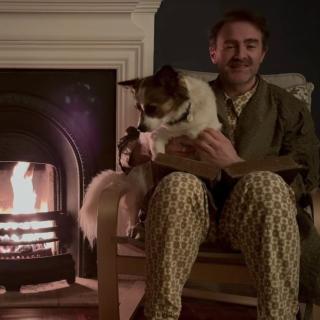
Every single word you hear tonight was recorded by me onto my microphone sitting in my studio with my little dog Timmy at my feet.
This is my work and this is my art.
And with that.
Hello,
My friend.
Welcome to your sleep story.
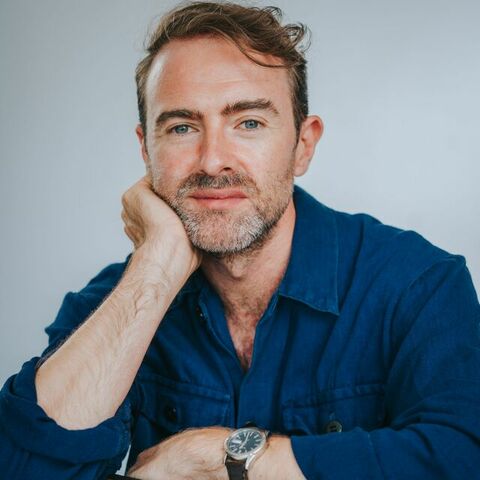
My name is Stephen Dalton.
I'm an Irish storyteller,
And it's my great privilege to be the voice that you listen to as you go to sleep tonight.
Tonight I continue my rainy,
Cozy hotel series.
And tonight we will visit a city that is very close to my heart.
Paris.
You will arrive in a taxi on a rainy November evening at your cozy hotel,
And I won't tell you anymore.
I'll let you discover as you go.
But first,
Let's do the relaxation session,
Which will take a few minutes,
Before tonight's sleep story.
I'm going to count down from ten to one,
And as I do,
Allow yourself to let go,
More and more.
Feel the support.
Of the bed beneath you.
Or is it fluid?
Whatever you lie upon tonight.
And beneath what you lie upon.
Feel a deeper support.
The support of the earth.
Our home.
Our constant support.
And as you become aware of that support,
See if you can.
Sink into this moment a little more now.
Just.
Let go.
A little more now.
You are safe.
Allow my voice.
To be an anchor of safety tonight.
To be a friend.
To be a gentle guide.
A guide that only ever brings you.
To safe places,
To warm and cosy places.
To places that enable and support your sleep.
Trust.
At my voice.
Is a friend tonight.
Feel into your body now.
Notice where you might still be holding tonight.
Notice.
Where you may have pain.
Or tingling.
Or tension.
Notice anything.
Maybe you feel something in your feet.
Or in your lower legs.
Through your sighs.
Or your belly.
Your chest.
Shoulders.
Arms.
Ends.
Or maybe you're like me.
You hold tension in your face.
Just see if you can soften a little now.
This is it time.
For kindness to yourself.
And to your body.
Seven.
The day is.
Whatever has been.
Has been.
Whatever will be.
Will be.
But right now.
All you have.
Is this moment.
Your thoughts can't change what has gone before.
Your thoughts can't change.
What will come tomorrow.
Your brain.
It needs rest now.
So,
As thoughts come and go now,
Don't fight them.
Don't chase them away.
See them for what they are.
So much.
Then just.
.
.
Watch them go.
Like leaves.
Floating away.
On a moonlit river.
Or clouds.
Passing through a starlit sky.
Six.
This is your moment.
Is your time.
You have earned this moment of kindness to yourself.
You deserve.
To have peace in your life.
We all do.
So,
As you become aware of that fact,
As you come to the understanding.
That we all deserve peace.
See if you can settle into this moment.
A little more now.
Letting your body know.
That it's really time for rest.
Peace.
Lives within you.
It is a constant friend.
Waiting to be found.
Waiting to be felt.
Where does it live within you?
Maybe it's in your heart.
Maybe it's in your head.
It's up to you to find it.
But I promise you it's there.
Perhaps,
Allow a little gratitude now.
Gratitude.
For the simple things.
For your body.
The shelter you have tonight.
Are the ones you love.
And who love you.
For the beauty and wonder of this world.
Of this planet.
That you can find.
When you look for it.
3.
Begin to engage with your imagination now.
Begin to see.
The magical,
Beautiful city of Paris.
On a rainy evening.
You have a feeling of peace and curiosity in your heart.
And you are about to be welcomed in.
To the coziest hotel.
You have ever been to.
Checking in with your body one more time now.
Finding the places you are holding still.
And allowing yourself to give in.
To allow the tension to ease away.
Your body has worked hard for you today.
It's time.
To give it rest.
And one.
Completely letting go now.
As I tell you.
Tonight's sleep story.
It is raining in Paris.
It is the last week of November.
And it is half past four in the afternoon.
And the lumps along the river have just come on.
You're in the back of a taxi.
On the Key Voltaire.
The driver is taking the long way.
Along the water.
Because he says the long way is the better way.
And he is right.
On your left.
The sun is running high and brown under the bridges.
On your right.
The Buchenists.
Have shut their green boxes for the day.
And padlocked them.
And the lids are shining.
Beyond them.
The tall,
Cream buildings have gone dark with the wet.
And every window in them is lit.
The driver's name is Laurent.
He has driven a taxi in Paris for 26 years.
And he has opinions about rain The visitors do not like it,
He says.
But he likes it.
He lifts one hand from the wheel.
Ahead of you,
A café has let its awning down to the pavement.
And under the awning.
The heaters are glowing orange.
And four people are sitting out there anyway.
With red blankets over their knees.
And small glasses in front of them.
Watching the street as if it were a film.
You'll see.
In the sun.
Everyone is busy.
In the rain.
Everyone sits down.
The taxi turns off the key into a narrow street that runs up from the river.
And halfway along it.
On the corner.
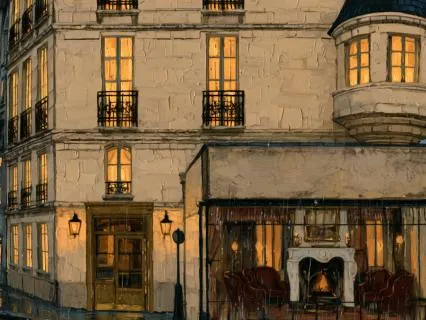
There is a hotel.
It is six stories of pale stone.
With iron balconies.
And on the corner.
There is a round tower with a pointed slate roof.
The sort of tower a child would draw.
If you asked them to draw a castle.
There is a brass and glass door.
With a lamp on either side of it.
And through the big,
Ground-floor window.
Past the rain running down the glass You can see a long room.
With a white marble fireplace.
And a fire in the fireplace.
And red armchairs around it.
And one of the red armchairs is empty.
Hôtel de la Tourelle,
Saint-Laurent.
You see the little tower?
Ask for the room in the tower.
They will tell you it is taken.
Ask anyway.
He gets your case from the boot.
And holds his own umbrella over you.
The forest steps to the door.
And the door is already opening from the inside before you reach it.
The lobby has a black and white tiled floor.
And a palm in a brass pot.
And a smell of furniture polish and wood smoke.
Behind a long dark desk.
There is a wall of pigeon holes.
And in every pigeonhole.
There is a key on a brass tag.
And above them a clock says twenty to five.
Behind the desk is Madame Hélène Aubry.
She is perhaps seventy.
Her hair is silver and pinned up.
Her reading glasses are on a chain.
And her cardigan is the colour of plums.
She has been on this desk for 41 years.
And her mother was on it before her.
And there is a photograph of the mother on the wall behind her at the same desk.
In this same cardigan.
Or one very like it.
She looks at you over the glasses She looks at the rain on your shoulders.
And she says.
.
.
You have come in so rain.
Good.
You have chosen the correct party.
You ask what she means.
May there are two,
She says,
Opening the register.
There is the one on the postcards.
With the blue sky.
People go home from that one with photographs.
And there is this one.
She nods towards the window.
People go home from this one.
With something else.
Your passport,
Please.
She writes your name in the register.
In a slow upright hand.
The Register is a real book.
With a marbled cover.
And you suspect that if you turned back far enough,
You would find her mother's handwriting in it.
And then someone else's before that.
Your room is on the sixth floor,
She says.
In the tower.
You tell her that the taxi driver told you to ask for the tower.
And that they would say it was taken.
Laurent,
Says Madame Aubrey.
Without looking up.
Durong tells everyone to ask for the tower.
It is nearly always taken.
As it happens.
It is yours.
The gentleman who had it has gone to Lyon a day early.
She closes the register.
It will be ready at a quarter past five.
Thibault is lighting the fire in it now.
Until then.
.
.
This salon has a fire.
And the fire has a chair.
And the chair is yours.
She lifts one hand.
And a young man in a grey waistcoat appears from somewhere.
And takes your case.
That is Thieper.
Is tall and quiet.
As the manner of a person who has already thought of the thing you are about to ask for.
The salon is a long room,
With a high ceiling.
And the ceiling has plaster moldings of leaves and ribbons.
That someone painted cream a hundred years ago.
And nobody has touched since.
The fireplace is white marble.
With a gilt mirror above it.
Gone cloudy at the edges.
And on either side of it.
Bookshelves go up to the ceiling.
There are lumps with fringed shades on every small table.
And they are all lit.
And their light is yellow and low.
At the far end.
The tall window looks onto the street.
And the rain is running down it.
And beyond it.
The lamps of the key.
Are doubled in the wet road.
On the horse rug in front of the fire.
An old basset hound is asleep on his side.
With his ears spread out on the rug.
Like two brown scarves.
His name is Guston.
He belongs to the hotel.
In the way that the clock does.
The chair by the fire is red velvet.
Worn pale on the arms.
With a footstool in front of it.
And it is empty.
It has the look of a chair that has been kept for you.
You sit.
The fire.
Is on your left.
The window is ahead of you.
The warmth comes through your damp coat and you decide to leave the coat on for a moment.
And then you decide to take it off.
And Thibaut is there to take it before you have finished deciding.
He comes back with a tray.
On the tray.
Is a white china pot of hot chocolate.
Sick.
With a cup.
And a small jug of cream.
A plate with two butter biscuits on it.
Madame Aubry says the rain requires it,
He says.
There is nothing like a butter biscuit on a rainy day.
And then he goes.
There are other people in the room.
And because you have nowhere to be for 40 minutes.
You can watch them.
By the window.
An elderly couple have the two chairs on either side of a small table.
They are Monsieur and Madame Lefranc from Bordeaux.
And Tebow will tell you later that they have come to this hotel.
For the same week in November every year.
For 38 years.
Since their honeymoon.
E as in newspaper.
She has a guidebook.
And she is reading things out of it to him.
Things about Paris.
That he is known for decades.
And after each one.
He lowers the paper an inch and says Are we?
As if he had never heard it before.
Between them there is one slice of tart tatin and two forks.
She eats the apple.
He eats the pastry.
That is the arrangement.
And it has clearly been the arrangement for a long time.
On the sofa.
A young woman in a green jumper is writing postcards.
She has a stack of them.
Eleven.
And a small address book.
And she is rising slowly.
Choosing her words.
And between sentences.
She looks at the fire.
Then she writes the next sentence.
She is the kind of person who still writes postcards.
And there are not many of them left.
And the world is a little better for each one.
In the far corner.
A man of about 60 has a sketchbook on his knee.
And is drawing the fireplace.
He draws and looks interrupts her.
And draws again.
People.
Passing.
Tells you quietly that the gentleman comes every November.
And draws the same fireplace.
And every year he says that this year He has nearly got it.
Cast on the dark.
Sighs in his sleep.
And stretches one back leg.
And settles There is something very restful.
About watching other people be content.
It asks nothing of you.
You drink your chocolate.
Which is so thick it is almost a pudding.
And the rain runs down the window.
In the clock in the lobby.
Which you can see through the double doors,
Says 10 to 5.
On this shelf at your elbow.
At exactly the height of your hand.
There is a blue cloth-bound book.
With the gold lettering nearly worn off the spine.
You tilt your head to read it.
Paris in the rain.
By Marguerite de Lorme.
Inside the cover.
Someone has written in pencil,
1954.
And undo that in a different pencil.
So long.
Please do not remove.
You open it where it falls open which is where everyone before you has opened it.
It reads.
November is the month in which Paris stops performing.
The chestnut trees along the quays let go of their last leaves.
The river comes up brown and fast under the bridges.
And the city.
Which has spent the summer being looked at.
Goes indoors.
And becomes itself.
You will know what I mean.
If you walk along this end.
At five o'clock on a wet afternoon The buchanists have shut their boxes.
The lumps are lit.
In every bakery window.
There is a light.
And behind the light.
There are rows of loaves standing on end.
The woman behind the counter has her coat on under her apron.
The cafes have let down their awnings.
And lit their heaters.
And put out their blankets.
And the people under the awnings are not tourists.
They are Parisians.
Doing the thing that Parisians do better than anyone in the world.
Which is sitting still in public.
I have lived in this city for thirty years.
And I have never once been disappointed by it in the rain.
The zinc roofs shine.
The stone goes the color of honey.
Under the lamps.
The streets empty.
And the rooms fill.
And from the pavement.
Every lit window.
Is a small.
Gold picture.
Of somebody's evening Go home then.
Go in.
Find a fire.
Paris in the rain.
Is a city that has gone indoors.
And it would like you to do the same.
You close the book on your finger and look at the window.
And it is doing exactly what she said it would do over 70 years later.
You have earphones in your coat pocket.
And on your phone there is an episode you saved for the journey and never got to.
It is a short one.
You put the earphones in and lean back.
And the fire is still on your left.
And welcome back.
Today,
We're in Paris.
And it's raining.
And I want to tell you that this is not a problem.
This is an opportunity.
Paris has been getting rain done for two thousand years.
And it has built itself accordingly.
Sir.
Here is where to go in Paris.
When it rains.
Start with the covered passages.
In the early 1800s.
Before anyone had sort of a shopping arcade.
Paris built dozens of them.
Narrow glass-roofed streets.
Running through the middle of city blocks.
Lying to his little shops.
So that a person could walk.
And look.
And buy a book.
Or an umbrella.
Marquee And never once feel a drop.
About 20 of them survived.
The Passage des Panoramas from 1799.
Is the oldest.
The Galerie Vivienne from 1823.
Is the loveliest.
With a mosaic floor.
And a glass roof.
And a bookshop that has been there since the start.
Go in one end dry.
And come out the other end dry.
And in between.
Take your time.
Then the Musée d'Orsay.
It was a railway station.
Built for the great exhibition of 1900.
With a glass roof.
And an enormous clutch.
And in 1986.
They turned it into a museum.
The trains are gone.
But the clock is still there.
And you can stand behind its face on the top floor.
And look out through the numbers at the river and the rain.
There is no better place in Paris to be indoors.
And then a cafe.
Any cafe.
Choose one with the awning down.
And the heater's on.
And sit outside under it.
And take the blanket when they offer it.
Order one thing.
Make it last an hour.
This is not idleness.
In Paris?
This is a skill.
And the locals have been practicing it.
For a very long time.
A few things to know while you're here.
The buildings are mostly the same height and the same cream color.
Because one man,
Baron Haussmann,
Rebuilt most of the city.
Between 1853 and 1870.
And he had firm views.
The green metal entrances to the Metro.
Are from 1900.
When the line first opened.
The Eiffel Tower.
Was finished in 1889 and was supposed to be taken down after 20 years.
And was saved because someone noticed it made a very good radio master.
And those green boxes along the river.
Belong to the Buchenists.
The booksellers of the sun.
Who have been there since the 1500s.
And to open when they feel like it.
Which in November is not often.
And when you have done all of that,
Go back to your hotel.
And find the fire.
And sit by it.
That's Paris in the rain.
Thanks for listening.
You take the earphones out.
The clock in the lobby says five past five.
The man in the corner has turned to a new page.
And started the fireplace again.
On the low table in front of you.
There is a big coffee table book of photographs.
Paris in winter.
And you turn the heavy pages with one hand.
While the chocolate cools in the oven.
Roofs under snow.
The river under fog.
A bakery at six in the morning.
And then a photograph of the Pond Nerve at night in the rain.
The lumps along this famous bridge doubled in the water.
And on the page facing the photograph.
Instead of a caption.
There's a short poem.
The lumps along the bridge come on at five.
And every one is two.
The one above and one below it.
Trembling in the river.
The last green box is luck.
The key is back.
A woman in a brown coat crosses over.
Her bread held in against her like a child.
Behind a hundred windows.
Soup is on.
Behind a hundred more.
A lamp,
A chair.
A book left open on a sleeping knee.
The city has gone in.
It does not mine.
It has been rained on for two thousand years.
And learned each time.
To light another window.
Go in.
Go up.
Someone has lit the fire.
The rain will mind the bridge until the morning.
You read it twice.
And then you close the book The fire is low and orange.
And Teepo is standing at the double doors.
Your room,
He says.
The lift is a brass cage from 1911 with a folding gate.
And Tebo closes the gate and turns the handle.
And the lift rises slowly past the landings.
And on every landing there is a lamp.
Sixth floor.
A short corridor with a red runner.
And at the end of it.
A door that is slightly curved.
Because the room behind it is round.
It is a round room.
There are three tall windows set into the curve.
One after another.
And the rain is on all three.
Between the windows the walls are papered in faded green with a small gold pattern.
Is a bed with white linen turned down at one corner.
And a heavy eiderdown in old rows.
And a lamp on the bedside table,
Already lit.
And set into the curve of the wall opposite.
The bed there is a small white marble fireplace a little one.
Made for a room this size.
And in it.
A fire that Thibaut lit half an hour ago.
Is burning well.
Your case is on the stand at the foot of the bed.
Your coat is on a hanger behind the door.
Try.
Madame Aubrey says breakfast is from seven.
Says Tipu.
And that nobody has ever been required to come down for it before nine.
And he goes.
And the curved door closes behind him.
You go to the middle window.
Below you.
The narrow street runs down to the river.
At the end of it,
There is the key.
And the lumps.
And the water with the lamps in it.
The long,
Dark line of the bridge.
Across the street the roofs are a sink and they are shining.
There is a chimney-putt with a lid.
A dormer window with a light on.
And inside the dormer window.
Someone is stirring something at a stove.
With their back to you.
And will never know you saw them.
You draw the curtains on the other two windows.
And leave this one open to the street.
Because the view.
Is the point.
You wash in the small bathroom.
You put on what you sleep in.
You fold back the eiderdown.
You get in.
You lie on your side.
The lamp on the bedside table.
Is the only light in the room apart from the fire.
And after a while you reach out and turn it off.
And then there is only the fire.
Low and orange in its little marble grate.
And even though it is early.
A great and cozy tiredness comes upon you.
The fire moves on the curved ceiling.
The rain is on the glass.
And you.
Fall in.
This leap.
Of your dreams.