Welcome to Restful Journeys.
In this track,
I will be reading the short story,
The Nice People by Henry Kyler Bunner.
Please find a comfortable place to sit or lie down and relax.
Take a few moments to clear your mind and allow yourself to listen to these words and help you become calm.
Let's begin with The Nice People.
They certainly are nice people.
I assented to my wife's observation,
Using the colloquial phrase with a consciousness that it was anything but nice English,
And I bet that their three children are better brought up than most of.
Two children,
Corrected my wife.
Three,
He told me.
My dear,
She said there were two.
He said three.
You've simply forgotten.
I'm sure she told me that they only had two,
A boy and a girl.
Well,
I didn't enter into particulars.
No dear,
And you couldn't have understood him.
Two children,
All right,
I said,
But I did not think it was all right.
As a nearsighted man learns,
By enforced observation to recognize persons at a distance when the face is not visible to the normal eye,
So the man with a bad memory learns,
Almost unconsciously,
To listen carefully and report accurately.
My memory is bad,
But I had not had time to forget that Mr.
Brewster Breed had told me that afternoon that he had three children,
At present left in the care of his mother-in-law,
While he and Mrs.
Breed took their summer vacation.
Two children,
Repeated my wife,
And they are staying with his Aunt Jenny.
He told me with his mother-in-law.
I put in.
My wife looked at me with a serious expression.
Men may not remember much of what they are told about children,
But any man knows the difference between an aunt and a mother-in-law.
But don't you think they're nice people?
Asked my wife.
Oh,
Certainly,
I replied.
Only,
They seem a little mixed up about their children.
That isn't a nice thing to say,
Returned my wife.
I could not deny it.
And yet,
The next morning,
When the breeds came down and seated themselves opposite us at the table,
Beaming and smiling in their natural,
Pleasant,
Well-bred fashion,
I knew to a social certainty that they were nice people.
He was a fine-looking fellow in his neat tennis flannel,
Slim,
Graceful,
Twenty-eight or thirty years old,
With a Frenchie-pointed beard.
She was nice in all her pretty clothes,
And herself was pretty with that type of prettiness which outwears most other types.
The prettiness that lies in a rounded figure,
A dusky skin,
Plump,
Rosy cheeks,
White teeth,
And black eyes.
She might have been twenty-five.
You guessed that she was prettier than she was at twenty,
And that she would be prettier still at forty.
And nice people were all we wanted to make us happy in Mr.
Jacobs' summer boarding house on top of Orange Mountain.
For a week we had come down to breakfast each morning,
Wondering why we wasted the precious day of idleness with the company gathered around the Jacobus board.
What joy of human companionship was to be had out of Mrs.
Tab and Miss Hugenkamp,
The two middle-aged gossips from Scranton,
Pennsylvania.
Out of Mr.
And Mrs.
Biggle,
An endurated head bookkeeper and his prim and censorous wife.
Out of old Major Halkett,
A retired businessman who,
Having once sold a few shares on commission,
Wrote for circulars of every stock company that was started and tried to induce everyone to invest who would listen to him.
We looked round at those dull faces,
The truthful indices of mean and barren minds,
And decided that we would be leaving that morning.
Then we ate Mrs.
Jacobus' biscuit,
Light as Aurora's cloudlets,
Drank her honest coffee,
Inhaled the perfume of the late azaleas with which she decked her table,
And decided to postpone our departure one more day.
And then we wandered out to take our morning glance at what we called our view,
And it seemed to us as if Tab and Hugenkamp and Halkett and the Bigglesses could not drive us away in a year.
I was not surprised when,
After breakfast,
My wife invited the breeds to walk with us to our view.
The Hugenkamp,
Biggle,
Tab,
Halkett,
Content never stirred off Jacobus' veranda,
But we both felt that the breeds would not profane that sacred scene.
We strolled slowly across the fields,
Passed through a little belt of woods,
And as I heard Mrs.
Breed's little cry of startled rapture,
I mentioned to Breed to look up.
"'By Jove!
' he cried,
"'Heavenly!
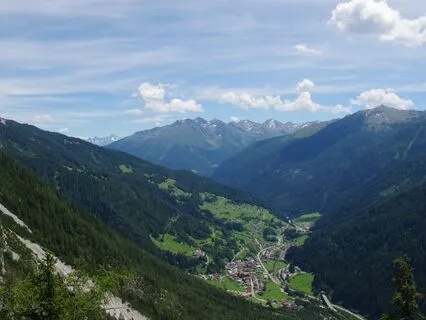
' We looked off from the brow of the mountain,
Over fifteen miles of billowing green,
To where,
Far across a far stretch of pale blue,
Lay a dim purple line that we knew was Staten Island.
Towns and villages lay before us and under us.
There were ridges and hills,
Uplands and lowlands,
Woods and plains,
All massed and mingled in that great silent sea of sunlit green.
For silent it was to us,
Standing in the silence of a high place,
Silent with the Sunday stillness that made us listen without taking thought for the sound of bells coming up from the spires that rose above the treetops.
The treetops that lay as far beneath us as the light clouds were above us that dropped great shadows upon our heads and faint specks of shade upon the broad sweep of land at the mountain's foot.
"'And so that is your view?
' asked Mrs.
Breed after a moment.
"'You are very generous to make it ours,
Too.
' Then we lay down on the grass and Breed began to talk in a gentle voice as if he felt the influence of the place.
He had paddled a canoe in his earlier days,
He said,
And he knew every river and creek in that vast stretch of landscape.
He found his landmarks and pointed out to us where the Posaic and the Hackensack flowed,
Invisible to us,
Hidden behind great ridges that in our sight were but comings of green waves upon which we looked down.
And yet,
On the further side of those broad ridges and rises were scores of villages,
A little world of country life lying unseen underneath our eyes,
A good deal like looking at humanity,
He said.
"'There is such a thing as getting so far above our fellow men that we see only one side of them.
Ah,
How much better was this sort of talk than the chatter and gossip of the Tab and the Hoogan camp,
Than the Major's dissertations upon his everlasting circulars.
' My wife and I exchanged glances.
"'Now,
When I went up to Matterhorn,
' Mr.
Breed began,
"'Why,
Dear,
' interrupted his wife,
'I didn't know you ever went up to Matterhorn.
' "'It was five years ago,
' said Mr.
Breed hurriedly.
"'I didn't tell you.
When I was on the other side,
You know,
It was rather dangerous.
Well,
As I was saying,
It looked,
Oh,
It didn't look at all like this.
' A cloud floated overhead,
Throwing its great shadow over the field where we lay.
The shadow passed over the mountain's brow and reappeared far below,
A rapidly decreasing block flying eastward over the golden green.
My wife and I exchanged glances once more.
Somehow,
The shadow lingered over all of us.
As we went home,
The breeds went side by side along the narrow path,
And my wife and I walked together.
"'Should you think,
' she asked me,
"'that a man would climb the Matterhorn the very first year he was married?
' "'I don't know,
My dear,
' I answered evasively.
"'This isn't the first year I've been married,
Not by a good many,
And I wouldn't climb it for a farm.
You know what I mean,
' she said.
I did.
"'When we reached the boarding house,
Mr.
Jacobus took me inside.
' "'You know,
' he began his discourse,
"'my wife,
She used to live in New York.
' I didn't know,
But I said,
"'Yes,
She says the numbers on the street runs criss-cross like thirty-fours on one side of the street and thirty-fives on the other.
How's that?
' "'That is the invariable rule,
I believe.
' "'Then,
' I say,
''these here new folk that you and your wife seem so mighty taken up with,
Do you know anything about them?
' "'I know nothing about the character of your boarders,
Mr.
Jacobus,
' I replied,
Conscious of some irritability.
"'If I choose to associate with any of them—' "'Just so,
Just so,
' broke in Jacobus,
"'I hadn't nothing to say against your sociability,
But do you know them?
' "'Why,
Certainly not,
' I replied.
"'Well,
That was all I was asking you.
You see,
When he come here to take the rooms,
You wasn't here then.
He told my wife that he lived at number thirty-four in his street,
And yesterday she told her that they lived at number thirty-five.
He said he lived in an apartment house.
Now there can't be no apartment house on two sides of the same street,
Can they?
' "'What street was it?
' I inquired warily.
"'Hundred and twenty-first street.
' "'Maybe,
' I replied,
Still more warily.
"'That's Harlem.
Nobody knows what people will do in Harlem.
' I went up to my wife's room.
"'Don't you think it's queer?
' she asked me.
"'I think I'll have a talk with that young man tonight,
' I said,
And see if he can give some account of himself.
"'But,
My dear,
' my wife said gravely.
"'She doesn't know whether they've had the measles or not.
' "'Why,
Great Scott!
' I exclaimed.
"'They must have had them when they were children.
' "'Please don't be stupid,
' said my wife.
"'I meant their children.
' "'After dinner that night,
Or rather after supper,
For we had dinner in the middle of the day at Jacobs's,
I walked down the long veranda to ask Breed,
Who was placidly smoking at the other end,
To accompany me on a twilight stroll.
Halfway down I met Major Halkett.
"'That friend of yours,
' he said,
Indicating the unconscious figure at the further end of the house,
"'seems to be a queer sort of dick.
' "'He told me that he was out of business,
And just looking round for a chance to invest his capital,
And I've been telling him what an everlasting big show he had to take stock in the Capitaline Trust Company.
Starts next month,
Four million capital.
I told you all about it.
' "'Oh well,
' he says.
"'Let's wait and think about it.
' "'Wait!
' says I.
"'The Capitaline Trust Company won't wait for you,
My boy.
This is letting you on the ground floor,
' says I.
"'And it's now or never.
' "'Oh,
Let it wait,
' says he.
"'I don't know what's into the man.
' "'I don't know how well he knows his own business,
Major,
' I said as I started again for Breed's end of the veranda,
But I was troubled nonetheless.
"'The Major could not have influenced the sale of one share of stock in the Capitaline Company,
But that stock was a great investment.
A rare chance for a purchaser with a few thousand dollars.
Perhaps it was no more remarkable that Breed should not invest than that I should not.
And yet,
It seemed to add one circumstance more to the other suspicious circumstances.
When I went upstairs that evening,
I found my wife putting her hair to bed.
I don't know how I can better describe an operation familiar to every married man.
I waited until the last tress was coiled up,
And then I spoke.
"'I've talked with Breed,
' I said,
And I didn't have to catechize him.
He seemed to feel that some sort of explanation was looked for,
And he was very outspoken.
"'You were right about the children.
That is,
I must have misunderstood him.
There are only two.
But the Matterhorn episode was simple enough.
He didn't realize how dangerous it was until he had got so far into it that he couldn't back out,
And he didn't tell her,
Because he'd left her here,
You see,
And under the circumstances—' "'Left her here?
' cried my wife.
I'd been sitting with her the whole afternoon,
Sewing,
And she told me that he left her at Geneva and came back and took her to Basel,
And the baby was born there.
"'Now,
I'm sure,
Dear,
Because I asked her.
' "'Perhaps I was mistaken when I thought he said she was on this side of the water,
' I suggested with bitter,
Biting irony.
"'You poor dear,
Did I abuse you?
' said my wife.
"'But do you know,
Mrs.
Tabb said that she didn't know how many lumps of sugar he took in his coffee.
"'Now,
That seems queer,
Doesn't it?
' "'It did.
It was a small thing,
But it looked queer,
Very queer.
' The next morning,
It was clear that war was declared against the breeds.
They came down to breakfast somewhat late,
And,
As soon as they arrived,
The biglasses swooped up the last fragments that remained on their plates and made a stately march out of the dining room.
Then Miss Hugenkamp arose and departed,
Leaving a whole fishball on her plate.
Even as Atlanta might have dropped an apple behind her to tempt her pursuer to check his speed,
So Miss Hugenkamp left that fishball behind her in between her maiden self and the contamination.
We had finished our breakfast,
My wife and I,
Before the breeds appeared.
We talked it over and agreed that we were glad that we had not been obliged to take sides upon such insufficient testimony.
After breakfast,
It was the custom of the male half of the Jacobus household to go around the corner of the building and smoke their pipes and cigars where they would not annoy the ladies.
We sat under a trellis covered with a grapevine that had borne no grapes in the memory of man.
This vine,
However,
Bore leaves,
And these,
On that pleasant summer morning,
Shielded us from two persons who were in the earnest conversation in the straggling,
Half-dead flower garden at the side of the house.
I don't want,
We heard Mr.
Jacobus say,
To enter in no man's privacy,
But I do want to know who it may be,
Like,
That I have in my house.
Now,
What I ask of you,
And don't want you to take it as in no way personal,
Is,
Have you your marriage license with you?
No.
We heard the voice of Mr.
Preed reply,
Have you yours?
I think it was a chance shot,
But it told all the same.
The Major,
He was a widower,
And Mr.
Biggle and I looked at each other,
And Mr.
Jacobus,
On the other side of the grape trellis,
Looked at,
I don't know what,
And was as silent as we were.
Where is your marriage license,
Married reader?
Do you know?
Four men,
Not including Mr.
Preed,
Stood or sat on one side or the other of that grape trellis,
And not one of them knew where his marriage license was.
Each of us had had one,
The Major had had three,
But where were they?
Where is yours?
Tucked in your best man's pocket,
Deposited in a desk,
Or washed to a pulp in his white waistcoat,
If white waistcoats be the fashion of the hour,
Washed out of existence.
Can you tell me where it is?
Can you?
Unless you are one of those people who framed that interesting document and hang it upon the drawing room walls.
Mr.
Preed's voice arose after an awful stillness of what seemed like five minutes,
And was probably thirty seconds.
Mr.
Jacobus,
Will you make out your bill at once and let me pay it?
I shall leave by six o'clock train,
And will you also send the wagon for my trunks?
I hadn't said I wanted to have you leave,
Began Mr.
Jacobus,
But Preed cut him short.
Bring me your bill.
But,
Remonstrated Jacobus,
If you ain't,
Bring me your bill,
Said Mr.
Preed.
My wife and I went out for our morning's walk,
But it seemed to us,
When we looked at our view,
As if we could only see those invisible villages of which Preed had told us,
That other side of the ridges and rises of which we catch no glimpse from lofty hills or from the heights of human self-esteem.
We meant to stay out until the Preeds had taken their departure,
But we returned just in time to see Pete,
The Jacobus man,
The blacker of boots,
The brasher of coats,
The general handyman of the house,
Loading the Preed trunks on the Jacobus wagon.
And as we stepped upon the veranda,
Down came Mrs.
Preed,
Leaning on Mr.
Preed's arm and as though she were ill,
And it was clear that she had been crying.
There were heavy rings about her pretty black eyes.
My wife took a step toward her.
Look at that dress,
Dear,
She whispered.
She never thought anything like this was going to happen when she put that on.
It was a pretty,
Delicate,
Dainty dress,
A graceful,
Narrow-striped affair.
Her hat was trimmed with a narrow-striped silk of the same colors,
Maroon and white,
And in her hand she held a parasol that matched her dress.
She's had a new dress on twice a day,
Said my wife,
But that's the prettiest yet.
Oh,
Somehow I'm awfully sorry they're going.
But going they were.
They moved toward the steps.
Mrs.
Preed looked toward my wife,
And my wife moved toward Mrs.
Preed.
But the ostracized woman,
As though she felt the deep humiliation of her position,
Turned sharply away and opened her parasol to shield her eyes from the sun.
A shower of rice,
A half-pound shower of rice,
Fell down over her pretty hat and her pretty dress,
And fell in a spattered circle on the floor outlining her skirt.
And there it lay in a broad,
Uneven band,
Bright in the morning sun.
Mrs.
Preed was in my wife's arms,
Sobbing as if her young heart would break.
Oh,
You poor,
Dear,
Silly children,
My wife cried as Mrs.
Preed sobbed on her shoulder.
Why didn't you tell us?
We didn't want to be taken for a bridal couple,
Sobbed Mrs.
Preed.
We didn't dream what awful lies we'd have to tell,
All awful mixed-upness of it.
Oh,
Dear,
Dear,
Dear.
Pete,
Commanded Mr.
Jacobus,
Put back them trunks.
These folks stays here long as they want to.
Mr.
Preed,
He held out a large,
Hard hand.
I'd ought of better known,
He said,
And my last doubt of Mr.
Preed vanished as he shook that grimy hand in manly fashion.
The two women were walked off toward our view,
Each with an arm about the other's waist,
Touched by a sudden sisterhood of sympathy.
Gentlemen,
Said Mr.
Preed,
Addressing Jacobus,
Biggle,
The Major,
And me,
There is a hostelry down the street where they sell honest New Jersey beer.
I recognize the obligations of the situation.
We five men filed down the street.
The two women went toward the pleasant slope where the sunlight gilded the forehead of the great hill.
On Mr.
Jacobus's veranda lay a spattered circle of shining grains of rice.
Two of Mr.
Jacobus's pigeons flew down and picked up the shining grains,
Making grateful noises far down in their throats.
Thank you for listening.
I hope you have enjoyed this short story.
Become relaxed and possibly fallen asleep.