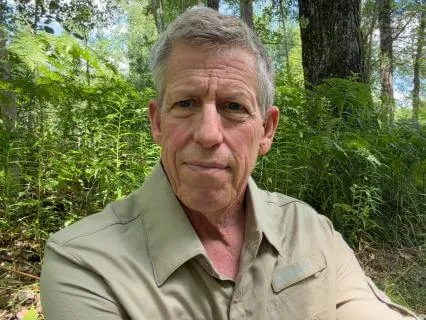
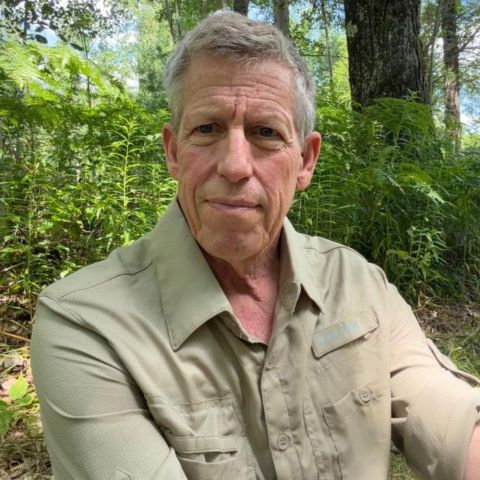
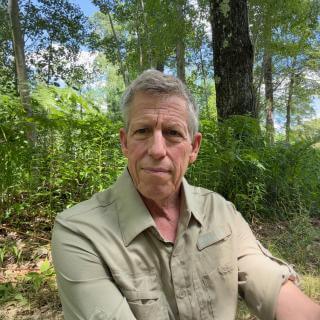
I'm Patrick Munson.
This is the introductory.
Video.
To a series that I'm calling Quantum Wilderness.
Where I would like to present The points of view that developed for me through the experiences that I've had in my life.
As an emergency physician.
As a person who studied extensively in the wilderness.
And taught wilderness survival and awareness.
For 15 years.
On a somewhat informal basis.
And also.
As a person who studied philosophy.
Classical philosophy.
The Upanishads.
But also more modern things like.
A Course in Miracles.
The Abraham and Seth.
Uh spot uh channeled works.
Anything and everything.
To form a point of view.
That I would like to share.
Now one of the difficulties.
.
.
I want to be honest and straightforward.
About this in the beginning.
Is that this is an amalgam.
Of my experience which has culminated in a point of view.
Which I can share with you.
But your point of view will never be exactly what my point of view is.
And in fact,
That's.
You know,
One of the essences.
Of our individuality,
That we each have a separate point of view.
What made the difference for me.
Is the fact.
That I began this study in wilderness.
So I would like to share with you.
My definition of wilderness or what the definition of wilderness came to mean to me.
Wilderness.
A resource.
Not for physical things so much.
The way that man has treated it.
Rather,
It is a resource of experience and connection.
Connection with the earth.
Connection with the physical stuff of the earth.
Connection.
With the energetic essence of the earth,
Its spirit,
If you will.
And This connection.
Extends not just in pure wilderness,
But once it's recognized there can easily be found.
As I found it.
In the emergency room,
Even in that sort of high tech.
Stressful environment.
My study in the wilderness opened my point of view.
To be able to instinctively know what was going on.
To instinctively know how to approach people.
To instinctively share.
The experience or the point of view they were having for a moment.
So that I could then.
.
.
Craft.
A way to help them.
So what is wilderness?
Think of a fractal diagram.
You may know what a fractal diagram is already,
But I'll just briefly say it is a pattern.
Generated oftentimes by a formula.
That repeats itself.
No matter how large you look at it,
Nor how small you look at it.
In other words,
The detail of the pattern.
Is unbroken from the largest scale to the smallest scale.
And that is the same thing.
I find in wilderness.
If I look at wilderness on the scale of the whole forest,
There is this rich,
Detail if I look closer into the cellular structure of a plant.
That detail persists if I look closer into the.
.
.
Organelles of the plant,
That detail is there,
All the way down to the molecular,
The atomic and the subatomic realm.
This detail,
This flow of detail is unbroken.
So that's pure wilderness.
Well,
What happens when man steps in?
I mean,
What is not wilderness,
Okay?
Certainly you can make an argument for the idea that man is part of wilderness and therefore what man does is also part of wilderness.
But let me explain this point of view that I have,
And that is that when man intervenes,
To build something.
For instance,
A sidewalk.
If you look at the macroscopic detail of the sidewalk,
There's detail there,
Okay?
If you look at the very microscopic view of the cement sidewalk.
The crystalline structure of the cement.
The atoms as they're bound in and the subatomic structure.
All that detail is still there.
But there's a point in between where the cement is actually made.
Where there's a chaotic boundary.
Same thing happens,
For instance,
You know,
If somebody puts a logging road through this wilderness that I'm sitting in.
The wilderness will be there in the soil.
But there'll be a point at which there is chaos,
Where the road,
The bulldozers come through and stir it up.
The chaos,
Okay?
The Native Americans,
For instance,
Used to look at this.
And for them,
Of course,
Because they lived.
In pure wilderness,
What I would call pure wilderness.
And their point of view was from pure wilderness as a.
Universal fact.
They didn't have bulldozers.
They didn't do that sort of thing.
They lived in concert with pure wilderness.
So when the white man came.
And started doing what the white man does.
Make roads,
For instance.
The natives were.
Confused by this.
Why would anybody want to do that?
Why would they want to break the chain of detail in the wilderness.
Why would they want to separate themselves from pure wilderness in that way?
What was going on with that?
You know,
There were stories even.
You know,
That as the white man.
Entered United States and moved west.
And these were the vanguard,
The trappers and explorers and so forth.
And the Native Americans,
Of course,
Were aware that they were there.
This was their backyard.
In a sense,
To them,
This wilderness had to do with the detail.
It didn't have to do with anything that was unknown.
They'd been living there.
This was known wilderness to them.
And so they would.
.
.
Watch and follow.
The white man.
And try to figure out what the heck was the matter with these people.
Why did they do what they did?
And one of the conclusions they came to is that their soles on their shoes were too thick.
That they couldn't feel.
The essence of the earth as they walked,
That they were separated literally by the soles of their boots.
And that this created a point of view that allowed them to feel okay about the level of destruction that they were.
Committing to the landscape.
There were times they actually stole their boots.
To see if that would change them.
It didn't,
Of course.
Little bit of a simplistic idea,
Right?
But nevertheless,
You get the concept.
Pure wilderness.
Is where we have an unbroken chain of detail.
Going from the largest macroscopic view that we can get.
Imagine.
All the way.
To the smallest,
Which,
You know,
In the modern world,
Our smallest idea is pretty darn small,
Right?
The subatomic foam is as small as it gets.
And that's why I'm calling this quantum wilderness,
Because the concepts that I want to bring to your attention.
Things I want to teach.
Relate to reality.
In a way that is continuous.
From the macroscopic to the microscopic to the subatomic to the quantum realm and beyond.
So quantum wilderness.
There's a lot of subject matter here,
Okay?
I'm 72 years old,
This has consumed at least 50 years of my life.
40 years,
Pretty.
Aggressively.
And.
I wanna be honest,
The.
.
.
Skills that are involved.
To have this experience.
Well,
Not difficult,
Not out of reach.
By anyone.
They do require time and attention and effort.
Many of the skills are physical,
Physical survival skills.
And if you want to experience pure wilderness and you want to experience it well.
You need to be comfortable there.
You need to be able to survive.
You need to be able to make shelter.
You need to be able to find food,
Water,
Make fire.
You need to be able to orient yourself.
You need to be able to tell what's going on out there.
You need some skills with animal tracking.
Your awareness has to expand.
Not only your external awareness,
But your internal awareness,
The way that you use your senses,
The way you smell,
The way you hear,
The way you move.
The way you walk on the landscape,
All of this comes together.
To generate.
And experience of pure wilderness.
Where spiritual awareness can open.
Spiritual awareness in my point of view,
In my opinion.
Is blocked.
Bye Vats.
Chaotic layer.
And so this is one of the reasons why we section off.
Our experience of spirituality into religions and into philosophies and into this sect and that sect.
And why we argue about.
Essentially nonsensical.
Traditions.
And details about what somebody may or may not have said or done thousands of years ago.
And why we allow our point of view to be hijacked.
Bye.
This teaching.
That nevertheless rests on separation.
So.
I'm going to endeavor to put together a series of videos.
I don't know how many there will be or how long it will take.
Or how much interest there will be,
Because frankly.
It's a deep subject.
It requires some introspection,
Some change,
Some.
.
.
Commitment.
Some risk.
Although not life-threatening risk,
But you know,
If you're gonna walk out into the wilderness with a blanket and a knife.
And spend a couple of nights.
Even if you're within walking distance of your car.
There's a little risk,
The kind of risk we don't normally expose ourselves to.
And so,
You know,
I do accept.
As real and okay.
The idea that you might listen to these videos,
You may never do anything.
On them.
You may never look at a track.
Much less spend three hours looking at a track.
You may never build a debris shelter or get functional at making fire.
And you may watch me do these things and call that okay.
And it is okay,
It's certainly okay.
On the other hand,
You might decide to dive in.
There's lots of points of entry.
And while I harp on the idea of pure wilderness and It is my.
Feeling my goal and with some ways to show.
That wilderness is something that we as humans need to maintain.
Not because.
.
.
Of some abstract idea about nature,
But because it has something to teach us,
Something to give us that we simply cannot find in another location.
You cannot learn this in a college classroom.
I don't care how good the professor is.
When I'm finished,
Perhaps you'll have an idea,
At least,
If you aren't.
Diving into the experience yourself.
What wilderness is worth.
And why.
Pure Wilderness.
Is important.
Why old-growth forest is different.
Than this Michigan forest that I sit in that looks gorgeous,
Right?
But remember,
This was all cuts.
To the ground.
Over 100 years ago,
But still,
The land remembers.
There is a.
.
.
Layer.
Of chaos buried in that past.
That is palpable.
In this wilderness.
And when you go to an old growth forest,
You'll notice.
The difference.
Our nature is robust.
Nature is very robust,
Very persistent.
And in my point of view,
Nature loves us unconditionally.
But it also.
Isn't giving it away for free.
So.
It wants you to walk towards.
It's not.
Common for you,
Okay?
So I hope that gives you a little bit of an idea about whether you want to.
Watch another video.
I think the next one.
I'll make about fire just because fire is cool and it's a physical skill and yet.
It opens the door to communication.
With the Earth.
As effectively as anything that I've ever done.
Come across.
I've taught fire to.
.
.
At least 100 people.
And I know that those that.
Worked with it.
Did develop that conversation.
And that did change the way they feel about themselves,
The way they feel about the earth.
I'll say one other thing before I close and that is that.
Having the ability to survive in the wilderness.
Even having the ability to see which plants that are growing in that fallow.
Where they tore down a building last year.
In your city.
Which of those are edible?
Where food is.
What it looks like while you're driving down the expressway.
While you're walking through a park or on a golf course,
Much less through the wilderness is this.
That feeling,
That knowledge,
That sense of self,
That no matter what happens,
No matter where you are,
You can survive.
You can be.
Be sheltered.
Have water and food.
And the comfort and security of fire.
Simply because of your own persistence and skills.
This is a huge thing to reduce.
Fear in your life.
Fear.
Is the great separator,
Right?
Separates for you from yourself,
From your environment,
If you have a fearful point of view.
You can't even really.
Commune with another human being,
Even if they have the same fear.
So survival skills in and of themselves have a value.
It reduces your anxiety.
It makes you more of a whole person.
If you are standing in a group of people and you know how to survive.
That whole group is empowered,
Whether they know it or not.
So.
I believe that acquiring these skills.
Is valuable in that way.
But I will caution you.
That if you're just watching.
Don't assume.
That you have the skills.
You need to prove it to yourself.
And you need to take what I say and not just accept it.
As whole cloth.
But take it out into your environment,
As much wilderness as you can access.
And test it out for yourself.
How does it work for you?
How does it feel?
In your own body,
In your own heart,
When you fox walk down a trail,
As opposed to just ambling,
Looking at your phone.
So there's a lot here.
And next time we'll just get started.