Welcome to our recovery journey with a brief talk about satya or truthfulness.
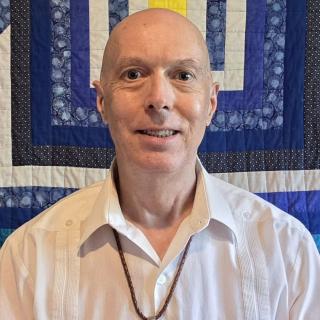
I'm Kevin.
I live with the chronic,
Progressive,
Potentially deadly condition of substance use disorder.
I have been in recovery since March 17,
2012.
In this talk,
The terms use and use may include any substances and behaviors that were direct or indirect part of our disorders.
Unless otherwise noted.
All quotes or translations I refer to come directly from Sri Swami Satchitananda's translation and commentary in his book,
The Yoga Sutras of Patanjali.
The yamas comprise the first of the eight limbs of yoga described by Patanjali.
Satya is the second practice in the yamas.
Yama refers to restraints or things we aspire to not do.
Ahimsa,
The first Yama,
Refers to refraining from harm and violence.
Although Satya is also a Yama,
A restraint.
The word translates as truthfulness.
Even if it is untruthfulness,
Dishonesty,
Deception,
Deceit,
From which we wish to refrain.
In his book,
Light on Yoga,
B.
K.
S.
Iyengar says satya,
Or truth,
Is the highest rule of conduct or morality.
He says truthfulness is the highest rule of conduct.
And the Yoga Sutras Patanjali records eight elements or limbs of yoga.
The physical postures,
The asanas familiar to many of us,
Comprise one of the eight limbs.
The first limb,
The foundation of the tree,
If you will.
Or five units.
Along with the next limb,
The niyamas.
These are often called the ethical code of the yogic tradition.
Patanjali does not go into depth in any of the yamas.
On Satya,
The translation gives us this.
To one established in truthfulness,
Actions and the results become subservient.
To me,
This says that when I understand a truth,
When I embrace and embody a truth and am committed to truth.
Then my words and actions come from truth.
Let's take a minute to revisit Ahimsa,
The first Yama,
And how it fits with Satya.
Ahimsa suggests refrain from harm or violence.
Regarding all the yamas,
The sutras tell us these great vows are universal,
Not limited by class,
Place,
Time,
Or circumstance.
So even if something is true,
We have to be mindful that in saying it,
We're living it.
Ahimsa calls this to not use truth to cause harm.
Concurrently practicing ahimsa and satya echoes 12-step program's ninth step.
In which adherents made direct amends,
Satya,
To such people wherever possible,
Except when to do so would injure them or others.
Ahimsa.
Remember the translation of this yama.
To one established in truthfulness,
Actions and their results become subservient.
Satya suggests we don't worry about what someone else may think about us as a result of our truthfulness.
Again,
To the ninth step.
And the 10th and the 4th and 5th steps.
If our hope is to free ourselves from the bondage of our disorders.
We need to practice truthfulness to the best of our ability.
I suggest we also need to hear and accept the other person's perspective or recollection,
If any.
And harm,
If any,
From our past actions.
This will help us fully understand any harm we caused and the truth others may be living as a result of our past actions.
Their truth.
Arising from our past actions.
Are part of our truth.
In lives ruled by substance use disorder,
The concept of truth can be fluid.
Many of us were intentionally deceptive about the substances and amounts we used to our families,
Doctors,
Therapists,
Coworkers,
The list goes on.
Satya is not just about the past.
Remember the sutra.
These great valves are universal,
Not limited by class,
Place,
Time,
Or circumstance.
Satya is about now.
Am I trying to deceive myself or someone else now?
Am I open to learning and embracing the truth,
Even if it is uncomfortable?
Now.
On the path of recovery,
We have a chance to put our past actions in the past and live in this moment.
In this breath.
Illuminated by truth and not clouded by the anxiety that can accompany deceit.
We can live free from worry about what we may say or do so long as we ground our words and actions in honesty.
We can be free from worry about what we did or said.
We don't have to remember and repeat a deception to save face.
We only have to remember the enduring,
Stable truth.
Not the truth we hope we can convince someone to accept.
But the truth we feel and know and embrace and live.
Our recovery journey began with Satya,
Even though most of us didn't know this yama at the time.
Most,
If not all,
Recovery journeys begin when we embrace the first truth of our disorders.
That no matter how many ways and times we tried,
On our own,
We could not stop or even moderate our use with any sustainability.
The yamas are restraints.
Satya doesn't call on us to refrain from truthfulness,
But from its opposites.
How do we do that in recovery?
After ending are self-deceptions that we are doing okay in active use.
After halting our internal dishonesty about being able to stop when we want to,
After we see through the delusion that we are functioning despite our disorders,
What's left?
The ways we still try to deceive ourselves and others are as varied as they are insidious.
Continuing use of other substances that were not our primary substance.
If our primary substance was illegal to possess or to use in the way we used it,
Continuing or switching to legal substances that produce similar effects is a common self-deception.
Continuing to use other substances still known to be addictive and ultimately deadly may prolong our demise.
But our lack of honesty with ourselves can't protect us from the fact that we are prolonging our disorders,
And with that,
Our suffering.
One of the most damaging truths many of us held onto was that we would never be able to stop using.
That our fate was to struggle with our disorders for the rest of our lives.
We gave up on the hope of recovery and we gave up on ourselves.
But our most profound truth is this.
We can live free from the bondage of our disorders.
We can live happy,
Joyous,
And free.
We can recover.
We can grow beyond surviving.
And begin thriving.
To one established in truthfulness.
Actions and the results become subservient.
When we are on a path illuminated by satya,
Living the truth of our disorders,
Then our actions to recover are not useless struggles.
Their affirmation of accepting our most profound truth.
We can live free from the bondage of our disorders.
Thank you for sharing this journey of recovery and truthfulness with me.
If you found this helpful,
Please let me know.
Your comments will help me create other guided meditations for our recovery.
I invite you to listen to my guided meditation.
Satya on the Path to Addiction Recovery.
And to my other guided meditations and talks about the yamas and niyamas on the path to recovery on Insight Timer.
May we be happy.
May we be healthy.
May we live with ease.