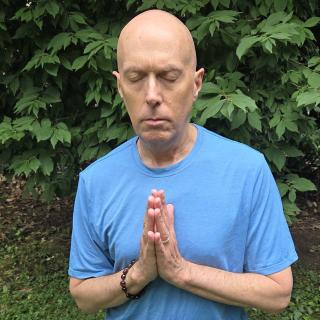
Thank you for joining me on our recovery journey with a brief talk about AHIMSA,
Or nonviolence,
Non-harm to ourselves and others.
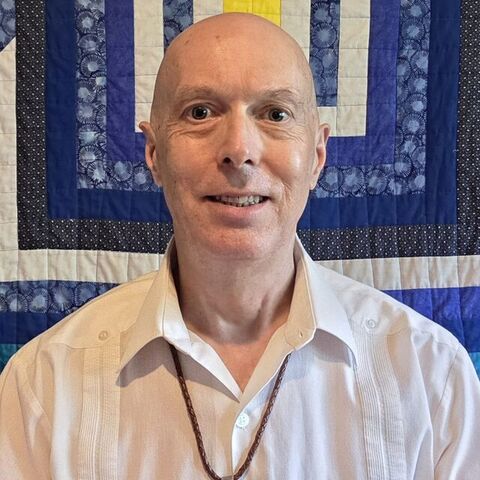
I am Kevin.
I live with the chronic,
Progressive,
Potentially deadly condition of substance use disorder.
I have been in recovery since March 17,
2012.
In this talk,
The terms use and use may include any substances and behaviors with which we have harmed ourselves and others.
The Yamas comprise the first of eight limbs of yoga described by Patanjali.
Ahimsa is the first practice,
The first yama.
So the first practice of yoga is to refrain from harming ourselves and others.
Patanjali is said to have lived in India sometime between 5000 years BCE and 300 CE.
He did not invent yoga,
But he is credited with documenting a system of teachings and practices that had been developed and spread through oral tradition to that point.
Patanjali's work came to be known as the Yoga Sutras.
In the Yoga Sutras,
Patanjali records eight elements,
Or limbs,
Of yoga.
The physical postures,
The asanas familiar to many of us,
Comprise one of the eight limbs.
The first limb,
The foundational limb of the tree,
If you will,
Are five yamas.
Along with the next limb,
The niyamas,
These are often called the ethical codes of yoga.
Patanjali does not go into depth in any of the yamas.
On Ahimsa,
One popular translation gives us this.
In the presence of one firmly established in nonviolence,
All hostilities cease.
That's it.
In the presence of one firmly established in nonviolence,
All hostilities cease.
Not a lot to go on.
But it's enough.
The gurus and yogis and scholars through the centuries have expanded on Patanjali to mostly converge on the idea that this yama suggests we cause no harm,
No violence.
If we are firmly established in non-violence,
All hostilities cease.
If we don't harm ourselves,
We don't harm others.
If we don't harm others,
They don't harm us.
It's an idealized view of the world,
But if we're striving to ease our own suffering,
This might be a good ideal to start with.
So what does this mean for our recovery?
Many of us have been carrying the weight of self-harm for many years through frequent heavy use of substances and behaviors.
As with every aspect of recovery,
We start where we are.
It's not helpful to expect instant expertise.
There's a line in the big book of Alcoholics Anonymous that says,
The principles we have set down are guides to progress.
I find it helpful to think of the yamas in the same way.
They are guides to progress.
If we practice them consistently and thoroughly,
They can become natural for us,
We can know ourselves and our actions more deeply,
And we can more frequently and maybe more easily,
In the case of Ahimsa,
Refrain from harming ourselves and others.
When we begin practicing ahimsa,
I think it's helpful to start with ourselves.
Whether or how much mental,
Emotional,
Spiritual,
Or physical harm we caused others,
In our disorders,
We inflicted frequent,
Sustained,
Direct harm on ourselves.
As the saying goes,
Hurt people hurt people.
So let's start by refraining from further harming ourselves physically,
Emotionally,
Spiritually.
When we feel less harmed,
Less damaged ourselves,
We may have more capacity to practice this same grace with others.
We can't change what happened in our past.
But we can shine Ahimsa on ourselves in this moment.
In this breath.
We can stop blaming ourselves for a disorder that grew from the need to ease our own mental,
Emotional,
Spiritual,
And physical pain and suffering.
We can pause the playlist of self-judgment for what we have done,
What we have not done,
What we should have or could have or would have done if it weren't for the substances and behaviors.
We can acknowledge that we are here,
In this moment,
Healing.
Medical science tells us,
Depending on the substance,
Our bodies begin the healing process within minutes of our most recent use.
Our liver,
Stomach,
Intestines,
Lungs,
Heart,
Throat,
Mouth,
Nose,
And even our skin begin self-healing after every use.
Science tells us that our bodies have been healing throughout our years of use,
But we give them time to catch up.
We kept using and sending the healing process back to the starting line.
I remember being in a meeting on my 90th day of recovery,
Sharing that I felt like my brain was just starting to wake up.
By refraining from harmful substances,
I was giving my body's natural healing processes a chance to work.
After we pass through the portal of detox and withdrawal,
The chain reaction of healing is well documented.
Our sleep quality improves,
And with it the mental benefits of better cognition and reduced stress and fatigue.
Our natural hunger and eating patterns return,
And with them the opportunity for better nutrition to help our bodies heal and thrive.
This doesn't mean our bodies will spontaneously heal all the harm we have done.
Some conditions created by our use need medical attention and care.
Some conditions preceded our use and may still need the care of medical and mental health professionals.
The point here is that when we stop our self-harm,
We give our bodies natural healing processes a chance to do what they can,
And we give medical care the benefit of not having to start at square one every time.
Now,
What if we turned the idea of Ahimsa around a bit?
What if,
Instead of non-harm or non-violence,
We thought of Ahimsa as a positive,
Affirmative idea?
With concepts like Peacefulness.
Gentleness.
Acceptance.
Tolerance.
Cooperativeness.
Kindness.
Friendliness.
Forgiveness.
Surely in early recovery,
The most important approach may be to think in terms of stopping,
Ending,
Leaving alone.
But can we simultaneously,
Or after some stability and recovery,
Begin to think in terms of what we do rather than what we don't do?
What do we add to our world?
And not only,
What do we take away?
Turning from the idea of stopping to a more positive image of starting,
I like to adapt the Prayer of St.
Francis as an aspiration,
Which comes out something like this.
May I be a channel of peace.
Where there is hatred,
May I bring love.
Where there is wrong,
May I bring the spirit of forgiveness.
Where there is discord,
May I bring harmony.
Where there is error,
May I bring truth.
Where there is doubt.
May I bring faith.
Where there is despair.
May I bring hope.
Where there are shadows.
May I bring light.
Where there is sadness,
May I bring joy.
May I seek to comfort rather than to be comforted.
To understand than to be understood.
To love rather than to be loved.
Thank you for sharing this journey of recovery and non-harm with me.
If you found this helpful,
Please let me know.
Your comments will help me craft other talks for our recovery.
I invite you to listen to my guided meditation about Ahimsa on the Path to Addiction Recovery on Insight Timer.
May we be happy.
May we be healthy.
May we live with ease.