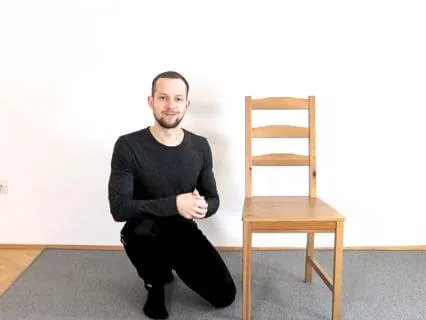
Today's lesson will be done in sitting,
So please get yourself a chair with a flat sitting surface and without any armrests.
The movements will only be done on the right side.
We'll explore some shoulder movements as well as some head and neck movements.
If you can't do the movements on the right side because you currently have some injury,
Then feel free to translate all the movements to the left side.
So get yourself a chair and enjoy the lesson.
Please come to sit at the front edge of your chair.
With your feet flat on the floor,
And your hands resting on your thighs.
Sit in a comfortable but upright position.
And now gently close your eyelids.
It is not important to watch the video.
Because I will guide you through the lesson verbally.
So if your eyelids are closed it's easier for you to pay attention to your own sensations.
Now with closed eyelids,
Sense your neck.
Sense the left side of the neck.
And sense the right side of your neck.
Does one side feel longer?
Or shorter than the other one.
Now sense your two shoulders.
Sense the left shoulder.
And sense your right shoulder.
Is one shoulder lifted higher towards the ceiling than the other one?
Nobody is symmetrical.
This means that all of us have one shoulder that points more towards the ceiling than the other one.
And these differences might be quite obvious to you,
Or they might be so small that you are not even able to feel it.
So don't try to correct anything.
Just notice your current sensations.
Now sense the distance from your left shoulder to your left ear.
And compared to the distance of your right shoulder to your right ear.
Which one is longer?
Now slowly start by moving your right shoulder towards the ceiling,
Lifting your right shoulder towards the ceiling and letting it sink again.
And repeat this movement a few times.
Don't reach your full limits.
Just lift the shoulder slowly and gently and let it sink back.
Don't drop your shoulder,
Let it sink.
And start with a small movement.
And you can gradually make it bigger,
But never go to your limits.
Always stay in a comfortable range while doing the movement.
And every time you let your shoulders sink back,
Make a tiny pause before starting the next movement of lifting your shoulder.
Allow yourself to breathe freely.
Try to make the movement even in both directions.
So when you lift the shoulder this movement is as slow as when you lower the shoulder.
Now bring the movement to an end.
And now start turning your head to the right and then back to the middle.
Only to the right and to the middle a few times.
And as well do the movement in an easy way.
So don't go to your full limit,
This movement is not about stretching your leg.
It's just about creating a gentle movement in this direction.
So you turn your head gently to the right and then come back to the middle.
And then start combining both movements.
So the same time you turn your head to the right,
Lift your right shoulder.
And when your head comes back to the middle,
Let your shoulders sink again.
And take a little bit of time for this movement.
We want to be in control of both movements.
So make both movements equally smooth.
Equally slow.
And equally small.
Allow your face to be relaxed.
Allow your breathing to be free while doing the movement.
Allow your neck to be free from tension.
So you can do both movements.
Without feeling tense,
Without feeling restricted.
And then bring both movements to an end.
Take a short break in sitting.
Now start a movement of tilting your head to the right.
In other words,
Move your head in such a way that your right ear comes closer to your right shoulder.
But without moving the shoulder,
It's just the ear going towards the shoulder.
So you are facing forward.
And you tilt your head to the right,
So your ear comes closer to the shoulder.
But the shoulder doesn't move,
It stays relaxed in its position.
So repeat this movement a few times.
Gently tilt your head to the right side and come back to the middle.
And again,
Avoid stretching.
So if you feel that a big stretch occurs in your neck,
At the left side of your neck maybe,
Then do the movement smaller.
It's just about.
Sensing the quality of the movement.
It's not about stretching any muscles.
And even if the movement is very small,
That's fine too.
So just tilt your head gently to the right and come back to the middle.
And can you do it half the speed of what you're doing now?
Feldenkrais movements can almost never be too slow,
But they can certainly be too fast.
So if you're not sure whether you're moving slowly enough,
Just move half the speed of what you have now.
Even if you're already very slow,
It's still possible to do it half as fast.
Now gently start to include your right shoulder in the movement.
So when you tilt your head to the right and your ear comes closer to the shoulder,
Also let the shoulder come closer to the ear.
So you lift the shoulder towards the ceiling and the right ear and the right shoulder come closer together.
And then they move further apart again.
So the shoulder sinks and the same time the head comes back to the middle.
Repeat this movement a few times.
Allow your breath to be free.
Allow your face to be soft.
Your lips are gently touching each other.
So your neck can be free.
And try to make both movements even.
So if the shoulder is very fast and the head is very slow,
Even this out.
Make the shoulder slow as well.
Now bring both movements to an end.
And now with closed eyelids again sense your neck.
Sense the left side of your neck.
And sense the right side of your neck.
Is anything different?
Is one side longer than the other one.
Now sense the distance from your left shoulder to your left ear.
And compare to the distance of your right shoulder to your right ear.
Is anything different there?
Is one side longer than before?
And by the way,
It's totally fine if you don't feel any differences at all.
Improving self-awareness takes time.
And if you practice Feldenkrais exercises regularly,
You will become better at sensing small differences.
It will be easier for you to sense tension in yourself and you will be able to release it.
Now open your eyelids.
Stand up and take a few steps.
Walk around in your room to integrate this new experience.
If you want to,
You can watch the video again and do the exercise on the other side now.
Or you can just stay with your new sensations.
Thank you.