There is a morning a lot of people would recognize and it starts well.
You sit down at the kitchen table with a hot cup of tea and one thing you actually want to do.
Maybe it is a letter you have been meaning to write since spring to someone who would be glad to hear from you.
Maybe you want to look at your money properly for once with the numbers open in front of you.
Maybe you just want 20 quiet minutes with a book and you have been promising yourself those 20 minutes for weeks.
Let's stay with the letter because a letter is the kind of thing that keeps getting moved to tomorrow.
So you sit down,
You take the lid off the pen and then you look up and the tea has gone cold and 40 minutes have gone somewhere and the letter is still a letter you have been meaning to write.
Something in you wants to explain that straight away and the first explanation that arrives is often about your character.
It tends to be an unkind one.
Before you accept it,
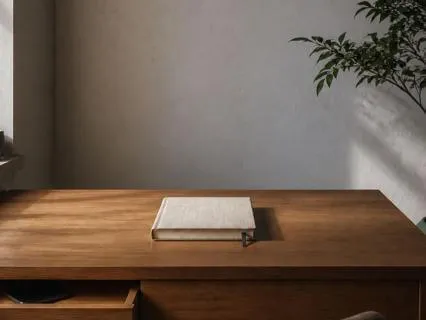
Look at the table.
Think about what was actually on that table while you were sitting there.
Your phone was near your hand,
Face up.
A small pile of post was sitting just past the phone,
And at least one envelope in that pile was something you have been avoiding.
Your laptop was there too,
And the laptop opens onto whatever you had opened the last time you closed it,
Which was probably not the latter.
Every environment contains instructions.
The phone lying face up is a standing offer,
Saying that at any moment you could be somewhere more interesting than here.
The pile of post is a worry sitting in your eyeline,
And the worry you can see is easier to pick up than a worry you have put away.
None of these objects intends anything.
They are simply close to you and being close is the whole of what they do.
So those 40 minutes had a shape after all.
The thing you wanted was a decision you had made quietly,
Inside your own head.
That decision was competing with several objects that were within reach of your hands.
And the objects within reach had a real advantage.
It helps far more to know that you opened the laptop to check one date and that three unread messages were sitting there when the screen woke up.
Now you know which door you walked through and a door is something you can move.
Here is the workable part of all this.
And you barely notice making them.
The fork goes where a hand will reach for it,
So that nobody has to think about reaching.
The salt goes near the middle so that nobody has to stand up.
The homework and the post and the laptop come off the surface completely because they belong to a different part of the day and would only sit there asking to be dealt with.
Nobody calls that a system.
It is what you do when you want a meal to go well.
Setting a table is a way of saying that for the next while this surface belongs to one thing and here is everything that one thing needs.
You can set a table for the latter.
The paper and the pen go in front of you and the address is already written on the page.
That part is about reach.
Everything the letter needs should sit close enough that your hands find it while your attention stays with the page.
Then everything else moves one step further away than it is now.
The phone goes onto a shelf behind you or out into the hall if the hall is close.
The post goes into a drawer.
The post is still there and it is still yours to deal with letters.
And it is simply out of your eyeline while you write.
One step is a very small distance and walking it takes a few seconds.
Reaching for a phone that is lying beside your hand can happen before you notice that you are reaching.
Standing up and walking to a shelf puts a gap in the middle and inside that gap you get to be the one choosing.
There is one more thing worth putting on that table,
And it is the easiest thing to leave out.
At some point you are going to look up.
Something outside will pull at you,
Or you will get tired,
Or your eyes will move to the window.
Looking up is ordinary,
So leave yourself a way back.
A way back can be very small.
Before you stop,
Write one line at the top of the page in your own handwriting,
Saying where you had got to.
You might write that you are up to the part about the garden.
When you look up and come back 90 seconds later,
That line is waiting for you.
You read your own handwriting,
Find your place and carry on from there.
Without a line like that,
Coming back becomes a small piece of work and small pieces of work are where a morning can quietly slip away.
You look up and the page has turned into a puzzle again and the phone out in the hall starts to seem like a reasonable idea.
So picture the same table on a different morning,
The tea is hot,
The paper and the pen are in front of you and the address is already written down.
The phone is on a shelf in the hall.
There is one sentence at the top of the page telling you where you are.
You still look up.
Looking up is allowed here.
What changes is what happens afterwards.
The room around you is quiet and the sentence is sitting at the top of the page and the gap that used to run for 40 minutes has a chance to run for 40 seconds.
The letter gets written in its own rough way and the tea is still warm.
Belongs to other people too.
It is where dinner happens.
Somebody else may need it at 6.
Setting a table is temporary and the temporary part is what makes it usable.
You set it,
You use it and then you clear it.
The clearing matters as much as the setting does.
Pen and the paper somewhere you will find them again and give the table back.
The room becomes a kitchen again,
Dinner can happen on it,
And nobody has to eat around a project that has taken over the house.
And the next time you want to write,
Setting up costs you 2 minutes,
Because everything the letter needs is already in one place.
If you share the space with someone,
The agreement can be ordinary.
You can tell them you are using the table until 10,
And that it is theirs after that.
You can tell them that headphones mean you are in the middle of something,
And that they can still interrupt you for anything that matters.
Sentences like those look after the work and the person at the same time.
There is one honest thing worth saying before the end.
Sometimes you set the table carefully and you put the phone out in the hall and 10 minutes later you find yourself standing at a cupboard reorganizing things.
The pool moved from the phone to the cupboard.
When that happens,
It helps to get curious instead of disappointed because the reaching is often asking for something real.
Sometimes it is asking for a break from a task that has turned uncertain,
Where every sentence feels like a guess.
Sometimes it is asking for contact with another person,
Or for the plain relief of finishing something,
At a moment when the thing in front of you refuses to finish.
You can answer that request more directly than a cupboard can.
You can send the message you actually wanted to send.
You can cut the letter down to one paragraph,
So that finishing becomes something you can reach today.
A room supports the work best when it leaves room for the person doing the work.
So here is the small thing to try.
Tonight,
Sit at the surface where this keeps happening and arrange a small welcome for the thing you care about.
For the latter,
That might be the open page with the address and one starting line already there,
While the phone spends the morning on the shelf.
When you walk in tomorrow,
Your own intention will have a place in the room.
You will still choose what happens next,
And your choice will have somewhere visible to begin.