Our story this evening is called The Longest Twilight.
It is a tale for anyone who has ever lived through a season that would not quite resolve.
For anyone who has waited for a clear answer and found only a softer light instead.
Today we travel to a remote northern town where evening lingers for hours and the sky doesn't hurry toward night.
There,
One man begins to learn that the in-between is not always a place to escape.
Sometimes it's a place to soften.
To breathe.
And to become quiet enough to hear your own life more clearly.
So settle in.
Let your breathing lengthen.
Let your body grow heavier and more at ease.
And as the room around you begins to dim.
Imagine a coastline.
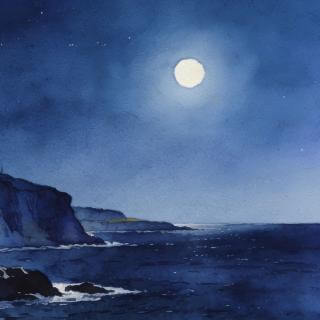
Washed in silver blue light.
A town of narrow roads and harbor lamps.
And an evening that seems to be in no hurry at all.
Here we begin the longest twilight.
By the time Ted arrived.
The hour should have belonged to the night.
He had checked the time on the ferry more than once,
As if a clock might explain the strangeness of the light.
Yet there it was,
Stretched across the harbor and the low hills beyond it.
A long,
Pearled twilight that refused to deepen.
The sky hovered between the blue and ash.
Between silver and lavender.
With a pale seam of brightness resting low over the water.
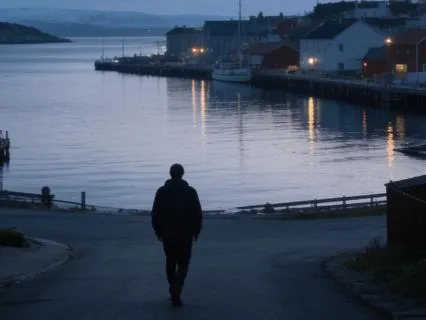
The town itself was small,
Little more than a harbor road,
A row of weathered houses,
A modest inn,
And the church with a dark steeple rising above the clustered roofs.
Nets hung to dry from wooden frames.
Coils of rope sat in neat circles along the dock.
Window panes caught the half-light and returned it in muted glimmers.
No one moved quickly.
Even the gulls seemed quieter here,
Their calls spaced farther apart and softened by the damp air.
Ted stood for a moment with his bag in hand and let the place gather around him.
He had come for work.
A navigation clock at the Old Harbor Observatory had stopped weeks earlier.
And the town council had sent for someone who knew how to tend delicate mechanisms.
He expected to stay only a few days,
Long enough to inspect the clock,
Clean its works,
Restore its rhythm.
And then leave again.
That had been the plan when he boarded the ferry that morning beneath a sky of flat grey.
And plans always felt more certain before they met a place with its own pace.
The innkeeper led him up the harbor road and left him in a room overlooking the water.
The bed was narrow,
The quilt heavy.
The windows old enough to murmur softly when wind touched the panes.
A tray of tea and oat cakes waited on the small table beside the bed.
And the room carried a scent of cedar,
Soap,
And faint sea air.
He crossed to the window.
The light had hardly changed.
At the sea lay a calm beneath the dark.
Its surface threaded with silver,
Where sky met the tide.
A rowboat touched its mooring post with a quiet,
Repetitive knock.
Across the water,
The far hills had turned dusky blue.
Their outlines softened as if the whole world had been drawn in charcoal.
And then lightly brushed by hand.
He should have been tired enough to sleep.
The ferry crossing had been long.
And the week before had been full of exacting work in the city.
Clocks?
Instruments.
A parade of small repairs requiring focused hands,
And a mind sharpened to precision.
Yet here in this half evening.
His thoughts didn't know where to settle.
The day felt unfinished.
Darkened.
Delayed,
He sat on the edge of the bed and waited for the room to feel complete.
It didn't.
So he rose again,
Left his coat open over his sweater,
And stepped back outside.
The harbor road was nearly empty.
A fisherman stood beside a crate of herring,
Pipe smoke drifting slowly over the stones.
Farther up the lane,
A child crossed with a loaf of bread held close to her chest.
A gate opened and closed.
Somewhere up the lane,
A kettle had recently whistled and fallen quiet.
No one seemed troubled by the lingering light.
It wrapped the town like a long thought.
One no one felt compelled to finish.
Ted walked without any clear destination.
Past the boathouse.
Past the churchyard.
Up a narrow path behind the observatory where wild grasses bent toward the sea.
The town grew quieter behind him until only the low wash of water against stone remained.
At the top of the rise he stops.
From there,
He could see the whole harbor laid out below.
The houses gathered close,
The roads curving inward.
The dock arms reaching into pale water.
The observatory stood nearby,
Its small dome dark against the sky.
The clock tower rising beside it.
Somewhere inside,
The stopped mechanism waited.
The thought of work didn't move through him the way it usually did,
Sharp and purposeful,
A narrow current pulling him forward.
Here in the long twilight.
Everything widened.
Ethan Obligation.
Even time.
He sat on a flat stone near the path and listened.
The sea gave a low,
Repetitive murmur,
As if speaking to itself.
Wind moved through the grasses in a dry,
Even sweep.
From somewhere below came the faint chime of a buoy.
Spaced wide apart by the tide.
The whole landscape seemed composed of intervals.
Nothing hurried toward the next sound.
Nothing strained for completion.
He drew his knees up and rested his forearms across them.
He has spent so much of his life moving toward conclusion,
Toward the repaired mechanism,
The balanced gear.
The solved problem.
The answer that clicked into place.
He liked things that resolved clearly.
He trusted them.
He knew how to work within their logic.
This place offered no such edge.
Evening did not end.
It thinned and softened and drifted.
Light did not vanish.
It lingered,
Transformed,
Leaned closer to night without fully surrendering.
And sitting there,
With the wind carrying the cold scent of the sea,
And the town below him held in blue-gray quiet.
He felt an unfamiliar resistance in himself begin to loosen.
He returned to the inn much later,
Though his watch offered no satisfying proof that night had truly begun.
He slept lightly at first,
Waking once to the pale glow still living at the curtains.
Then slept again more deeply than he expected.
In the morning,
The observatory greeted him with the same calm reserve as the rest of the town.
It was a modest building,
Older than he had imagined.
With a circular room at its center and a brass instrument mounted beneath the dome.
The clock he had come to repair stood in a side chamber,
Tall and lacquered,
Its case dark with age.
The pendulum hung still.
Dust had settled along the interior frame.
On the work table nearby,
Lay a note from the councilman.
Indicating there was no urgency.
Only a wish that the clock keep faithful time again.
The phrase settled into him as he unpacked his tools.
A spring needed resetting.
A pivot required cleaning.
The escapement had gathered a residue that slowed the release.
He knew the work.
He could have done it under brighter lights in a louder city.
Within the quick pulse of ordinary time.
Here,
Even his own hands seemed to move differently.
The town's pace had entered him.
He cleaned each part a little more slowly.
He listened longer to the click of each test rotation.
He paused between adjustments and let the mechanism rest before asking it to move again.
The clock,
For its part,
Seemed responsive to patience.
By midday,
A faint rain had begun to cross the harbor in long silver lines.
Ted could hear it on the observatory roof,
Then on the windows,
Then in the gutters outside.
The sound was steady and low.
Without drama.
He stopped his work for a moment and stood at the narrow window looking down on the lane below.
The town had grown softer in the rain.
Roofs deepened in color.
The road darkened.
Water gathered in shallow curves along the stones and carried the pale sky in broken reflections.
Still,
Even under cloud,
The day retained the strange half-light.
It wasn't dark,
Nor was it bright,
But the light held.
He worked through the afternoon in the same quiet rhythm,
And by evening had coaxed the clock back into motion.
The pendulum moved with a patient swing.
The escapement released its tiny measures cleanly.
The hands began once more to advance through the hours,
Though in this place,
Hours seemed less like divisions and more like weather.
When he stepped back outside,
The rain had passed.
The world smelled of wet wood,
Salt,
And stone.
Twilight had returned,
Or perhaps it had never fully left.
Washing the harbor in a luminous blue-gray calm.
That evening,
He walked the lower road by the docks.
Lamps had begun to appear in the windows,
Each one making a small golden room inside the long,
Cool light.
A woman folded laundry at an upstairs window.
A boy carried in firewood,
One armful at a time.
Two men repaired a net on the dock with movements so unhurried,
They seemed almost ceremonial.
The town had not stopped because the hour was uncertain.
It had simply learned how to live inside uncertainty with grace.
Ted felt that like a lesson settling around him.
For the next two days,
He remained,
Finishing the details of the clock and making smaller repairs within the observatory.
He mended a latch.
Cleaned a set of brass sighting rings.
Realign the cabinet door swollen slightly by damp air.
Nothing demanded strain.
Each task belonged to the same long breath the town seemed to share.
And each evening he walked.
He walked the rise behind the observatory.
He walked the harbor road.
He walked beyond the churchyard to the edge of the meadows,
Where the sea wind bent the tall grass flat in one direction,
Then another.
Always the same silver blue light.
Always the same sense that the world was holding itself in a state of gentle suspension.
At first,
He had wanted the place to choose.
To become night.
To offer a clean transition that would tell his body how to rest.
Yet over time,
He realized that the town needed no such certainty.
People lit lamps when they wanted warmth.
They drew curtains when they wanted privacy.
They rested when they were tired.
They didn't wait for the sky to define the hour for them.
The thought stayed with him.
How much of his own life had been spent waiting for a clear signal?
Waiting for things to feel finished before allowing himself to soften.
Waiting for a decision to become obvious.
For a season to declare its meaning.
For the day to close neatly before he could stop carrying it.
And here was a whole town living tenderly inside unfinished light.
By the fourth evening,
The twilight no longer unsettled him.
He could sense its textures now.
The way the harbor darkened first.
The way the windows warmed by contrast.
The way gulls gave up the sky a little earlier than the light itself.
He noticed how damp ropes deepened in color,
How stones near the tide line held a last trace of silver longer than the wood of the docks.
How the hills across the water became not less visible,
But more subtle.
That evening,
He climbed again to the flat stone above the harbor.
The buoy chimed in the same slow intervals.
The grasses moved in patient sweeps.
The sea gave its low,
Endless murmur against the land.
Nothing sought to resolve.
Nothing seemed diminished by remaining in transition.
He sat there until the town lamps below formed a loose constellation of their own.
Gold against blue,
Warm against cool,
Human-made stars beneath a sky still deciding what it wanted to keep.
And in that long suspended hour.
Ted understood something he had been too hurried to learn elsewhere.
The in-between was not empty.
It held its own life.
Its own rhythm.
Its own form of mercy.
Not every season asked to be solved.
Some asked only to be inhabited by them.
To be entered fully with less resistance and more trust.
To be lived through gently enough that their lessons could rise.
When he finally returned to the inn,
He didn't check the time.
He slept deeply that night,
And in the morning the room seemed simpler.
Clearer as if some small arrangement inside him had shifted into place.
The clock at the observatory kept faithful time now.
The sky remained soft and undecided.
The town continued exactly as it had before.
Only Ted had changed.
On the day of his departure,
He stood once more by the harbor before boarding the ferry.
The same road.
The same boat.
The same silver-blue seam along the horizon.
He looked toward the observatory on the rise.
Then,
Toward the inn windows.
Then out across the long water.
He felt no dramatic feeling of completion.
No revelation made larger than life.
Only a quiet certainty that something useful would travel home with him.
The fairy horn sounded again,
Low and even.
He picked up his bag and stepped aboard.
As the shoreline began to draw away.
The town didn't seem to recede so much as soften again into its own element.
Roofs.
Dock.
Church steeple.
Observatory dome.
All held in the long and gracious light of an evening that would likely continue for hours.
Ted remained at the rail for a while.
Watching until distance turned the windows into pinpricks.
And the road to a pale thread above the harbor.
Then he looked up.
The sky stretched wide over the water,
Still silver at the edge.
Still carrying that strange tenderness between ending and arrival.
And he felt in himself a new willingness to leave things there sometimes.
To let a question remain open.
To let a season stay uncertain.
To let a day soften without demanding that it explain itself before he rested.
The ferry moved on through the calm water.
Behind him,
The town entered its longest twilight.
Ahead of him,
The day did not yet need a conclusion.
And somewhere between the two,
Held by the sea and the dim steady light.
Ted allowed himself to belong to the in-between at last.
The end.
Tonight,
You traveled into a place where evening did not hurry toward night.
Where the sky held its light a little longer.
And where one man learned that unfinished hours can still be peaceful ones.
There may be places in your own life that feel suspended right now.
Questions without answers.
Seasons without clear edges.
Changes still unfolding.
And,
Like that northern town beneath its silver blue sky,
You don't need everything to resolve before you rest.
Some of the most tender moments arrive in the middle space.
In the waiting.
In the softening.
In the long twilight before a clear conclusion comes.
Let yourself rest there tonight.
Let your thoughts drift into gentler shapes.
You Let your breath move with the same calm pace as the harbor tide.
Let the edges of the day blur a little.
The way the town softened under its lingering sky.
Nothing more is required of you now.
You don't need to solve the whole horizon.
Before sleep arrives.
You only need this breath.
This bed.
This quiet.
And somewhere within you,
The same soft light remains.
Steady enough to guide you through the in-between.
Gentle enough to let you rest beneath it.
Good night.