Hello and welcome!
The tale I bring you tonight is called The Houseboat Garden.
It takes us onto a small houseboat moored along a quiet canal where a woman named Kara spends her evenings,
Preserving the delicate traces of the living world – reeds,
Wild herbs,
Late petals,
River grasses,
And leaves marked by weather.
In the warm hush of her floating home,
She presses each gathered piece between in paper and time,
Learning that beauty does not have to remain unchanged in order to remain with us.
Saddle in.
Let your shoulders lower.
Let your hands unclench.
Let your breath move at the calm pace of water meeting wood,
And imagine a narrow boat at dusk gently rocking against its moorings,
Its windows lit gold against the deepening blue of evening.
And with that,
The tale begins.
Tara's houseboat rested in a quiet bend of the canal where the water moved slowly enough to reflect nearly everything.
In the late evening,
When the air cooled and the sky grew pale at the horizon before dimming into blue,
The canal became a long ribbon of softened light.
Reeds gathered at the bank's impatient green clusters.
Willows leaned over the water,
Their trailing branches touching the surface in loose,
Wavering lines.
Here and there,
Small footbridges crossed from one towpath to another,
Their undersides mirrored in the dark water below.
The houseboat had once been painted a cheerful red,
Though years of sun and mist had worn it into a gentler color,
Something between brick and faded berry.
Its trim was cream-colored.
Its roof held a scattering of terracotta pots,
Where thyme,
Mint,
And lavender grew in small,
Fragrant abundance.
You At the bow,
A coil of pale rope lay beside a watering can turned silver at the seams.
The boat was narrow inside,
But full of order.
Shelves ran across the walls,
Fitted precisely into the boat's modest proportions.
Some held books,
Others jars.
Others,
Stacks of paper and linen-bound folios.
Along one side,
Beneath a row of brass framed windows,
Stood a long work table made of oak.
This was where Kara kept her garden.
She returned to it each evening after a walk.
One night,
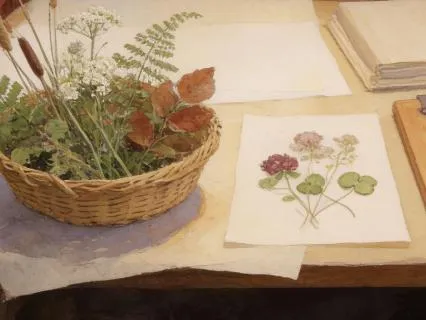
She came in carrying a shallow willow basket looped over one arm.
Its contents were gathered loosely.
Not arranged for display,
But resting as they had fallen into her hands.
A stem of wild yarrow.
A fan of maidenhair fern?
Three narrow reeds from the edge of the canal.
Two leaves turning bronze at their tips.
And a small cluster of clover blossoms,
Whose pink had already begun to soften.
She set the basket on the table and opened the nearest window a little farther.
Evening air slipped in.
Cool and faintly green with the scent of water and damp earth.
The boat answered with a soft shift against its moorings,
One gentle movement beneath her feet,
Then stillness again.
Kara stood for a moment,
With her hand resting on the edge of the basket.
There was gentle calm at this hour.
After the day's walking was done and before night had fully settled over the canal.
It came to her here,
In this floating room,
Among paper and petals and the small sounds of water touching wood.
A knock underneath the hull.
A creek in the rope.
A quiet tap of leaves against the side window where a willow branch leaned close enough to listen.
She picked up the arrow first.
The stem was slender and a little crooked.
Its white blooms flattened in places from where it had rested against the basket.
She turned it in her fingers and noticed the faint scent that still clung to it.
Green,
A little bitter,
Almost peppery.
There was nothing extraordinary about it.
That had always been part of the point.
Her garden wasn't a collection of rare specimens.
It was a record of passing beauty.
The small and ordinary things that would have gone unnoticed had she not paused long enough to carry them home.
She laid the arrow on a waiting sheet of blotting paper and reached for another.
Each piece she had gathered came from the same path and carried its own atmosphere.
The reeds held the cool hush of the canal edge.
The fern carried a woodland shade from the bank where the towpath dipped into a stand of alder trees.
The clover blooms still seemed warm from the meadow where she had found them.
It made her smile that that place could linger so gently in a stem or a leaf.
Kara had begun her garden years earlier,
Soon after she moved on to the boat.
At first,
It had been little more than a way to mark the seasons.
A pressed violet in spring,
A buttercup in early summer.
A yellow leaf from the first autumn she spent on the water.
But over time,
The practice deepened into something quieter and more sustaining.
She no longer gathered only to remember when a plant had bloomed or where she had found it.
She gathered these things because the act of noticing changed the shape of the day.
Walking became slower.
Looking became more precise.
She saw how many kinds of green could live in a single hedgerow.
How some petals held color more faithfully after rain.
How the undersides of leaves often carried a gentler version of the hue displayed above.
Attention itself became a kind of shelter.
Now,
Each evening,
She brought a little of that attention back to the boat.
She crossed to the shelf above the table and lifted a linen folder filled with clean sheets of pressing paper.
Beside it sat two heavy wooden boards,
Cut exactly to size,
Smooth at the corners from years of use.
She arranged the materials in their familiar order.
Blotter.
Sheet.
Specimen.
Every movement was quiet,
Exact.
And kindly pace.
The boat gave another small sway,
And the brass lamp hanging above the table shifted almost imperceptibly.
Its light moved across the oak in a warm oval,
Touching the basket rim,
The edge of the paper,
The slight curve of Kara's wrist.
She placed the fern next.
Its fronds were delicate and airy.
Each tiny leaflet perfectly spaced along the stem.
It would flatten beautifully,
She knew.
The best specimens always carried themselves lightly even before pressing,
As if they understood how to yield to preservation without losing their grace.
That thought stayed with her as she moved through the basket.
So much of life,
She had learned,
Involved exactly that.
The boat itself was proof.
It was moored,
Yes,
But never rigid.
It shifted with current.
Weather.
Passing wake.
It yielded to movement and,
Because of that,
Remained steady.
The pressed plants also changed form in order to remain.
A flower fresh in the hand could not be kept forever.
But pressed between paper,
It entered a different kind of life.
Flatter.
Quiet her.
More fragile,
Perhaps.
And capable of lasting far longer than bloom alone would allow.
Kara rested both palms on the table and looked toward the shelves that held earlier folios.
Each volume contained pages of carefully mounted flowers and leaves,
Neatly labeled in her handwriting.
Many were dated.
Some included the names of places.
Towpath after rain.
East bank at dusk.
Hill Meadow in late May.
Canal Lock in Morning Miss.
Others held no more than the plant itself and the memory she alone would understand.
There was a stem of rosemary from her first winter on the boat,
When she had been lonelier than she let herself admit.
A pressed poppy petal from a June afternoon so bright it seemed to hum.
A line of river moss,
Gathered after flood water had receded,
Still carrying its deep mineral scent even days later.
An entire page of maple keys from a windstorm that had turned the towpath into a quiet,
Spinning map.
Her garden had become,
Without her intending it,
A record of inner weather as much as outer season.
She could turn its pages and remember not only what bloomed,
But how she had felt while noticing it.
She returned to the table and began placing the first completed layers between the wooden boards.
The pressure would be gentle at first,
Enough to begin flattening the stems and petals.
Enough to draw the first moisture into the blotting sheets.
Tomorrow she would tighten the straps around the boards a little more.
In a few days,
She would change the papers and reset the specimens.
Some would be ready within a week.
Others,
Especially the thicker stems and clustered blooms,
Would need a little longer.
Time entered the work as naturally as touch.
That was another reason she loved it.
Nothing in her garden could be hurried into beauty.
It had to pass through a stage of quiet,
Unseen becoming.
It took time.
The gift arrived later,
After patience had done its work.
The evening outside deepened.
A narrow boat moved slowly along the canal,
Its engine low and subdued.
The wake reached Kara's hull in two soft pulses.
The hanging lamp above the table trembled faintly,
Then steadied.
Along the bank,
A blackbird offered its last notes of the day before falling quiet.
Kara secured the wooden boards with linen straps and set the press aside on the lower shelf.
Then she drew one of the older folios toward her and opened it at random.
Her page offered wildflowers from late spring.
Stitchwort.
Speedwell.
A single buttercup.
And a spray of cow parsley so fine it looked almost like frost.
The colors had softened over time,
But somehow remained distinct.
Blue gone to dusky sky.
Yellow,
Mellowed to cream.
Green-turned sage and pale olive.
The forms remained elegant in their reduced life.
No longer vivid,
But still entirely themselves.
She brushed one fingertip lightly over the edge of the page.
She felt a sense of comfort in knowing that beauty could remain after change.
Present.
Held.
Translated into another form.
There was a time when she thought preservation meant keeping things exactly as they were.
Holding on tightly enough that nothing could fade.
Age had taught her a gentler truth.
To preserve something was often to let it become quieter,
Smaller,
Less immediate,
And more enduring.
The canal outside had taught her that as much as the plants had.
Living on water had softened her relationship to permanence.
Drawers shifted a little with the weather.
The cups rang softly together on their hooks when a boat passed by too quickly.
The horizon outside the window changed with the mist.
With the rain,
With growing reeds,
With swans arriving and leaving.
Even the light inside the cabin moved differently from one hour to the next.
Shaped by current and cloud and season.
And within all that change,
The boat remained home.
The pressed flowers remained flowers,
And the leaves remained leaves.
She remained herself,
Though surely quieter in some ways than when she had first come to live there.
She closed the folio gently and returned it to the shelf.
On the work table,
One clover blossom had rolled free of the basket and come to rest near the edge of the lamp's circle.
It was too small to press well.
Already folding in on itself.
She picked it up between thumb and forefinger and held it right under her nose.
The aroma had nearly vanished,
But a trace remained.
It smelled green,
Faintly sweet,
Almost more memory than aroma.
She smiled and carried it to the little dish by the sink,
Where she placed spent petals and stems that had reached the end of their keeping.
She tried not to waste anything here.
What could not be pressed returned to water or compost or soil in the pots above decks.
Even endings had their own usefulness.
When the table was cleared and the papers stacked neatly again,
Kara stepped outside.
The canal had darkened to a deep reflective blue.
Lamps burned in a few distant windows.
Her roof herbs released a faint fragrance where the night air cooled them.
Thyme and lavender and mint mingled with the damp,
Mineral scent of water.
She sat on the small bench at the stern of the boat and drew a wool blanket around her shoulders.
Around her,
The world seemed held in a stillness so complete,
It felt almost visible.
A fish rose near the reeds,
Leaving a ripple of widening rings.
Farther down the canal,
A lock gate moved with a low wooden groan.
The branch of the willow brushed the window again.
A soft sound like fingertips on paper.
Kara rested her head back against the cabin wall and looked up.
The sky above the canal was not fully dark yet.
A dim pearl of evening still lingered behind the silhouettes of trees.
One star had appeared near the western edge,
Faint at first,
Then steadier as the sky deepened.
She thought of the fresh plant life pressed inside.
The yarrow stem giving up its moisture,
The fern settling flatter between papers,
The clover petals beginning their quiet transition from bloom to memory.
All of them held in darkness and pressure,
Becoming something that could last.
A feeling of tenderness arose in that process.
It felt almost like prayer.
The world moved so quickly in so many ways.
The blossoms opened and fell.
Rain rose and returned.
Summer green shifted to autumn bronze.
Days gathered their small brightness and dimmed again.
Here on this boat.
She had made a practice of meeting passing beauty with enough attention that it didn't have to disappear completely.
The water tapped again against the hull,
Then once more.
Kara closed her eyes and let the rhythm of the boat settle through her spine.
The day had folded itself down into a manageable shape.
The pressed boards waited below deck.
The folios stood quiet on their shelves.
The canal carried its own dark,
Unhurried current through the night.
She didn't feel the need to demand any more from the evening.
In the morning,
There would be tea.
A walk along the toe path.
New stems,
Perhaps.
Maybe none at all.
The turning of pages.
The changing of blotters.
Another quiet arrangement of whatever the season offered.
For now,
She had the water.
The herbs.
The paper,
For Boat.
The gathered stillness.
And that was enough.
The end.
Take a slow breath in through your nose.
Let it arrive gently as if carried by water,
Then let it go.
Tonight,
You drifted beside Cara through a quiet canal evening,
Into a warm cabin filled with paper,
Pressed leaves,
And the soft work of preserving delicate things.
In that stillness,
There is a gentle reminder Beauty doesn't have to remain unchanged in order to remain with us.
Some things stay in fragrance.
Some in memory.
Some in form softened by time.
And some simply in the way they taught us to notice.
As you rest now,
Imagine your own day being laid gently between clean sheets of paper,
Held only with enough care to let its edges soften.
Let your thoughts flatten into quiet.
Let your breathing move with the same patient rhythm as the water beneath the boat.
Let whatever felt too bright or too heavy become simpler now.
Quieter.
Lighter in your hands.
You don't need to preserve everything.
Only what's worth holding lightly.
Tonight,
What remains worth holding is rest.
Let your body grow heavier.
Let the room around you dim.
Let the inner pages of your mind become soft and still.
The water keeps moving.
The boat stays held.
And you can drift gently into sleep.
Good night!