Hello everyone,
Welcome.
To the session one,
The four paths to truth.
Today I want to start with a simple observation.
Have you ever noticed how different people are when it comes to spirituality?
Some people love singing bhajans and chanting.
They can sit for hours in devotion and their heart feels full.
Others aren't drawn to that at all.
They would like.
To spend their time.
In helping people,
Serving a cause,
Or making a difference in the world.
Some people love meditation.
Give them silence and a quiet room.
And an hour to sit and they are completely happy.
And then there are those people who keep asking.
Some deep questions.
Like who am I?
Why am I here?
What is consciousness?
What is truth?
Maybe some of you recognize yourself in one of these.
The beautiful thing is,
That none of them are wrong.
In fact,
The ancient sages recognized these.
Concepts long ago.
They understood that human beings are different.
What inspires one person?
May not inspire another.
What happens?
With one person.
May not happen with another person.
What opens.
One person's heart,
May leave another person completely untouched.
So,
Instead of creating one path for everyone,
They described four major pathways to truth.
And I love the metaphor they use.
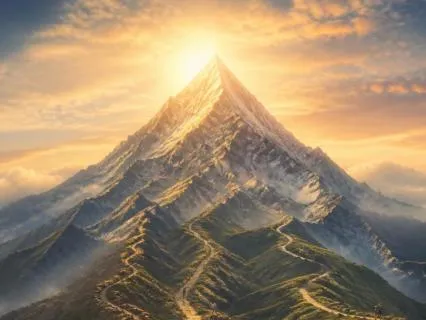
They said truth is like a mountain.
There's only one summit.
But there are many trails leading to it.
One person may climb from the north side.
Another may come from south.
A third may take a winding path through the forest.
The roots look different.
But they all lead to the same peak.
The first part.
Is called Jnana Yoga.
The path of knowledge.
Now when we hear the word knowledge,
We usually think about information,
Books,
Learning.
Or becoming smarter.
But that's not what this path is all about.
This path is about one question,
Who am I?
Not your name,
Not your profession,
Not your nationality.
Not your personality type.
Who are you really?
Think about it.
Your body has changed since childhood.
Your thoughts change every day.
Your emotions come and go.
Even your beliefs evolve over time.
Something has been present all through it.
Something has been watching every experience.
Gyan Yoga is the exploration of that something.
It's less about collecting answers.
And more about removing.
Misunderstandings.
It's like cleaning a window.
You don't create the sunlight,
You simply remove.
Was blocking it.
The second path is bhakti yoga,
The path of devotion.
This path is completely different.
The person on this path is not trying to figure out.
Everything.
They are trying to fall in love.
For them,
Spirituality is a relationship.
They sing,
They pray.
They remember the divine,
They surrender.
IF GYAN ASKS Who am I?
Bhakti asks,
How deeply can I love?
And something beautiful happens.
The more love grows,
The smaller the ego becomes.
The walls start dissolving.
Eventually,
The devotee discovers that the distance between themselves and the Divine was never really there.
The third part.
Is Karma Yoga the path of action?
Now this path is specially relevant to cause.
Most of us spend our lives working.
We have jobs,
Families,
Responsibilities,
Meetings,
Deadlines.
Projects.
The beauty of Karma Yoga.
Is that it does not ask you to leave.
Your life behind.
It says,
Use your life as a practice.
Do your work.
Serve people.
Fulfill your responsibilities.
But stop making our happiness dependent on the outcome.
Most of our suffering comes from the attachment.
We work.
And immediately ask.
Will I get recognition?
Will I succeed?
Will people appreciate me?
Will I get what I want?
Karma Yoga teaches us.
To act wholeheartedly and then let go.
Do your best.
Offer the results.
Move on.
When do you do that?
Think about it.
But when you do that.
.
.
Work becomes lighter.
Service becomes joyful.
And slowly the ego loosens its grip.
Now the last and the fourth path is the Riya Raja Yoga.
The path of meditation.
This is the path many people are familiar with today.
The basic observation is simple.
Most people's mind never stops.
One thought follows another,
Then another.
Then and then there.
We are constantly replaying the past or rehearsing the future.
Rajyoga.
Teaches us how to become still.
Through breath.
Concentration.
Discipline.
And meditation.
The mind gradually settles.
Imagine a lake on a windy day.
The surface is disturbed and you can't see anything clearly.
Now imagine the same lake becoming completely still.
Suddenly everything is reflected perfectly.
The mind works the same way.
When it becomes quiet,
Reality becomes clear.
And in that stillness,
We discover a peace that was always present beneath the noise.
So if I had to summarize these four paths in one sentence,
I would say.
On the path of devotion.
The heart melts.
On the path of action,
The ego softens.
On the path of meditation.
The mind becomes still.
And on the path of knowledge,
The illusion of separation disappears.
Different paths,
Same destination.
Now you might be wondering,
If all four paths are beautiful,
Why are we focusing on the path of knowledge in this course?
Because at some point in life,
Almost every human being encounters a deeper question.
Maybe you have achieved success.
Maybe you have built a career.
Maybe you have accumulated experiences.
Maybe you have done everything.
And you thought.
Would make you complete.
Even after all of this.
Yet something inside quietly asks.
Is this all there is?
What am I really looking for?
What is that I truly want?
Most people think they are searching for money relationship.
Security or success.
But if you look carefully,
What you are really searching for is the lasting peace.
Lasting fulfillment.
Something that doesn't come and go.
The path of knowledge begins right here,
Not with the answer,
But with honest questions.
And what makes this path unique is that it does not ask you to believe anything.
It does not ask you to adopt a new identity.
It does not ask you to join a religion.
It simply says,
Look at your experience.
Look at for changes.
Look at what remains.
And look at the awareness that is present right now.
As we move through this course.
We are going to explore that together.
Not as a philosophy,
Not as a belief system.
But as a direct investigation into the nature of who we are.
And perhaps the greatest discovery waiting for us is this.
You are not moving towards the truth.
You are Truth itself.
Temporarily forgetting and then remembering its own nature.
That is the journey.
And that is where we begin.
That's all for today.
Thank you all and I'll see you in the next session.
Namaste.