Some of the most consuming and exhausting thoughts are mostly the thoughts which nobody is listening to.
These are thoughts which are just playing in our mind,
Within us,
And nobody is listening to them.
Now.
Imagine you have sent a message to somebody and the person has not even replied.
There is a meeting which is supposed to happen maybe tomorrow,
Not yet has happened.
Or a decision which you are eagerly waiting but the decision has not yet been made.
But while all these events which have not happened,
Our mind has already made a decision.
Visualized or thought or has seen all of these events happening.
And we have thought of five different situations,
Three different instances and several answers and responses and have planned how would we handle those situations.
Mind you,
They have not yet happened.
Now,
We call it overthinking,
But yoga looked at this situation a problem in a very different way.
Yoga said,
Let's understand or let's find out what actually is happening with these movements of the mind.
Like what is really happening when there is so much of working which is happening in the mind.
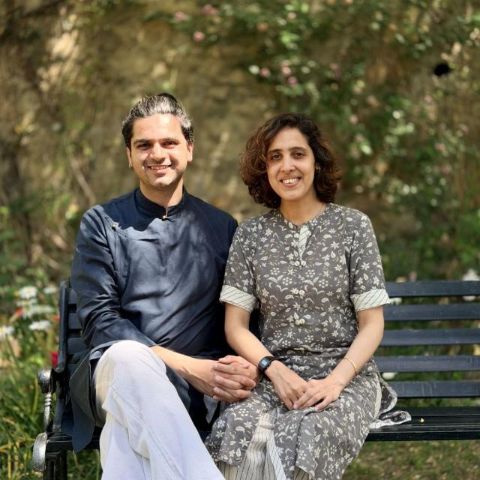
My name is Aarti.
Namaste.
I am from Yuga.
And today I want to show some of the most practical methods of the yoga philosophy.
Let's start from understanding what is overthinking.
Overthinking is actually not just one simple clinical diagnosis or a complicated one also.
It is slightly more,
Slightly deeper than that.
Psychologists also use this thought these days wherein the mind is repeatedly,
Constantly thinking mostly negative about what is going to happen,
What will happen,
What if I did this,
What if I did that.
I'll give you an example.
For instance,
We all several times go through these situations wherein We sit and say,
Oh,
I wish I had not said that to that person.
I wish I had not done that.
And,
You know,
Now what is going to happen?
What are they going to think?
And,
You know,
What is it going to be like?
So all of these thinking and the planning and overthinking and repetitive thinking is constantly playing in our minds.
Now,
Thinking is not the problem.
Thinking is important.
Thinking is very critical.
But thinking repeatedly without reaching anywhere is definitely going to be very exhausting and I'm sure we all go through that.
Now,
Several thousands of years ago,
When we didn't have words like cognitive loop or rumination,
But at that time,
Yoga sutras were constantly worried about the workings of the mind,
Like what exactly is happening,
What exactly is playing.
And I'm going to bring two important words at this stage from Sanskrit,
From the sutras,
The first one being and the second is vrittis.
So,
Without paying attention on the pronunciation,
Etc.
,
We'll loosely understand.
So,
Chitta means the functioning or the field of the mind.
And vrittis are the movements or the modifications or the fluctuations of the mind.
An example here simply could be,
Imagine the surface of water and the wind creating ripples at the surface.
Now,
These ripples are actually the perceptions,
Our thoughts,
Our memories,
Our imagination,
Which are creating these multiple movements in our mind all the time.
Now here I want to say the Yoga Sutras,
Patanjali,
Sage Patanjali gave us a beautiful explanation or a Sutra here which is Yogaha Chitta Vritti Nirodaha.
The Chitta and Vritti we spoke about So it simply says that yoga involves or can lead to or means the stilling or the settling of the movements,
The fluctuations or the modifications of the mind.
You know another sutra,
I will not complicate it for you,
But another sutra which helps us understand more about overthinking and it says that when we are engage in these movements,
Remember the modifications of the mind,
We mostly start to identify with those movements.
I'll try to give an example.
For instance,
Think about this,
You know,
We seldom say things like,
I think I'm going to just fail,
You know,
In this particular thing.
And then the next thought comes,
I am definitely going to fail.
And the following one,
Is.
I am such a failure.
So it started from one movement which is I might fail.
Then came a prediction or sometimes the verdict that I am going to fail and then followed by that I'm identifying with myself with the fact that I'm a failure.
So how,
You know,
This movement which came in is not just a thought now.
We have stepped inside that thought.
We have started to live inside that thought.
We are thinking that this is the reality,
Which is actually not the truth.
Like,
You know,
Modern psychology also draws an interesting parallel here,
Which with a similar concept of de-centering,
Which says recognizing a thought as not a real fact but identifying it as just an event,
Like something which is playing in your mind,
Like you are speaking about the movement of the mind and not automatically just accept it or start to believe it as it's a fact.
So,
Slightly taking it further,
Like what happens when a thought comes to our mind or we are constantly overthinking thinking and we know that it's irritating us.
We mostly start to suppress it.
We try to stop it or we say,
Okay,
I will not think about it and I will forget about it.
It does not exist and I will not stress too much about it or finding multiple methods to press it down.
But unfortunately,
The suppression or forcibly you know,
Quiet,
Quietening these thoughts.
Are mostly not working out because mostly the thought is going to come back more strongly and impact us or hurt us more deeply this time.
But yoga has an interesting view about it.
Yoga says stillness has nothing to do with fighting with the mind.
We don't have to have a competition with the mind here.
We don't need to really force it.
Rather,
It says work towards changing your relationship with these movements.
Instead of pushing them down,
Let's try to have a different relationship with them.
Another saying by Sage Patanjali,
Which talks about two new words I'm going to bring in Abhyasa and Vairagya.
Now Abhyasa is the practice of returning again again and again.
And Vairagya is the practice or the learning to not focus or not engage in everything.
For example,
A practice wherein I train to come back to it again,
Train to come back to it again,
Train to return to it so that I master and slowly perfect that situation,
The practice.
And then the vairagya or detachment like,
You know,
Not necessary that I have to listen to or pay attention to everything that I see or everything that I listen.
Trying to disengage or loosen up a little bit and say just loosening up the grip there and just not bothering about some of the aspects.
Now let's try to experience it.
So a small little practice wherein we can all you know you could be sitting down or you could be in a chair or sitting down on the floor as you're comfortable and if you prefer you can keep your eyes closed and And as we close our eyes,
We sit comfortably.
And slowly just bringing our focus.
To the breath.
Just watching and observing.
The breath is coming in.
And the breath is slowly going out there is no change we are not increasing the speed we are doing nothing just in Now just watching where it's coming in and going out.
Just being there for a few seconds.
Now there may be a situation or a point where a thought slowly might come in.
Now I want you to notice that a thought has come in.
Just simply noticing it.
It could be that you're thinking something.
Or maybe the mind has already gone planning something or you're remembering something.
It can be any of these.
Now as you have noticed it and you have identified the thought,
Slowly.
Return back to the next breath,
Leaving the thought aside.
We do the Abhyasa,
The practice of coming back to the breath.
Once again inhale Exhale,
Just watching the breath.
And now maybe another thought will surely come in and as you have identified,
You have noticed,
You have seen the thought has come in again.
Identify what is this thought.
And slowly.
Detach with it.
Not important right now.
Can wait for some time.
Or not relevant,
Just coming back to the breath.
So,
The practice here which we are trying to slowly develop is not focusing on that a thought should not appear or suppressing the thought.
Rather,
It is that a thought came and I noticed the thought.
I am aware that the thought has come.
So the next time you are in the spirals,
Of the mind and the mind is playing with you or there is too much of overthinking.
Don't try to stop it.
Don't begin by saying,
Oh,
Quiet,
Quiet,
Quiet.
I don't want to listen to you.
You should just go away.
Rather,
Start with noticing it.
Notice the thought.
Notice what has come.
Try to identify it,
Try to see it,
Try to become aware of it.
And then slowly try to come back.
Let it go.
Come back.
And this time.
The thought is still there,
But along with the thought being there,
You are fully aware that the thought is there.
And that small gap is the beginning of the practice.
Thank you so much for practicing with us.
See you soon.
Namaste.