Aum NOOOOOOOOOOOOOOOOOOOOO The End Om Shanti Shanti Shanti!
Let's start with a fun fact.
Our heart does not beat at the same speed as we breathe.
So,
It's not 100% synced.
As we inhale and exhale,
The heart is not beating at the same speed.
Now when we inhale,
Our heart rate goes up.
And as we exhale,
The heart rate tends to lower down.
It's a very normal phenomenon,
Has a very intimidating name in science,
Which is called respiratory sinus arrhythmia,
Something like a tongue twister for me.
So.
.
.
That is a little bit of a science,
But let's try to just simply think about this,
That what happens to my breathing when I am stressed,
When something goes wrong,
I'm running late for work,
Somebody is extremely annoying,
Or something really bad has happened.
What happens when I've missed a deadline and things are not going the way they should be?
What happens to the breathing at that time?
It tends to get faster,
It becomes slightly out of control,
We are gasping for breath.
And of course,
The heart is beating at a much faster speed and much faster rate at that time.
Breathing does not only respond to how we are feeling.
Our state of being,
Our state of mind.
Does not just impact our breathing,
But.
Also.
If we change the way we breathe.
That can also impact and influence.
The way we feel and how our state of being is.
Namaste.
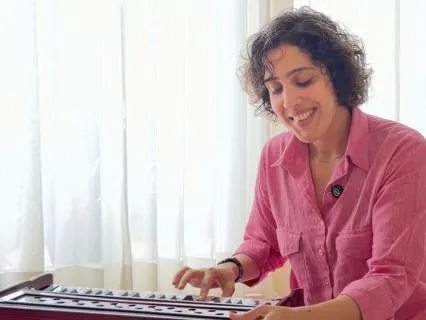
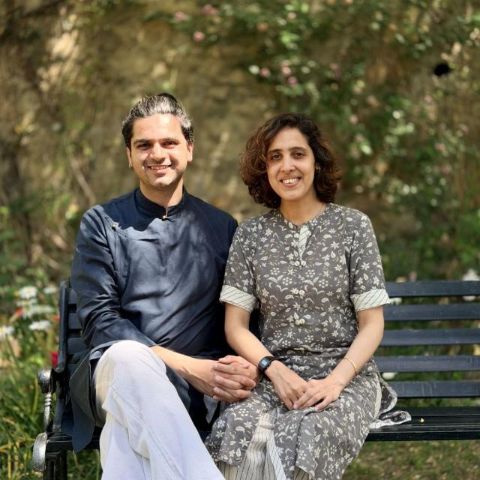
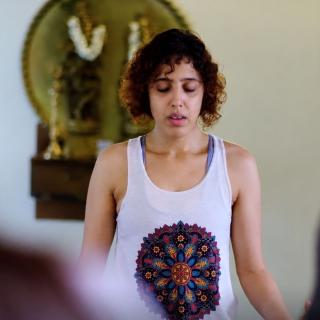
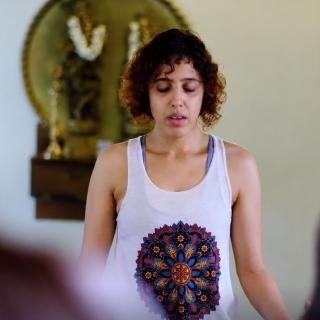
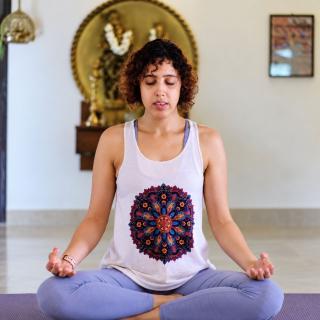
My name is Aarti.
And let's start with the point that yoga as a philosophy has been working for centuries on this point.
Now let's try this out for a minute.
Let's not just arrive at a conclusion right up.
Let's try to get a little bit of feeler here.
So,
You know,
If you can comfortably feel your breath,
You know,
Just being there,
We can just feel the breath.
Our natural breath is coming in.
No forcing,
No effort we are making of pulling the breath in or exhaling.
Just simply we are noticing how a breath is coming in and how a breath is going out.
Just being there.
Now take another natural breath.
How it comes naturally.
And this time.
Try to slow her down.
The exhalation.
Slow down the speed at which it is leaving.
We are not making any decision yet whether it worked or it did not work,
You know,
Nothing like that.
We are simply noticing and observing how and what is happening.
Now your breath and heartbeat,
They are in a conversation with each other.
So every breath you take has a rhythm for the heart.
And pranayama in yoga is only making this relationship more conscious so it's not creating a new relationship it's not you know bringing in something which does not exist The science already has established and we have enough facts to say that this relationship is there.
In one sense,
What it's actually doing is it's only making the whole work more conscious and leading to this relationship being more effective and efficient.
The moment we hear breathwork,
You know,
A breathwork session,
A breathwork class,
We start to pull in huge inhalations and,
You know,
There is,
You know,
Different guidelines and different guidance everybody is guiding it at.
But does that really mean the work of the breath or the goal is not bigger breaths?
The goal is basically slower and better.
Comfortable breathing.
That is the real goal for us to achieve.
It both from the philosophy of yoga and also science.
We will learn more about it but simply put slow breathing can change the conversation between your breathing Your heartbeat.
And your soul.
Blood pressure regulations and of course the autonomic nervous system.
Now the heart is not working all alone,
You know,
All three of them,
The breathing,
The heart rate,
The breath pressure,
They are constantly communicating,
They are influencing each other.
A little bit of science here.
So,
You know,
There is something which is called the pressure sensors inside our blood vessels.
Now,
These pressure sensors are typically working like a thermostat for the blood pressure,
Which is called,
This pressure sensors are called the barometer,
Word is not important,
But the work is that it's a thermostat.
So,
The moment the pressure changes,
The pressure sensors,
They send a signal to the brain to make the required changes.
Sometimes it is tiny adjustments to the heartbeat,
Tiny adjustments to the pressure in the blood vessels.
So that is the job.
That is one thing.
The work of the pressure sensors.
The other aspect is that just simple breathing,
Breathing in,
Breathing out,
Is also creating a type of oscillation,
A type of a rhythmic change in our overall blood pressure.
Now,
So imagine.
Three rhythms,
The breathing in and out,
The heartbeat,
And the blood pressure regulation.
All of them are actually interacting with each other.
Constantly,
They're dancing with each other in a symphony,
So to say.
So any change,
You know,
Will make an impact to all three of them.
And mind you,
They are interacting without us really thinking about them.
They are doing their,
They're ongoing with their job.
Now imagine this,
That you are pushing a child on a swing.
Now if you will randomly give the push,
It will obstruct the movement.
The movement will not be in a simple nice pleasant flow.
But if your push comes at the right time the push comes with the with the right flow then Firstly,
The push has to be much less of an effort.
And secondly the swing is going to be more comfortable and more enjoyable and it is not going to be an obstruction.
Slow breathing,
Say 5 to 7 or 6 to 7 times per minute for normally an adult.
Can hugely impact health.
Or work with the cardiovascular system or the feedback system,
Which is called the resonance effect.
Simply.
The heartbeat,
The breathing,
And the blood pressure regulation.
They can be more organized if they are flowing in a beautiful,
Slow rhythm.
The catch here is that the rhythm is extremely important because it really means here.
Now.
Another misconception is that a perfect healthy heart should beat like a metronome.
That's not quite really true.
Timing or between the two beats.
Automatically changes,
Naturally changes and this phenomena is called the HRV,
Which is the heart rate variability,
Which simply means that,
You know,
With the changing environment,
You know,
Things will change.
The rhythm or the timing between two heartbeats will change.
That means that slow rhythmic breathing can directly make a huge impact and make it extremely pronounced and make impact on the overall system.
Now that gives us the conclusion here is that for a human to be physiologically steady,
It does not mean that everything has to be flat and everything has to be just the same way all through.
No,
Rather in most cases,
A healthy system is mostly a system which can adapt which can manage the changes very efficiently and effectively without falling down.
Now another simple way to understand this could be the understanding with the heart muscles which is called the myocardium.
Now the myocardium,
The heart muscle needs energy and needs oxygen for it to perform its functions.
Hence a breathing pattern or how the rhythm of the breathing is in that particular moment makes a huge impact or influence on the overall cardiovascular system because the myocardium is dependent on the energy supply and the oxygen supply.
Now let's simply understand this that if slow breathing we can easily arrive at this conclusion that if slow breathing is leading to a drop in the heart rate and is also dropping or reducing my blood pressure,
Then it can be arrived that the heart is now making less effort or there is less work for the heart here.
So,
Does that mean if I breathe slowly,
And I feel relaxed is because I am taking in more oxygen and I am putting more oxygen in my system.
Not really,
Not quite actually.
So most people,
Because when they are healthy,
They are already well oxygenated.
So,
You know,
It doesn't need that we need to pump in more oxygen.
A required amount is already there.
So the heart is already well oxygenated.
And if we work to take in more oxygen,
That can actually be counterproductive,
Because with that you will also be exhaling more carbon dioxide which means it can cause you dizziness it can cause you lightheadedness and and all of those things can can happen to appear.
The interesting thing here to remember is the ventilation efficiency of and the carbon dioxide regulation which means it's not just about stuffing more oxygen in my system,
Rather most important thing to understand about the whole a breath work here is that.
Slow breathing does not mean huge,
Long,
Deep breaths.
And calm breathing does not mean that I have to breathe more.
And I have to take more breaths.
Rather it means that I have to breathe more efficiently and more effectively so that the rhythm that we talked about can be managed.
Now I want to bring in the yoga philosophy here.
Very old pranayama technique here comes to a very influential play.
And in yoga as a philosophy,
Breath is not just about in and out.
It is not just about oxygen coming in and carbon dioxide is going out.
It is slightly more deeper.
It is the work of regulation of your breath.
And with practice with time gradually with the with the learnings of the yoga philosophy.
Eventually,
It leads to the regulation and increase of prana itself in your system.
Now Swami Vivekananda actually gives a very useful way to look at this aspect.
He says that let us begin with something which is gross,
Something which we can feel like the breath.
Let's start with that.
And use the breath or look at the breath as a doorway to something more subtler which is the prana and another deep rooted system in yoga and really you know deep here which also talks about you know how When one is progressing in their pranayama techniques and practice,
Gradually one can also work at lengthening the exhales.
Which is for it to be a 1 is to 2 ratio.
Example,
If I inhale for a count of 4 which is 0.
1,
2,
3,
4,
Then my exhale has to be a count of 8.
So,
1 is to 2 is the ratio that is given by one of the schools.
But remember that the word here is gradually,
It is progressive work that as you gradually become there and you're ready and your system is ready and it's not that we are forcing it and we are forcibly holding a breath to to meet that count it has to become smooth and and you know naturally it should come and gradually it should come so that is That is the work.
Which yoga also talks about,
Which is a parallel drawn there,
That the heart rate tends to rise as we inhale and it tends to drop as we inhale,
Which means it is eventually a calm,
Rhythmic breathing,
Which is giving a direct impact to my system.
And talking about this also brings in the point that there are researchers who hugely support the slow rhythmic breathing and its impacts and validate that it is working.
But in some of the researches,
There is a comparison which is being made between the 1 is to 2 ratio and the 1 is to 1 ratio.
And which means long exhalations versus equal inhalation and exhalation.
1 is to 2,
2-1 is to 1.
And some of the researchers here support longer exhalations and say that they are really working.
And the others actually are not saying that they could find very meaningful difference between the two ratios here.
So that's interesting for us to know and that actually brings us to a conclusion that slow rhythmic breathing maybe by itself is doing most of the work.
Majority of the work just gets done if one is just practicing or is working on slow rhythmic breathing and the longer exhalations is a beautiful tool.
It is a great way to go further deeper gradually,
But it's not some magic ratio that will work or it's not the law for a human physiology that only a certain ratio is going to work.
So just slow rhythmic breathing is fantastic.
Now why,
You know,
If slow rhythmic breathing is working so well,
Then why should one practice longer exhalations.
Now it has its meaningful results also.
It definitely slows your overall breathing rhythm.
It makes your inhalations much better,
Much smoother,
And they are not rushed.
And of course,
It impacts the overall system more deeply.
And most importantly for me personally,
Your exhalations are Do not rush.
You let the exhalation finish completely.
And then you move on to the next one.
Now,
Let's take a pause with all the talking here.
Let's try to experience something here.
Let's try to also feel if there is a difference that we could feel.
So come,
Let's try to do a little short practice.
You could be sitting down or sitting in a chair.
Comfortably.
You could choose to keep your eyes open or closed.
Or as you prefer.
Your hands can be rested comfortably.
And complete relaxation for a few seconds.
And we will begin with just simple natural three rounds of There is no force.
There is no push.
We are not working at equal or unequal breaths right now.
Just simply let the natural breath come in as we inhale.
Simply the natural breath is coming in as we inhale.
And the breath goes out as we exhale.
One more round,
Inhale naturally as per your own rhythm.
Exhale as per your own rhythm.
One last time.
And now if we have got comfortable with our natural breath and the natural pattern,
Let's add a little count there.
So we begin with inhalation.
A count of 4 and exhalation to a count of six.
We will perform three rounds of this.
Slowly begin to inhale.
Remember slow,
Comfortable,
Rhythmic breaths.
Inhale two,
3 forward.
Exhale.
Two.
Three.
Falls.
Five,
Six,
Inhale.
2 3 4 Exhale 2,
3,
4,
5,
6 One last time,
Slow,
Comfortable,
Inhale.
2,
3,
4 Exhale 2,
3,
4,
5,
6 Just simply observe.
Now let's try to increase the count of the exhale.
And observe two rounds of slightly more longer Exhalations.
Inhale,
Slow,
Comfortable breath.
2,
3,
4.
Exhale,
2,
3,
4,
5,
6,
7,
8.
Inhale 2,
3,
4 Exhale 2,
3,
4,
5,
6 7 8 simply observe Do not judge.
Do not conclude.
There is no force.
There is no push or pull.
Just simple,
Natural,
Slow,
Rhythmic breaths.
Return back to your natural breath.
Natural inhalations,
Natural exhalations,
Simply Observing.
Slowly come back and you can release your hands release your posture if your eyes were closed slowly open your eyes Welcome back.
That concludes to a point that breath works.
Or the practice of breath.
Is not to force a calm or force a state of calm.
And breath is not a switch or longer exhalations or just our exhalation is not a switch that the moment you will switch it on or off,
All the stress is going to go out.
It doesn't quite work like that.
And the important takeaway here is that the breath is in a constant conversation.
It's communicating regularly with your heart.
With the circulation,
With the blood pressure and of course the autonomic nervous system.
The change in the rhythm of our breath.
Can absolutely make a huge change in this entire conversation,
In this dance,
In this interaction between these three or four very important aspects.
And sometimes it's okay to give the breath some more time.
To go,
To leave.
And just by doing this.
Just by giving the breath some more time to leave can actually make a huge change to your overall state of being,
Your overall state at that moment.
Thank you so much for practicing with us.
Have a good day ahead.
Thank you.