Bye!
Shanti Shanti Namo Namah Take a moment and think about this.
How many times or how much?
Just today,
Your attention.
Has got deployed or you were required to be engaged in different situations just today.
Could be a notification,
Could be a message,
Could be somebody.
Demanding something,
Somebody speaking something,
You were doing something and you thought of something else and you know the attention just moved from one to another to another just in today.
Now the big question here is that is it that we have too much of information or the technology is overpowering us?
Is that the real problem?
Or the real problem is that our attention has become so automatic?
That it has started to behave in a way that it gets deployed or feels the need to respond or to react to everything that we do.
That touches us or everything that crosses us.
Now,
Yoga has a practical solution to this several years ago.
It is called Pratyahara.
Namaste.
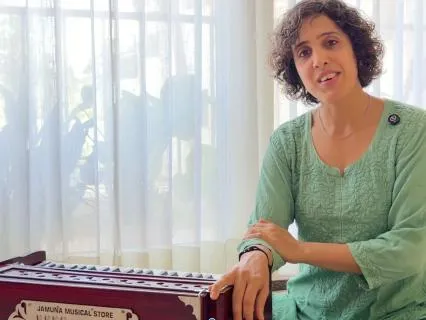
My name is Aarti.
Now let's take another example.
We all must have gone through this situation many times.
Think of a situation where you're writing an email and your phone lights up and there's a notification.
You look at your phone.
There is a message.
You respond to the person.
You look at another message.
You're responding to that.
Then your attention goes to another app.
And from there to another app,
And maybe now you've thought of having a cup of coffee,
So you move from there.
Eventually,
You come back to the email that we were originally writing,
But physically we have come back.
But think about this,
That are we really back?
Is our attention completely back to that email or it is still traveling in multiple places?
Something that we all need to take a pause and maybe question that,
What is the real problem?
So is the real culprit that I have too much cravings,
My mind wanders too much,
I'm too restless,
Or there is too much of stimulus around me,
Or the screen time is too much,
Or the real problem is actually not the senses.
The culprit is not the senses.
Rather,
It is that our attention very easily,
Very quickly gets deployed to one thing,
To another thing,
And to another thing.
Patanjali in the Yoga Sutras has explained Pratyahara,
But mostly Pratyahara is understood as the withdrawal of the senses.
But I think In practicality,
It is not just or it probably is not the withdrawal of the senses.
It is actually trying to or actually regaining the choice over where my attention or where our attention is going to rest,
Where it is going to be in that particular moment.
So,
It is not about cutting ourselves from the rest of the world or shutting ourselves down.
It is something beyond that.
It is like how in the eight limbs of yoga,
Which have been explained by Patanjali,
It is said that Pratyahara is the bridge between our external limbs and our internal limbs.
It's a beautiful transition of how our external self eventually,
When that is in control,
Comes or makes it possible for us to control our internal self and Pratyahara is the bridge,
Is connecting both these two.
Circuits so the senses continue to work you know they don't have to be shut down the senses continue to work the eyes are still seeing everything the the ears are still hearing everything and i can feel all the sensations but it's just the mind which does not have to necessarily attach to everything that appears everything that i see that i feel i i you know my mind has to learn to not attach to all of them or to not respond or to not react very quickly to all of that.
Now in the Bhagavad Gita there is a beautiful example of a tortoise which has been given to explain a similar concept which says that you know the tortoise how it has the ability to take all its limbs inwards when it's required and bring them out when that is required.
Now the tortoise is not cutting out you know itself from the rest of the world or hiding always or you know the limbs and getting them off his body.
Rather,
It is a skill to engage when engagement is required and to withdraw when withdrawal is required,
To disengage when disengagement is important in that particular.
So,
Pratyahara is not escapism,
It's not running away,
It's not shutting down,
Rather it's the flexibility of our own attention and the ability to deploy it with our control where we want to deploy it and withdraw it where we don't want to or not pay attention to you know,
Things which are not required for that moment.
Now,
Psychologists also explain sometimes with something called attention residue,
Where they say that a large part of the mental space is still occupied with the previous tasks but technically we have moved on to the next one.
So we are still with the previous one,
But yeah,
We have moved on to the next one.
And you know a question for all of us that the worry actually is not that the senses are there and the senses are bad and you know i get engaged in all these things because of my senses rather it is the problem is or rather the concern should be the mind which should not be the slave of these senses the mind should not be blind and just follow wherever the senses are taking them the mind should have have the ability to pull back,
Take a pause and reflect and see what's happening and then deploy wherever I want my attention to get deployed for that particular situation.
So I should be able to see things,
I should be able to see everything without having to respond to it or without having to jump into a reaction for it.
I could be able to hear everything But I should not need to investigate or need to invest myself into it so much that it occupies or exhausts me to a large extent.
Rather,
It should be a situation that,
For example,
I have the urge to have an ice cream,
Does not mean that I should just pick up my phone and immediately order the ice cream.
Should not blindly follow the senses,
Should not blindly just obey or become a slave,
Like I said,
To the senses.
So,
Could I reach a situation where I could just simply close my eyes and just go inwards?
I could see everything,
I could observe everything and just go inwards.
A question for all of us.
Now having said that.
That does not mean that I am becoming insensitive.
A lot of times it's misunderstood as I will not care,
I will not bother,
I will not engage.
No,
It is not that we are becoming insensitive.
The modern research also draws a parallel to explain this that noticing something or having our attention going to something does not mean that now I have to engage with it,
Does not mean that now I must respond to it,
I must follow the stimulus.
Does not need to.
We have the power for us to just take a call whether this is required or whether this is not.
Really needs me to engage in this moment or I could just train my awareness to that level,
Train myself to that level that I can listen to the whole drama that's going on.
I can listen to everything which is happening deep down there and be able to decide or choose that no,
I think I will pass this one.
I think it's not required for me to indulge or engage or to respond or to react in this moment especially immediately most of us jump you know all of us mostly do this that we very quickly become attached to that particular moment.
So,
That is something that is worth considering.
Now,
Let us try to maybe experience it a little while we have heard about what really Pratyahara could mean,
But let us try to experience it.
So,
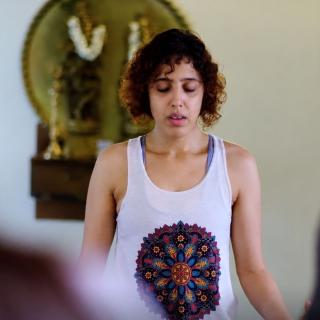
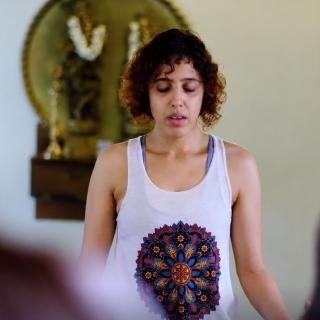
We will do a small practice.
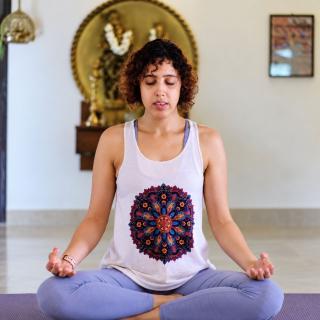
And you could choose to be wherever you are or sit in a comfortable position you could be sitting in a chair or you could be sitting down as per your comfort and just you know if possible if that is comfortable for you you could close your eyes gently or the eyes can remain open also whatever is most suitable for you and your body can can be relaxed hands can be gently placed on the thighs comfortably or can rest you know on your knees and Just calmness.
And now.
.
.
We will try to hear everything,
Every sound.
That you can hear possibly,
We will use our ears as a radar for all the sounds that we can possibly hear.
Sounds coming from inside.
Outside,
Everything,
You know,
Maybe a fan,
Or maybe an air con,
Or maybe something,
Some sounds coming from the kitchen,
Kids are talking,
Some family member,
Friends are talking,
If you're at work,
And maybe,
You know,
It's coming from,
You know,
Other people,
Or,
You know,
Somebody's phone may be ringing.
Anything,
Just listen to all the sounds.
Sounds from outside,
The traffic,
The birds.
Anything,
Anything that catches your attention,
Just try to gather and listen to all these sounds.
Everything that comes to our attention.
Now,
Take a moment and pick one sound from all these sounds that we are hearing.
You will pick one sound can be an outside sound and inside sound your choice but choose one sound that you can hear and now just Be with that sound.
Stay with just that sound.
Try to only listen to that particular sound.
You could choose the fan,
You could choose the board,
Anything.
Somebody talking any sound you can stick with.
Now slowly release that sound and move to another sound.
Pick another sound.
Jump your awareness to another sound.
And we will forego that previous sound.
Anything that catches your attention,
Just be with that sound.
Just stick to that sound.
Or your attention.
With that.
Now we will let that sound be.
The last sound that you chose.
Let that sound be wherever it is,
But we will slowly move away from that sound.
We will slowly shift away from that sound and Let that sound be where it is.
But we have released that sound.
We have moved away from that sound.
So you release that sound,
Let it pass.
And now slowly come back to the center.
To the recollection,
To the existence of your own body.
Your awareness can go to your own body.
Or to your breath,
Whichever is comfortable for you.
You can observe with your closed eyes or just your whole body or you could choose to move your awareness to your breath.
The next inhalation.
Awareness to the inhale.
Awareness to the exhale.
Inhale.
.
.
And exhale.
Try to connect to the small changes that happen.
Nothing actually changes.
Which is different sounds,
Different distractions.
And the attention.
They were pretty much.
The same as they are every day,
But we only looked at how the relationship between them can be changed.
This attention can be drawn and can be moved.
As per our will as per our choice.
As per how we regain the control over where it is going to be and where it is going to move away from.
So pratyahara is not something that is practiced or experienced or can be used.
Done only in a 30 minute or a 1 hour or a 15 minute session when you're sitting on a cushion.
It is something that must and can be practiced.
Throughout your day throughout all the time in every action every activity whatever you're doing whatever you are you know you know you're practicing everywhere this practical practice can be experienced.
So,
Think about this.
Let's ask these questions to us,
To ourselves that can I have one meal without more information pouring in while I am eating?
With that meal?
Can my attention just be to that meal?
Can I just be with eating,
With the activity of eating and all my senses fully engaged in the action of eating?
Or can I just.
.
.
Fully concentrate and finish one task.
Remember that email,
Can I just finish this email and not engage or not go and follow the pull of different stimulus around me and once I finish this then I move to the next one.
Or can this notification just exist for five minutes.
Just five minutes can this notification just exist because let's ask this question that This is just a notification,
Right?
This is just some information which has come to me.
Now this information should not become an instruction.
It should not be that I have to now follow this.
As an invitation which has come and I just blindly follow it.
A lot of times,
We believe strongly that peace is something or other.
Stillness or calmness is something that can be attained or can be felt only when there is quiet.
Mess around with.
Nobody should be talking.
It should be complete silence.
And then I can experience it.
I personally feel that it is something that we can feel all the time.
It is something that is within us.
It is in our control.
So the phone can ring,
People can talk,
Work can go on.
Things can continue to move.
Thoughts can continue to come and go,
Movements can continue to happen,
But The big question is.
.
.
Does everything that comes across me,
That reaches me,
That I see,
That I hear,
All my senses feel,
Does everything have to possess my attention?
Does everything have to have my attention?
Now,
When the answer to this question for us individually,
Slowly,
Gradually,
No push,
No fight here.
When the answer slowly becomes a no,
That no,
I don't need to respond or to follow or to get invited or to go and accept that invitation all the time.
That is when That is when the stillness disappears.
Starts to exist.
And it's possible.
Even when the world has not become quiet,
Even when we are not waiting for our surroundings to become quiet.
Thank you for practicing with us.
You Om Shanti Shanti Shanti you.