Worksheet
Whose Feeling Is It? A Post-Session Countertransference Check-In for Therapists
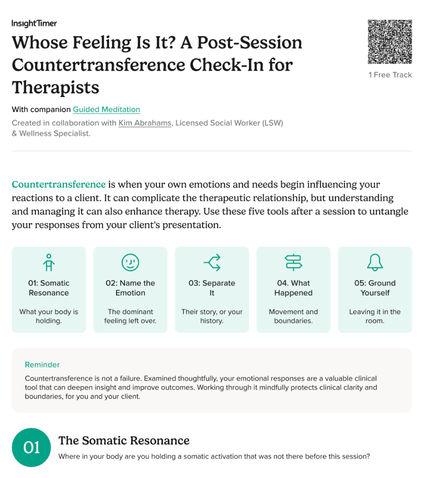
This clinical resource helps therapists navigate emotional responses and countertransference after client sessions. Created in collaboration with Kim Abrahams, Licensed Social Worker (LSW) & Wellness Specialist, this post-session tool separates a clinician's personal history from a client's material. By reframing countertransference as a valuable clinical asset rather than a personal failure, the guide protects practitioner boundaries and sharpens therapeutic clarity.

by Insight Timer in collaboration with Kim Abrahams
How to Use This Worksheet
Complete this immediately after a session, while the body and mind still hold residue from the room. Move through each step in order: notice the body, name the emotion, separate whose story it belongs to, map your movement in the room, then ground yourself before the next client or the end of the day. It works well as a standing post-session ritual, or as a targeted tool after a particularly activating session.
Who This Worksheet Is For
This guide is designed exclusively for therapists, clinical social workers, psychologists, counselors, and mental health practitioners navigating post-session emotional residue or blurred therapeutic boundaries. It serves as a structured self-supervision tool to process complex relational dynamics safely. Additionally, it provides clinical supervisors and training institutions with an actionable reflective protocol for supervisees
Expected Outcomes
- Improved ability to separate client material from personal history
- Greater clarity on in-session boundary drift
- Reduction in carried emotional residue between sessions
- Increased insight into recurring emotional patterns across caseload
- Protected clinical judgment and objectivity
Related Topics
References
Abrahams, K. (2026). Whose Feeling Is It? A Post-Session Check-In for Therapists. Clinical reflective tool developed from 20 years of practice in clinical social work and therapy.
Abrams, Z. (2025). How to manage countertransference in therapy: therapists' emotional responses, when examined thoughtfully, can deepen clinical insights and improve patient outcomes. Monitor on Psychology, American Psychological Association, 56(6).
Racker, H. (1968). Transference and Countertransference. International Universities Press. (Foundational text on concordant and complementary countertransference.)
Gelso, C. J., & Hayes, J. A. (2007). Countertransference and the Therapeutic Process: A Guide for Clinical Practice. American Psychological Association.

Frequently Asked Questions About Whose Feeling Is It? A Post-Session Countertransference Check-In for Therapists Resources
© Copyright 2026 Insight Network Inc. All rights reserved.
If you are in a crisis or any other person may be in danger - don’t use this site. Use these resources