Worksheet
Understanding Your Body's Energy Budget: A Guide to Stress, Repair, and Longevity
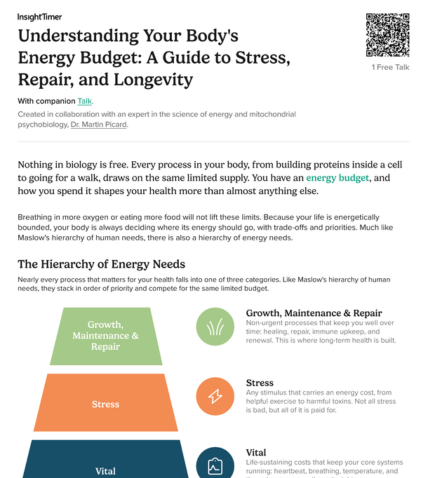
This guide helps clients understand how the body allocates limited energy across vital functions, stress responses, and long-term repair. Developed with Dr. Martin Picard, an expert in mitochondrial psychobiology, it introduces a hierarchy of energy needs, similar in structure to Maslow's hierarchy, to explain why chronic stress quietly erodes health over time. Clients learn to identify what drains their energy budget and what restores it.

How to Use This Worksheet
Introduce the hierarchy of energy needs early in a session focused on stress, fatigue, or burnout. Walk clients through the difference between short-term strain, which recovers with rest, and chronic drain, which accumulates and damages health. Use the two comparison lists to help clients identify personal stress costs and recovery behaviors. Close with the reflection prompts, ideally revisited that same evening, to build ongoing awareness of daily energy allocation.
Who This Worksheet Is For
This worksheet is built for individuals navigating chronic illness, environmental burnout, severe occupational exhaustion, sleep disorders, or prolonged relational stress. It offers a practical biological framework for trauma-informed therapists, somatic coaches, health psychologists, and integrative medicine practitioners seeking to anchor cognitive behavioral adjustments inside clear, quantifiable cellular psychobiology.
Expected Outcomes
- Greater awareness of personal stress costs
- Improved ability to distinguish short-term strain from chronic drain
- Increased motivation toward restorative behaviors
- Enhanced daily practice of energy self-monitoring
Related Topics
References
Picard, M., & McEwen, B. S. (2018). Psychological stress and mitochondria: A conceptual framework. Psychosomatic Medicine, 80(2), 126–140.
Maslow, A. H. (1943). A theory of human motivation. Psychological Review, 50(4), 370–396.
McEwen, B. S., & Stellar, E. (1993). Stress and the individual: Mechanisms leading to disease. Archives of Internal Medicine, 153(18), 2093–2101.
Behnke, A., Shaulson, E., Pontzer, H., Kempes, C. P., & Picard, M. (2026). Energy constraint on human health. Trends in endocrinology and metabolism: TEM, S1043-2760(26)00045-7. Advance online publication. https://doi.org/10.1016/j.tem.2026.02.010

Frequently Asked Questions About Understanding Your Body's Energy Budget: A Guide to Stress, Repair, and Longevity Resources
© Copyright 2026 Insight Network Inc. All rights reserved.
If you are in a crisis or any other person may be in danger - don’t use this site. Use these resources