Worksheet
The Resilience Timeline™: A Step-by-Step Guide to Mapping the Strengths and Relationships That Carried You
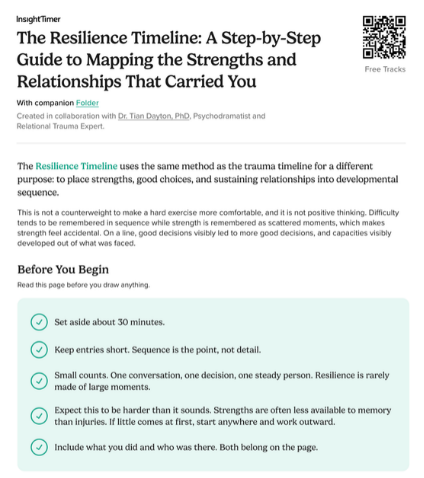
Strength is often remembered as scattered moments, which makes it feel accidental. This guide, developed with Dr. Tian Dayton, PhD, Psychodramatist and Relational Trauma Expert, uses the same five-year-segment method as the Attachment Trauma Timeline™, but in reverse: mapping good choices, developed capacities, and steady, supportive people across a client's life. Set beside the trauma timeline, it restores a fuller picture of the same life.

by Insight Timer in collaboration with Dr. Tian Dayton
How to Use This Worksheet
Introduce this guide alongside or after the Attachment Trauma Timeline™, so clients can view both side by side. Review the "Before You Begin" points first, noting that strengths are often harder to recall than injuries and may take more than one pass. Guide clients through marking what they did above the line and who supported them below it. Use the reading and reflection prompts to help clients trace chains of good decisions and count the people who showed up for them.
Who This Worksheet Is For
This guide is designed for psychodramatists, trauma therapists, and clinicians using strengths-based or resilience-focused approaches alongside relational trauma work. It also suits individuals who have completed the Attachment Trauma Timeline™ and want a companion exercise to recognize the capacities and relationships that supported them through difficulty.
Expected Outcomes
- Increased recognition of personal strengths developed through difficulty
- Greater awareness of supportive relationships across the lifespan
- Improved ability to trace how one good decision led to another
- Reduction in a sense of isolation or that strength appeared accidental
- Increased insight into capacities still available in the present
- Greater appreciation for people who provided steady support
Related Topics
References
Dayton, T. (2015). Neuropsychodrama in the Treatment of Relational Trauma. Health Communications.
Dayton, T. (2026). Growing Up With Addiction. St. Martin's Press.
Dayton, T. (2007). Emotional Sobriety: From Relationship Trauma to Resilience and Balance. Health Communications.
Dayton, T. (2005). The Living Stage: A Step-by-Step Guide to Psychodrama, Sociometry, and Experiential Group Therapy. Health Communications.
Dayton, T. (2023). Treating Adult Children of Relational Trauma: 85 Experiential Interventions to Heal the Inner Child and Create Authentic Connection in the Present. PESI Publishing.
Masten, A. S. (2001). Ordinary magic: Resilience processes in development. American Psychologist, 56(3), 227–238.
Werner, E. E., & Smith, R. S. (2001). Journeys From Childhood to Midlife: Risk, Resilience, and Recovery. Cornell University Press.
Southwick, S. M., & Charney, D. S. (2018). Resilience: The Science of Mastering Life's Greatest Challenges (2nd ed.). Cambridge University Press.
Emmons, R. A., & McCullough, M. E. (2003). Counting blessings versus burdens. Journal of Personality and Social Psychology, 84(2), 377–389.
Frequently Asked Questions About The Resilience Timeline™: A Step-by-Step Guide to Mapping the Strengths and Relationships That Carried You Resources
© Copyright 2026 Insight Network Inc. All rights reserved.
If you are in a crisis or any other person may be in danger - don’t use this site. Use these resources