Worksheet
The Neuroscience of Trauma and Addiction: How Your Brain Learns to Crave Relief
This trauma-informed clinical tool connects trauma, brain biology, and cravings to explain compulsive patterns. Developed with the Trauma Therapist Institute, it reframes addictive behaviors as neurobiological responses instead of character flaws. It maps out the nervous system's survival mechanisms to foster self-compassion and support sustainable recovery.

by Insight Timer in collaboration with Trauma Therapist Institute
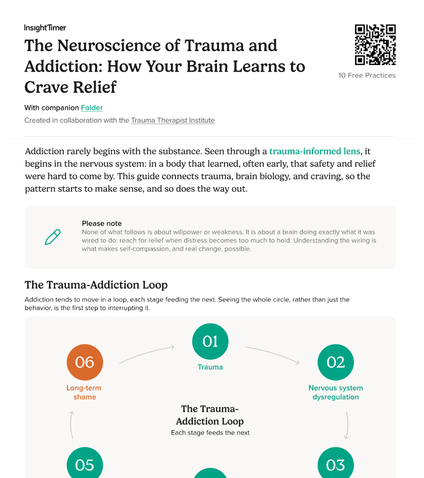
How to Use This Worksheet
Introduce this tool during sessions to trace the six stages of the Trauma-Addiction Loop. Use the guide to explain the three distinct systems—reward, threat, and regulation—behind a sudden urge. Anchor the conversation around finding safety in connection to heal underlying attachment deficits.
Who This Worksheet Is For
This resource is for individuals navigating substance dependencies, behavioral compulsions, and chronic trauma triggers. It serves as a compassionate guide for adult survivors looking to understand their nervous system. Additionally, it provides a structured psychoeducational framework for trauma therapists, addiction counselors, social workers, and clinicians.
Expected Outcomes
- Greater self-compassion through a clearer understanding of the neurobiological roots of cravings and compulsive patterns.
- Reframed addictive behaviors as neurobiological responses instead of character flaws.
- Restored safety in connection to heal underlying attachment deficits and support sustainable recovery.
- Enhanced capacity to restore physiological safety through connection and co-regulation rather than forced willpower.
References
Maté, G. (2010). In the Realm of Hungry Ghosts: Close Encounters with Addiction. North Atlantic Books. (Framing of addiction as rooted in unmet attachment needs, with addictive behaviors as attempts at self-regulation).
Porges, S. W. (2011). The Polyvagal Theory: Neurophysiological Foundations of Emotions, Attachment, Communication, and Self-regulation. W. W. Norton & Company. (Applied to tracking the role of the vagus nerve, co-regulation, and nervous system safety).
Bowlby, J. (1969). Attachment and Loss, Vol. 1: Attachment. Basic Books. (Applied to the relational and attachment basis of chronic nervous system dysregulation underlying addictive behavior.)

Frequently Asked Questions About The Neuroscience of Trauma and Addiction: How Your Brain Learns to Crave Relief Resources
© Copyright 2026 Insight Network Inc. All rights reserved.
If you are in a crisis or any other person may be in danger - don’t use this site. Use these resources