Worksheet
Relational Trauma Repair (RTR)®, Explained: How Experiential Methods Work With Attachment Wounds, Adaptations, and the Nervous System
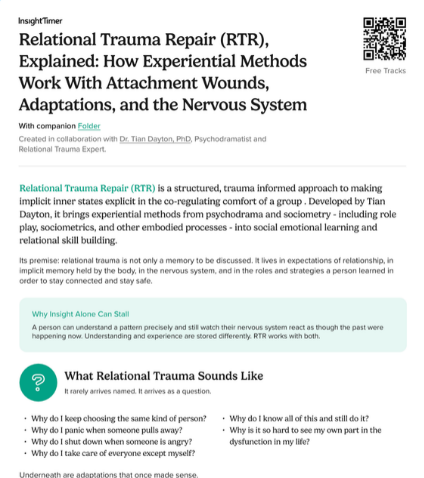
Insight alone can't always reach relational trauma: it lives in the nervous system, not just memory. This guide, developed with Dr. Tian Dayton, PhD, Psychodramatist and Relational Trauma Expert, introduces Relational Trauma Repair (RTR)®: a structured, experiential approach using Floor Checks, timelines, sculpting, and role reversal to make implicit attachment wounds visible and workable within the co-regulating safety of a group.

by Insight Timer in collaboration with Dr. Tian Dayton
How to Use This Worksheet
Introduce this guide to clients or groups ready to move beyond talk-based insight into experiential processing. Walk through the four core tools in sequence - Floor Checks, Timelines, Social Atoms, and Role Reversal - pacing the work to the nervous system rather than emotional intensity. Use the closing reflection questions to help clients name their adaptations and connect past survival strategies to present-day choice.
Who This Worksheet Is For
This guide is designed for psychodramatists, group therapists, and trauma clinicians using experiential or somatic methods with attachment-wounded clients. It also suits individuals, trauma survivors, and therapy clients navigating developmental trauma, relational wounds, anxious attachment, or compulsive survival adaptations.
Expected Outcomes
- Greater insight into the link between past survival strategies and present reactions
- Improved capacity to separate historical threat from current relationships
- Reduction in automatic fight, flight, freeze, or fawn responses
- Stronger integration of understanding and embodied experience
Related Topics
References
Dayton, T. (2015). Neuropsychodrama in the Treatment of Relational Trauma. Health Communications.
Dayton, T. (2026). Growing Up With Addiction. St. Martin's Press.
Dayton, T. (2007). Emotional Sobriety: From Relationship Trauma to Resilience and Balance. Health Communications.
Dayton, T. (2005). The Living Stage: A Step-by-Step Guide to Psychodrama, Sociometry, and Experiential Group Therapy. Health Communications.
Dayton, T. (2023). Treating Adult Children of Relational Trauma: 85 Experiential Interventions to Heal the Inner Child and Create Authentic Connection in the Present. PESI Publishing.
van der Kolk, B. A. (2014). The Body Keeps the Score: Brain, Mind, and Body in the Healing of Trauma. Viking.
Moreno, J. L. (1946). Psychodrama, Volume 1. Beacon House.
Porges, S. W. (2011). The Polyvagal Theory: Neurophysiological Foundations of Emotions, Attachment, Communication, and Self-Regulation. W. W. Norton.
Kellermann, P. F. (2000). Psychodrama With Trauma Survivors: Acting Out Your Pain. Jessica Kingsley Publishers.
Frequently Asked Questions About Relational Trauma Repair (RTR)®, Explained: How Experiential Methods Work With Attachment Wounds, Adaptations, and the Nervous System Resources
© Copyright 2026 Insight Network Inc. All rights reserved.
If you are in a crisis or any other person may be in danger - don’t use this site. Use these resources