Worksheet
EMDR Readiness Checklist: How to Know When a Client Is Ready to Reprocess Trauma Memories
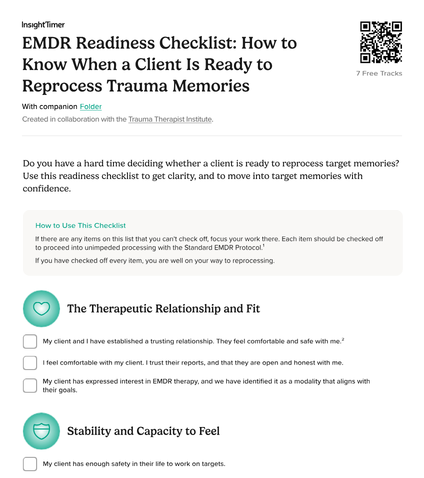
Deciding when a client is ready to reprocess target memories is one of the hardest calls in EMDR. This checklist, created in collaboration with the Trauma Therapist Institute, helps clinicians assess the relationship, stability, commitment, and dissociation screening before moving into the Standard EMDR Protocol. It gives clarity on where to keep preparing and when to proceed with confidence.

by Insight Timer in collaboration with Trauma Therapist Institute
How to Use This Worksheet
Work through each item with a specific client in mind. Any item you can’t check off shows where preparation should continue. Once every item is checked, move on to the next steps: explaining EMDR, reviewing bilateral stimulation options, discussing side effects, and exploring hopes and fears. Close with the reflection questions to plan skill-building and identify consultation needs.
Who This Worksheet Is For
This checklist is designed for EMDR therapists and EMDR-trained clinicians who want a structured way to judge client readiness before reprocessing. It also suits trauma therapists in training, consultants, and supervisors supporting clinicians who feel unsure about timing in the preparation phase.
Expected Outcomes
- Greater clarity on client readiness for reprocessing
- Increased confidence moving into target memories
- Improved ability to identify gaps in preparation
- Stronger assessment of client stability and emotional regulation skills
- Greater awareness of the clinician’s own readiness and consultation needs
References
Shapiro, F. (2018). Eye Movement Desensitization and Reprocessing (EMDR) Therapy: Basic Principles, Protocols, and Procedures (3rd ed.). Guilford Press.
Norcross, J. C., & Lambert, M. J. (2018). Psychotherapy relationships that work III. Psychotherapy, 55(4), 303–315.
Ogden, P., Minton, K., & Pain, C. (2006). Trauma and the Body: A Sensorimotor Approach to Psychotherapy. W. W. Norton.
Korn, D. L., & Leeds, A. M. (2002). Preliminary evidence of efficacy for EMDR resource development and installation in the stabilization phase of treatment of complex PTSD. Journal of Clinical Psychology, 58(12), 1465–1487.
Bernstein, E. M., & Putnam, F. W. (1986). Development, reliability, and validity of a dissociation scale. Journal of Nervous and Mental Disease, 174(12), 727–735.
Nijenhuis, E. R. S., Spinhoven, P., van Dyck, R., van der Hart, O., & Vanderlinden, J. (1996). The development of the Somatoform Dissociation Questionnaire (SDQ-20). Journal of Nervous and Mental Disease, 184(11), 688–694.
International Society for the Study of Trauma and Dissociation. (2011). Guidelines for treating dissociative identity disorder in adults, third revision. Journal of Trauma & Dissociation, 12(2), 115–187.

Frequently Asked Questions About EMDR Readiness Checklist: How to Know When a Client Is Ready to Reprocess Trauma Memories Resources
© Copyright 2026 Insight Network Inc. All rights reserved.
If you are in a crisis or any other person may be in danger - don’t use this site. Use these resources