Worksheet
Attachment Styles: Understanding How Early Bonds Shape Relationships
This clinical resource helps individuals understand how early childhood caregiver bonds shape adult intimacy, trust, and relationship behaviors. Created in collaboration with Clinical Registered Social Worker Shelley Lord, MSW, RSW, this worksheet outlines the four primary attachment styles. By reframing adaptive survival responses with compassion, the guide supports clients in developing emotional awareness and building earned security. themselves in curiosity, clarity, and compassion.

by Insight Timer in collaboration with Shelley Lord
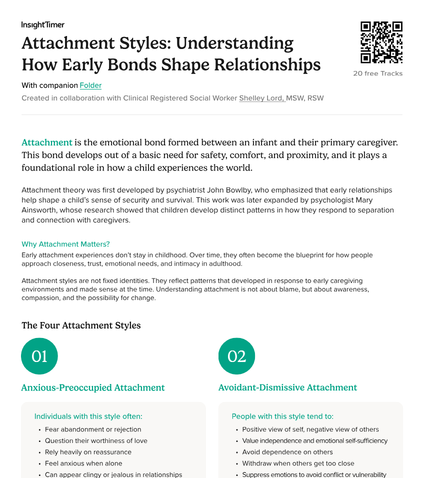
How to Use This Worksheet
Introduce this worksheet early in relational or couples work. Use it to open a conversation about attachment history. Invite clients to read each style and notice which resonates most. Use the "Further Reflection" section as a session prompt or between-session journaling task. Revisit it later to track shifts in insight and relational patterns.
Who This Worksheet Is For
This guide is written for individuals, partners, and clients who experience relational anxiety, fear of abandonment, emotional withdrawal, or inconsistent bonding behaviors. It serves as a gentle personal roadmap to help readers understand their relational patterns. Additionally, it provides an accessible clinical resource for marriage and family therapists, licensed social workers, professional counselors, and trauma-informed practitioners.
Expected Outcomes
- Increased insight into personal attachment patterns
- Greater self-compassion around relational struggles
- Improved ability to name emotional needs
- Reduction in shame around anxious or avoidant behaviors
- Stronger foundation for secure relational functioning
- Greater clarity on communication and trust patterns in relationships
Related Topics
References
Bowlby, J. (1969). Attachment and Loss, Vol. 1: Attachment.
Ainsworth, M. D. S., et al. (1978). Patterns of Attachment.
Main, M., & Solomon, J. (1986). Discovery of an Insecure-Disorganized/Disoriented Attachment Pattern.
Bartholomew, K., & Horowitz, L. M. (1991). Attachment Styles Among Young Adults.
Hazan, C., & Shaver, P. (1987). Romantic Love Conceptualized as an Attachment Process.

Frequently Asked Questions About Attachment Styles: Understanding How Early Bonds Shape Relationships Resources
© Copyright 2026 Insight Network Inc. All rights reserved.
If you are in a crisis or any other person may be in danger - don’t use this site. Use these resources