Worksheet
Animal-Assisted EMDR Therapy: 10 Ways to Integrate the Human-Animal Bond Into Trauma Treatment
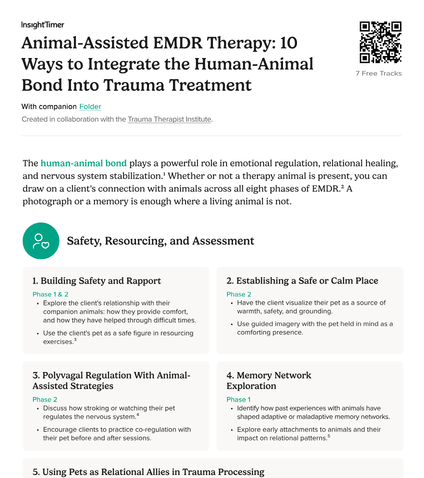
The human-animal bond supports emotional regulation, relational healing, and nervous system stabilization. This guide, created in collaboration with the Trauma Therapist Institute, shows clinicians how to draw on a client’s connection with animals across all eight phases of EMDR. A living therapy animal isn’t required. A photograph or a memory is enough.

by Insight Timer in collaboration with Trauma Therapist Institute
How to Use This Worksheet
Review the ten strategies and match each to the EMDR phase you are working in. Start by exploring the client’s relationship with their companion animals. Then weave the pet into resourcing, reprocessing, and closure as it fits. Assign the at-home grounding strategies between sessions to extend regulation beyond the therapy room.
Who This Worksheet Is For
This guide is designed for EMDR-trained therapists and trauma clinicians who want to integrate the human-animal bond into treatment. It also suits clinicians supporting clients who find comfort, safety, or secure attachment through companion animals, including clients navigating pet loss and grief.
Expected Outcomes
- Improved ability to stay in dual awareness during reprocessing
- Stronger therapeutic rapport through shared connection to animals
- Increased insight into how early animal attachments shape relational patterns
- Support for clients processing pet loss and grief
Related Topics
References
Fine, A. H. (Ed.). (2019). Handbook on Animal-Assisted Therapy: Foundations and Guidelines for Animal-Assisted Interventions (5th ed.). Academic Press.
Shapiro, F. (2018). Eye Movement Desensitization and Reprocessing (EMDR) Therapy: Basic Principles, Protocols, and Procedures (3rd ed.). Guilford Press.
Korn, D. L., & Leeds, A. M. (2002). Preliminary evidence of efficacy for EMDR resource development and installation in the stabilization phase of treatment of complex PTSD. Journal of Clinical Psychology, 58(12), 1465–1487.
Beetz, A., Uvnäs-Moberg, K., Julius, H., & Kotrschal, K. (2012). Psychosocial and psychophysiological effects of human-animal interactions: The possible role of oxytocin. Frontiers in Psychology, 3, 234.
Julius, H., Beetz, A., Kotrschal, K., Turner, D., & Uvnäs-Moberg, K. (2013). Attachment to Pets: An Integrative View of Human-Animal Relationships with Implications for Therapeutic Practice. Hogrefe.
Packman, W., Field, N. P., Carmack, B. J., & Ronen, R. (2011). Continuing bonds and psychosocial adjustment in pet loss. Journal of Loss and Trauma, 16(4), 341–357.
International Association of Human-Animal Interaction Organizations. (2018). IAHAIO White Paper: Definitions for Animal-Assisted Intervention and Guidelines for Wellness of Animals Involved.
Porges, S. W. (2011). The Polyvagal Theory: Neurophysiological Foundations of Emotions, Attachment, Communication, and Self-Regulation. W. W. Norton.

Frequently Asked Questions About Animal-Assisted EMDR Therapy: 10 Ways to Integrate the Human-Animal Bond Into Trauma Treatment Resources
© Copyright 2026 Insight Network Inc. All rights reserved.
If you are in a crisis or any other person may be in danger - don’t use this site. Use these resources