The world’s largest free audio library for everyday wellbeing
Sound-Based
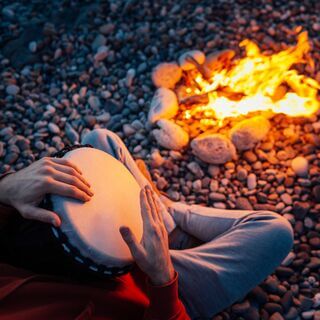
A shamanic drumming journey uses steady, repetitive drumming at around 4 to 4.5 beats per second to support a guided inner journey of imagery and reflection (Kjellgren & Eriksson, 2010).
Last Updated
4 Jul 2026
We are still reviewing this page. Our research team checks every technique page for accuracy and evidence quality before final release. Details may change as that review completes. The evidence badge shows our current reading of the published research.
RECOMMENDED DOSE
A phenomenological study of a single 20-minute shamanic drumming journey and a controlled comparison using 15 minutes of repetitive drumming with shamanic journeying instructions both relied on short single sessions, making this a sensible introductory duration. No study reports an ideal weekly frequency, so a gentle 1–2 sessions per week is an editorial starting point.
The 20-minute journey used in shamanic drumming research can be extended toward the longer sessions seen in related drumming work such as 40-minute djembe sessions. Weekly to twice-weekly schedules in related drumming programmes inform the frequency, which is extrapolated from these adjacent modalities.
This longer range draws on related drumming studies rather than shamanic-journey trials: 40-minute djembe sessions and 30–45 minute therapeutic drumming sessions. Sustained programmes ran weekly or twice weekly across 8–12 weeks or more; no shamanic-journey study tested this duration or frequency directly.
Session length
Session length: 15–20 minutes
15
MIN
How long each individual practice session should last from start to finish.
Frequency
Frequency: 1–2 days
1
DAY
The number of days per week to fit a session into your routine.
Session length
Session length: 20–30 minutes
20
MIN
How long each individual practice session should last from start to finish.
Frequency
Frequency: 2–3 days
2
DAYS
The number of days per week to fit a session into your routine.
Session length
Session length: 30–45 minutes
30
MIN
How long each individual practice session should last from start to finish.
Frequency
Frequency: 2–3 days
2
DAYS
The number of days per week to fit a session into your routine.
About this card. Direct dose-response evidence for shamanic drumming journeys is limited; session-length figures come from a small number of studies of this technique, while frequency guidance is extrapolated from related drumming programmes or editorial synthesis. These recommendations are not a substitute for personalised guidance from a qualified practitioner.
Quick answers to what people most often ask. Each card links to the deeper section below.
evidence
Small, early studies show steady drumming reliably makes inner imagery more vivid and produces a light-to-moderate trance more readily than silence, with tempo and session length shaping the effect. Brain recordings in experienced practitioners find measurable shifts during trance, but no large trial shows any clinical benefit unique to shamanic drumming over ordinary calming music.
good for
Shamanic drumming suits adults drawn to an experiential, imagery-rich practice for reflection, relaxation, or a sense of inner exploration and guidance. Most research has involved healthy adults or experienced practitioners rather than clinical groups, so it supports a richer, more absorbed inner experience and light rest, not treatment for any diagnosed condition.
Read moresafety
Most healthy adults find shamanic drumming low-risk and restful, but it deliberately shifts you into an altered, trance-like state where attention turns inward, which can occasionally feel disorienting or surface strong emotions and memories. People living with trauma, dissociation, a psychosis-spectrum condition, or a seizure disorder should consult a clinician first. No studies tracked adverse events.
Read morehow it works
Steady, monotonous drumming at roughly four beats a second works mainly through rhythmic entrainment, the tendency for the body's and brain's own rhythms to fall into step with an external beat, drawing attention inward until imagery feels more vivid than the room. Brain recordings in practitioners show the attention networks decoupling from outside sound during this absorbed state.
Read moreA shamanic drumming journey uses steady, repetitive drumming at around 4 to 4.5 beats per second to support a guided inner journey of imagery and reflection (Kjellgren & Eriksson, 2010).
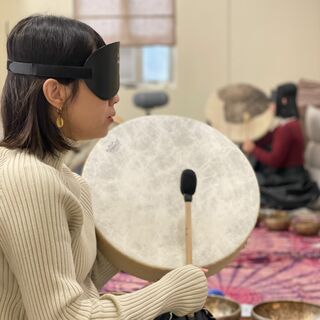
The practitioner lies down or sits with eyes closed while a frame or buffalo drum holds a continuous, monotonous pulse of about 4 to 4.5 beats per second for roughly 15 to 30 minutes. Guided journeying instructions, often drawn from Michael Harner's core-shamanism method, invite an inward descent to meet figures, landscapes, and sources of felt inner guidance, before the drumming shifts to signal a return to ordinary waking awareness.
This is a guided, inwardly focused practice built on one sustained drumbeat, not a group drum circle, a music-performance class, or a percussion-for-fitness workout. It also differs from simply listening to relaxing music, because the steady rhythm is paired with journeying instructions meant to deepen absorption and inner imagery. It is an experiential and spiritual practice rather than a proven medical treatment, and it is not a substitute for professional care.
Not to be confused with
Learning or performing on a drum
A shamanic journey is a receptive practice in which the participant usually lies still and listens while someone else keeps the beat, rather than learning to play or perform on the instrument.
Psychedelic or plant-medicine altered states
Although a drumming trance is sometimes described as resembling a psychedelic state, it is induced by sound and attention alone, with no drug or entheogen involved.
Sound bath or gong bath
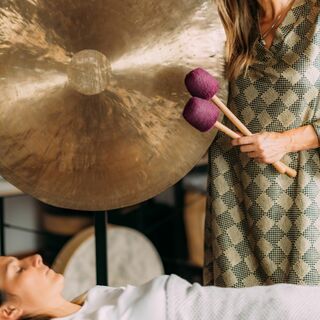
A sound bath surrounds the listener in sustained, evolving tones from gongs or bowls for passive relaxation, whereas a drumming journey uses a single steady percussive pulse to guide an intentional inner journey.
Shamanism as a whole tradition
The drumming journey is one specific technique within core and neo-shamanism, not the entire tradition of ritual, ceremony, and healing practice it belongs to.
Shamanic drumming appears to work mainly through rhythmic entrainment, the tendency for the body's and brain's own rhythms to fall into step with a steady external beat, which practitioners often feel as being carried by the sound into a calmer, more absorbed state (Aparicio‐Terrés et al., 2025), (Psychological Effects of Rhythmic Entrainment an, 2020). Much of this mechanism evidence comes from research on rhythm and music broadly, not the shamanic protocol specifically, so it is best read as a plausible explanation rather than a confirmed one. Steady, monotonous drumming also seems to draw attention inward until inner imagery feels more vivid than the surrounding room, a deepening absorption that helped people in one 206-person study settle into a light-to-moderate trance (Maurer et al., 1997).
When a racing mind won't settle on its own, the drum's steady 4–4.5 beat-per-second pulse gives it a single rhythm to follow. Brain and bodily rhythms are thought to gradually fall in step with the beat, a synchronization called rhythmic entrainment, which practitioners often describe as being carried by the sound into a calmer, more absorbed state (Aparicio‐Terrés et al., 2025), (Psychological Effects of Rhythmic Entrainment an, 2020).
Focus stops having to work to hold itself in place. A steady drumbeat at roughly four beats per second gives the brain's own electrical rhythms a pattern to fall into step with, a frequency-following response that researchers describe as one likely route into the absorbed, relaxed state of a drumming journey (Aparicio‐Terrés et al., 2025), (Psychological Effects of Rhythmic Entrainment an, 2020).
Attention stops scanning the room and folds inward, settling into the steady pulse of the drum until inner imagery feels more vivid than the surroundings. This deepening absorption is thought to be one route by which monotonous drumming helps people ease into a light-to-moderate trance and a more relaxed state (Maurer et al., 1997), (Aparicio‐Terrés et al., 2025).
Inner scenes, figures, and landscapes tend to arrive more readily when steady drumming accompanies journeying instructions than when you simply sit in silence (Rock et al., 2006), (Rock et al., 2005). Researchers link this richer imagery to activity in the brain's visual areas, though how vivid it feels depends on the drumming tempo, the length of the session, and how easily you become absorbed.
Racing, keyed-up alertness has less to grip onto when the drum holds one steady, unchanging beat, and studies of monotonous drumming report people easing into a lighter, more relaxed state as the rhythm carries their attention (Maurer et al., 1997). Researchers think this rhythmic pull helps the nervous system's activation settle, which practitioners often feel as the body loosening and the pace of thought slowing (Aparicio‐Terrés et al., 2025), (Psychological Effects of Rhythmic Entrainment an, 2020).
As the steady, unchanging drumbeat settles you, muscles loosen, breathing slows, and mental urgency quiets. This is parasympathetic activation, the body's rest-and-recovery mode taking over from fight-or-flight, and in one study of monotonous drumming people drifted into a lightly relaxed, mildly trance-like state (Maurer et al., 1997).
Brain-recording studies show shamanic drumming trance is linked to measurable shifts in brain activity in experienced practitioners, changes people often notice as an absorbed, awake-but-inward quality of attention (Huels et al., 2021). Imaging in a small group of practitioners found the brain's inward-focus and attention networks reorganizing and decoupling from outside sound, which maps onto the felt sense of the room fading while inner imagery grows vivid (Hove et al., 2015). Cortisol, the body's main stress hormone, has been measured to fall during repetitive drumming, felt as tension loosening, though that drop was no larger than with calming meditation music (Gingras et al., 2014).
During a drumming journey, practitioners often feel vivid inner imagery and an absorbed, awake-but-inward focus of attention. That state lines up with a rise in gamma waves, the brain's fastest rhythm tied to alert, vivid processing, which was measured as higher during shamanic drumming than at rest in experienced practitioners (Huels et al., 2021).
During the steady drumbeat, attention can loosen from the room and turn inward, so inner imagery becomes easier to sink into. Brain-recording studies link this to altered brainwave oscillation patterns, the brain's electrical rhythms recorded as waves, measured in experienced practitioners rather than left to guesswork (Huels et al., 2021).
As the steady drumbeat draws attention inward, the room and even the drum itself seem to fade while vivid inner scenes rise. Imaging links this to the default mode network, the brain circuit tied to self-focused, wandering thought, reorganizing how it connects with sensory areas during a drumming trance (Hove et al., 2015).
As absorption deepens, attention seems to draw inward and the room and the drumbeat quietly recede. Brain imaging during this drumming trance has measured stronger connectivity between the anterior cingulate and the insula, two regions that work together to steer attention and body awareness (Hove et al., 2015).
During steady drumming, many people feel the room receding while inner imagery becomes vivid and absorbing, a shift that lines up with raised theta waves, the slow brain rhythm that dominates drowsy, dreamlike states rather than alert focus, seen in brain-recording studies of experienced practitioners (Huels et al., 2021). Imaging alongside this shows attention decoupling from outside sound and turning inward (Hove et al., 2015).
Steady, monotonous drumming is often felt as tension loosening and the mind slowing down, and one measured sign of that shift is cortisol, the body's main stress hormone, which fell while people listened (Gingras et al., 2014). That drop was no larger for shamanic drumming than for calming meditation music, so it appears to reflect a general relaxation response to soothing sound rather than anything unique to the journey itself.
Limited–emerging evidence, drawn mostly from small studies, supports shamanic drumming for a richer inner experience rather than for treating any diagnosed condition. Repetitive drumming has been shown to make guided mental imagery feel more vivid than silence in 100 participants (Ayyildiz et al., 2025), to raise subjective trance into a light-to-moderate range in 206 participants (Maurer et al., 1997), and, in a group of 22 adults, to bring vivid imagery and a felt sense of inner guidance (Kjellgren & Eriksson, 2010). What is not yet supported: large randomized trials, any long-term benefit, and any claim that shamanic drumming eases stress more than ordinary calming music, since one controlled study found no such advantage (Gingras et al., 2014).
The most consistent finding is that steady drumming reliably changes inner experience: people report more vivid imagery and a light-to-moderate trance more readily than in silence, with tempo and session length shaping how strong the effect feels (Rock et al., 2005), (Maurer et al., 1997), (Ayyildiz et al., 2025). Brain-recording and imaging studies in experienced practitioners find measurable shifts in brain activity during trance (Huels et al., 2021), (Hove et al., 2015). The main limits are that most studies are small and indirect, and some effects, such as lower stress hormones, appear no different from ordinary calming music, so no trial yet shows a clinical benefit unique to shamanic drumming (Gingras et al., 2014).
0
Meta-analyses
0
RCTs
0
Systematic reviews
0
Observational
12
Pilot
Studied populations
Altered States During Shamanic Drumming: A Phenomenological Study
n = 22
Finding: In this study, 22 adults each took part in a single 20-minute shamanic-style drumming session and afterward wrote down what they experienced. Most described vivid inner imagery along with sounds and bodily sensations, encounters with animals, and moments of personal insight, and nearly everyone found the session worthwhile with few unpleasant effects. For someone curious about the practice, this suggests a short drumming journey can reliably open up a rich imaginative and reflective inner space. Keep in mind that this was a small, descriptive study with no comparison group, so it captures what people felt rather than proving any specific healing effect.
reported narratively
Exploring shamanic journeying: repetitive drumming with shamanic instructions induces specific subjective experiences but no larger cortisol decrease than instrumental meditation music.
n = 39
Finding: In a controlled experiment with 39 people new to shamanic journeying, 15 minutes of repetitive drumming with journeying instructions produced distinctive inner experiences more often than plain relaxation instructions did, including sensations of heaviness, a slowed heart rate, and dreamlike states. Stress hormone levels (measured as cortisol in saliva) dropped after listening, but they dropped by a similar amount whether people heard drumming or gentle instrumental meditation music, so the drumming did not lower cortisol any more than other calming sound. For someone drawn to this practice, the takeaway is that the vivid subjective journey can feel real and specific, while the calming effect on the body appears to come from settling in to listen rather than from drumming in particular. This was a small, single-session study with beginners, so it can't tell us about longer-term or repeated practice.
Modern guided shamanic drumming journeys grow largely from Michael Harner's core-shamanism method and from cross-cultural traditions in which steady drumming is used to enter a deliberate shift in consciousness for healing, insight, and connection. These roots help explain the practice's form, its sustained beat, journeying instructions, and inward descent, rather than proving any clinical effect.
For most healthy adults, a shamanic drumming journey is a low-risk, restful practice. It is worth knowing that it deliberately shifts you into a trance-like state, a genuine change in mental state where attention turns inward and outside sounds fade, rather than simple relaxation. That inward turn is usually absorbing and calming, but it can occasionally feel disorienting or bring strong emotions, buried memories, or unusually vivid imagery to the surface. This caution is drawn from how the practice works and from practitioner experience, not from a documented harm, since no study in the current research base tracked adverse events (Marie et al., 2024). People living with a trauma history, dissociation, a psychosis-spectrum condition, or a seizure disorder should approach it more carefully and talk with a clinician before starting.
Take extra care if you live with a trauma history or PTSD, a dissociative disorder, or a psychosis-spectrum condition. A state that loosens your hold on ordinary surroundings and blurs the line between inner imagery and reality can surface intrusive memories or feel destabilising, so it is safest to begin with clinical support in place. This is a caution inferred from how the practice works, not a measured harm. Anyone with a seizure disorder should check with a clinician first, since sustained rhythmic stimulation is a sensible precaution for people sensitive to repetitive sensory input. If you are drawn to this within care for trauma, addiction, or the perinatal period, treat it as an adjunct alongside professional support rather than a stand-alone treatment.
A shamanic drumming journey deliberately loosens your hold on ordinary surroundings and turns attention inward, which can surface intrusive memories or feel destabilising for someone with a trauma history. Begin only with clinical support in place, keep early sessions short, and treat the practice as an adjunct alongside professional care rather than a stand-alone treatment. This caution is inferred from how the practice works and from practitioner experience, not from a documented harm, since no study in the current research base tracked adverse events.
| Technique | Best for | Use with care | Evidence strength | Distinction |
|---|---|---|---|---|
| Instrumental meditation or relaxation music | Winding down or easing everyday stress when you want calm without any intention of entering an altered state. | moderate EVIDENCE | Both use sound to calm the body and quiet the mind, but relaxation music aims mainly at rest and settling, while a drumming journey adds a steady rhythmic pulse and guided imagery intended to carry attention inward into a light trance and inner exploration. | |
| Group drumming circles (djembe, African drumming) | Social connection, expressive engagement, and a shared lift in mood within a group. | moderate EVIDENCE | Both center the drum, but a drumming circle has people actively playing together for social connection and mood, whereas a shamanic journey is a receptive, usually solitary practice in which a facilitator keeps the beat and the participant lies still and travels inward. |
You lie down or sit with eyes closed while a steady drumbeat of about 4 to 4.5 beats per second plays for roughly 15 to 30 minutes, using the rhythm to carry your attention inward toward imagery and reflection (Kjellgren & Eriksson, 2010).
+
During a session you settle into a comfortable position with eyes closed while a continuous, monotonous drum, often a frame or buffalo drum, keeps a steady pulse for about 15 to 30 minutes, and you follow that rhythm inward on a guided inner journey of imagery and reflection (Kjellgren & Eriksson, 2010). People commonly report the body feeling heavier, the room seeming to recede, and inner scenes or figures becoming more vivid, and some describe a felt sense of inner guidance or insight (Kjellgren & Eriksson, 2010). A first session can feel like little more than lying still, and the sense of settling tends to deepen with practice. This is a descriptive picture of the experience, not a treatment.
No. Belief in spirits is not required. Core effects like rhythmic entrainment, deep absorption, and a light-to-moderate trance have shown up in participants new to the practice with no prior belief (Maurer et al., 1997), (Rock et al., 2005). The shamanic worldview is a meaning frame that shapes what you notice, not a precondition, so it can work as a secular relaxation and imagery practice.
+
No. The mechanisms that make a drumming journey feel absorbing don't depend on spiritual belief. Steady rhythm is thought to help the body's and brain's rhythms fall into step, and journeying instructions paired with a monotonous beat reliably evoke more vivid inner imagery than sitting quietly, even in first-time or skeptical participants (Aparicio‐Terrés et al., 2025), (Psychological Effects of Rhythmic Entrainment an, 2020), (Rock et al., 2006), (Rock et al., 2005). Monotonous drumming can also settle people into a light-to-moderate trance without any required belief (Maurer et al., 1997). The shamanic framing, its spirit imagery and felt sense of inner guidance, is a meaning system that adds coherence and value for those drawn to it, not proof of a distinct clinical effect. You can approach it purely as rhythmic relaxation and reflection, and it is not a treatment for any condition.
The deliberately altered, trance-like state that steady drumming is used to bring on, in which attention turns inward and inner imagery becomes vivid. Reviews describe it as a distinct, non-pathological state rather than a disorder.
An induced altered state of consciousness marked by perceptual decoupling from the environment and vivid autobiographical imagery, characterized in brain-recording studies of experienced practitioners and framed by review work as non-pathological.
The guided inner exploration at the heart of the practice, in which a person, carried by the drumbeat, imagines descending to meet figures, landscapes, or sources of inner guidance and then returns to ordinary awareness.
The cross-cultural method popularized by Michael Harner that distills drumming-induced journeying from many indigenous traditions into a portable, non-denominational practice, and forms the basis of most modern guided drumming journeys.
The tendency of the body's rhythms, such as neural activity, heart rate, and breathing, to fall into step with a steady external beat, which practitioners often feel as being carried by the drum into a calmer, more absorbed state.
The brain's habit of synchronizing its own electrical rhythms to a repeating sound, proposed as one route by which a roughly four-beat-per-second drum supports an absorbed, relaxed state rather than effortful focus.
The slow brain rhythm that dominates during drowsy, dreamlike states rather than alert focus, reported as elevated during drumming trance in brain-recording studies of experienced practitioners.
The loosening of attention from outside sights and sounds so awareness turns inward, which people often experience as the room receding while inner imagery grows more vivid. Imaging in experienced practitioners links it to the trance state.
Anette Kjellgren, Anders Eriksson (2010). Altered States During Shamanic Drumming: A Phenomenological Study. https://doi.org/10.24972/ijts.2010.29.2.1
Cited in: Benefits, Faq, What it is
B. Gingras, Gerald Pohler, W. Fitch, S. Kotz, Gingras Bruno, Pohler Gerald (2014). Exploring shamanic journeying: repetitive drumming with shamanic instructions induces specific subjective experiences but no larger cortisol decrease than instrumental meditation music.. https://doi.org/10.1371/journal.pone.0102103
As the drum carries you, breathing slows and the muscles let go, the settling many people feel when the body's rest-and-recovery branch, the parasympathetic nervous system, takes stronger control. This shift is inferred from the calm, absorbed trance rather than measured directly: the technique studies here recorded brain activity during trance (Huels et al., 2021), (Hove et al., 2015), not autonomic markers such as heart-rate variability.
That wired, still-on-alert feeling is sympathetic arousal, the body's fight-or-flight activation. Steady drumming is expected to ease it toward a calmer, rest-oriented state, which can feel like the shoulders dropping and the breath slowing; so far, though, studies of shamanic drumming have not isolated this shift directly, and one trial found no greater fall in the stress hormone cortisol than with other calming music (Gingras et al., 2014).
During a drumming journey, closed-eye scenes can feel unusually detailed, almost like watching something play out behind your eyelids. That vividness lines up with heightened activity in the visual cortex, the brain region that builds mental pictures, and EEG recordings in experienced practitioners show measurable brain-activity changes during shamanic trance (Huels et al., 2021).
Outcomes measured
The research base is small and early, so the findings can support realistic expectations rather than promise what any single session will bring. Much of the brain evidence comes from experienced practitioners, so a first-timer may not notice the same vivid inner imagery or absorbed, trance-like calm the studies describe. There are no large randomized trials and no study of long-term effects, and because the practice deliberately shifts you into an altered, inward-turned state that can stir up strong feelings, some people may notice disorientation or unexpected emotion, which is why it can support reflection and rest but is not a replacement for professional care.
reported narratively
Phenomenological experience in response to monotonous drumming and hypnotizability.
n = 206
Finding: In a study of 206 people, 15 minutes of steady, monotonous drumming brought most listeners into a light-to-moderate trance, and those who reached deeper trance scores were more likely to report feeling relaxed and to describe shamanic-type experiences. When the drumming came before a guided hypnosis session, people rated their sense of trance as noticeably stronger, suggesting the rhythm helps prime a receptive, settled state. That said, how far you go varies a lot from person to person depending on how easily you enter trance, so drumming is better understood as a reliable way to settle into a calm, altered state than as something that produces deep trance in everyone.
reported narratively
Neural Correlates of the Shamanic State of Consciousness.
n = 48
Finding: Using high-density brain recordings, researchers compared 24 experienced shamanic practitioners with 24 people new to the practice, and found that while drumming the experienced group showed distinct shifts in brain activity, including a rise in fast "gamma" rhythms that tracked with the intensity of their inner visual imagery. When practitioners rated how altered their state of consciousness felt, their scores matched or exceeded those typically reported under psychedelics, yet the underlying brain pattern looked clearly different from a drug state, suggesting the drumming journey is its own kind of experience rather than a chemical-free copy of one. Because everyone studied was an experienced practitioner and the sample was small, these brain changes describe what a trained trance looks like, not proof of health benefits or what a beginner would experience.
reported narratively
Experimental Study of Ostensibly Shamanic Journeying Imagery in Naïve Participants II: Phenomenological Mapping and Modified Affect Bridge
2006
Finding: Working with small groups of first-time participants (around 46 and 68 people), this study found that Harner-style journeying instructions paired with steady, monotonous drumming produced noticeably more inner imagery than simply sitting quietly, and that both the drumming tempo and the length of the session shaped how much imagery people reported. The exact wording of the instructions mattered too, and people who naturally get absorbed in their inner world tended to have stronger experiences. For someone trying this practice, that suggests the drumming and the guidance genuinely help shape what you see and feel inside, and that the length and pace of a session are worth paying attention to. Keep in mind these were short experiments with people new to the practice, and the imagery reflects inner experience rather than any objective outside reality.
See full citation in referencesExperimental Study of Ostensibly Shamanic Journeying Imagery in Naïve Participants I: Antecedents
n = 46
Finding: In a small experiment with 46 people new to the practice, following shamanic journeying instructions paired with steady, monotonous drumming produced noticeably more inner imagery than simply sitting quietly, and both a faster drumming tempo and a longer session led to more images. People who naturally get absorbed in their inner world tended to report richer experiences, which suggests the practice may land differently from person to person and can be deepened by adjusting pace and length. Because this was a single short session with a small group of beginners, it tells us the drumming and instructions reliably spark vivid inner imagery, not that those images reflect anything beyond the practitioner's own mind.
reported narratively
Brain Network Reconfiguration and Perceptual Decoupling During an Absorptive State of Consciousness
n = 15
Finding: In this brain-imaging study, 15 experienced shamanic practitioners listened to rhythmic drumming while their brains were scanned, and when they slipped into trance the scans showed the brain reorganising how its networks talked to each other: connections in the hearing pathway quieted down, as if attention was pulling away from the outside sound and turning inward, while regions tied to internal focus and self-reflection became more active hubs. The researchers read this as a shift that could open up a longer, uninterrupted flow of inner experience where a sense of insight can surface, which may explain why practitioners describe drumming journeys as vivid and absorbing. Because this was a small study of seasoned practitioners and it measured brain activity rather than any health or wellbeing outcome, it tells us something about what may be happening in the mind during trance, not whether the practice treats any condition.
reported narratively
Micro-variations in timing and loudness affect music-evoked mental imagery
n = 100
Finding: In an experiment with 100 people asked to imagine a journey, listening to steady, repetitive drumming made that mental imagery feel more vivid than silence, and the effect was stronger when the drumming carried small natural variations in timing and tone. Those richer drumming patterns also stretched how far and how long people felt they had travelled in their imagination. Personal traits like how easily someone becomes absorbed, their natural knack for imagery, and their musical background all shaped how much the sound helped, so results varied from person to person. This was a single controlled study of guided imagery rather than a full shamanic journey, so it points to why the drumbeat can deepen an inner experience without telling us about any therapeutic outcome.
reported narratively
Scoping review on shamanistic trances practices
2024
Finding: This review gathered 27 studies on shamanic trance and found that these deliberately altered states are not a sign of mental illness; they differ measurably from ordinary waking consciousness in both subjective experience and brain activity, and their character is shaped by the person and their surroundings. For someone drawn to drumming journeys, that means the trance state itself is a real, distinct experience with genuine therapeutic promise. Still, the reviewers were careful to note that rigorous, controlled research is still lacking, so shamanic drumming should be approached as a promising practice rather than a proven treatment.
See full citation in referencesThe neurobiology of altered states of consciousness induced by drumming and other rhythmic sound patterns
2025
Finding: This review gathered research on the mind states that steady drumming and other repetitive sounds can bring on, and found the evidence lines up with these rhythms helping people slip into absorption and relaxation. Its authors suggest one reason may be that slow, steady beats help brain rhythms fall into step with the drum, easing you into that settled, inward state many practitioners describe. Because it draws together studies that used very different methods, the brain-level findings varied a good deal, so this synced-up-rhythm explanation is still a working idea rather than a settled fact.
See full citation in referencesPsychological Effects of Rhythmic Entrainment and Trance Experience: A Review
2020
Finding: This narrative review of studies on drumming and other steady rhythmic sounds concluded that the evidence lines up with these rhythms helping people slip into a state of deep absorption and relaxation, and it proposed that the effect may come from brain rhythms falling into step with the drum's slow, repetitive beat. For someone trying a drumming journey, that offers a plausible reason why a consistent pulse can quiet the mind and draw attention inward. The proposed brain mechanism is still a working hypothesis rather than a settled fact, and the neural measurements gathered across the reviewed studies varied widely depending on how each was run.
See full citation in referencesMonotonous Percussion Drumming and Trance Postures: A Controlled Evaluation of Phenomenological Effects
n = 284
Finding: When 284 students tried one of four setups, sitting quietly with or without drumming, or holding a specific "trance posture" while drumming played, the postures did not deliver the vivid, distinctive visions that earlier reports had promised. In fact, the posture-plus-drumming conditions left people with less imagery, joy, and deep absorption, and more inner chatter, self-consciousness, and muscle tension than simply sitting quietly. For anyone drawn to drumming journeys, the practical takeaway is that adopting a particular body posture is no guarantee of a richer inner experience, and may even pull you out of the relaxed state. This was a one-time session with psychology students rather than experienced practitioners, so it speaks to first-time effects rather than what unfolds over months of regular practice.
reported narratively
Because the practice blurs the line between inner imagery and ordinary reality, it can deepen dissociation for people living with a dissociative disorder. Speak with a clinician before starting and practise only with support in place. This is a caution drawn from how the practice works, not a measured harm.
A state that loosens contact with ordinary surroundings and makes inner imagery feel vivid and real can be destabilising for people on the psychosis spectrum. It is safest to begin with a clinician's guidance in place and to treat it as an adjunct to professional care, not a replacement. This precaution is inferred from the practice rather than measured in research.
Sustained rhythmic sensory input is a sensible thing to be cautious about if you are prone to seizures, so check with a clinician before trying a drumming journey. This is a precautionary step for people sensitive to repetitive stimulation, not evidence of a documented risk in this practice.
A shamanic drumming journey is gentlest when you treat it as a genuine shift into a trance-like state rather than ordinary relaxation, so it helps to approach it in a settled, protected setting where you will not need to stay alert straight afterward. For your first journeys, leaning on a trained facilitator or a well-structured guided recording gives you someone to help you reorient if strong emotions or vivid imagery surface. Keep early sessions on the shorter side and let the length grow only as the inward state becomes familiar.
Before a first session, consider whether you have a history of trauma, dissociation, a psychosis-spectrum condition, or a seizure disorder, and if so speak with a clinician first. This screening step comes from how the practice works and from practitioner experience: the drumming deliberately induces an altered state, and no safety research rules out these risks.
For early sessions, work with a trained facilitator or a well-structured guided recording rather than journeying alone, so someone can help you reorient if strong emotions or imagery surface. This is a practical safeguard rather than an evidence-tested requirement.
Lie down or sit somewhere you cannot fall or hurt yourself, with eyes closed and the drumming at a comfortable volume. Because attention pulls away from your surroundings during trance, a settled space lowers the risk of a startle or a stumble.
Begin at the shorter end of the typical 15-to-30-minute range and lengthen only as you learn how the state feels for you. A gradual approach keeps you within your comfort as absorption deepens.
Follow the closing return-to-waking cues, then take a few minutes to feel the floor beneath you, open your eyes slowly, and notice the room before standing. This grounding step helps any disorientation that can follow a deep inward state settle before you resume normal activity.
If a session brings up overwhelming memories, panic, or a sense of being unable to come back, stop, open your eyes, and ground yourself in the present. If difficult material persists afterward, seek support from a mental-health professional. This practice is an adjunct, not a substitute for clinical care.
This information is educational and is not medical advice. This practice is not a substitute for professional care and should not replace prescribed medication or treatment for any medical or mental-health condition. If you are managing a health condition or taking medication, talk with a qualified health professional before changing your practice. If you are in distress or crisis, seek professional support.
| Binaural beats and brainwave entrainment audio | A headphone-based, self-guided way to explore relaxation or focus states at home. | emerging EVIDENCE | Both are thought to work partly by encouraging brain rhythms to fall into step with an external stimulus, but binaural beats deliver two slightly different tones through headphones, while a drumming journey uses an audible steady percussive pulse paired with guided imagery. |
| Guided imagery and visualization | Structured mental rehearsal or calming imagery when you prefer not to enter an altered state. | moderate EVIDENCE | Both guide inner scenes, but visualization relies on verbal prompts and imagination alone, whereas a drumming journey uses steady rhythm to deepen absorption, which tends to make imagery feel more vivid and spontaneous than sitting quietly. |
| Hypnosis and hypnotic trance | Working with a trained clinician on specific suggestions, habits, or symptoms. | moderate EVIDENCE | Both cultivate a focused, inward, suggestible state, but hypnosis is led by a practitioner's verbal suggestions, while a drumming journey relies on rhythm and self-directed imagery to induce the state. |
Both, in a sense. Steady drumming reliably shifts inner experience, bringing more vivid imagery than silence and a light-to-moderate trance, but no trial shows it eases stress more than ordinary calming music (Ayyildiz et al., 2025), (Gingras et al., 2014).
+
Both, in a sense. Repetitive drumming does something specific. It makes guided mental imagery feel more vivid than silence and helps people settle into a light-to-moderate trance, an absorbed inward state (Ayyildiz et al., 2025), (Maurer et al., 1997). For calming the body, though, it is not clearly distinct from ordinary relaxation music, since one controlled study found cortisol, the main stress hormone, fell no more with shamanic drumming than with instrumental meditation music (Gingras et al., 2014). Reviews describe shamanic trance as a real, non-pathological state that shows early promise, while noting strong clinical evidence is still missing (Marie et al., 2024).
Not as a treatment. Shamanic drumming may bring light, general relaxation, but one controlled study found it lowered the stress hormone cortisol no more than calming meditation music, and reviews note robust clinical trials are still lacking (Gingras et al., 2014), (Marie et al., 2024).
+
Not as a treatment. Any calming effect appears general to soothing rhythmic sound rather than unique to shamanic drumming. In one controlled study, salivary cortisol, the body's main stress hormone, fell during repetitive drumming but no more than during instrumental meditation music (Gingras et al., 2014). A recent review describes shamanic trance as a distinct state worth studying but notes that robust clinical trials for stress or anxiety are still lacking (Marie et al., 2024). It may offer light relaxation, but it is not a replacement for professional care for stress or anxiety.
Largely through rhythmic entrainment. Your brain and body rhythms tend to fall into step with a steady beat, which can pull scattered attention into one pattern and deepen absorption, felt as being carried inward (Aparicio‐Terrés et al., 2025), (Maurer et al., 1997). This is a plausible explanation, not a settled one.
+
The leading idea is rhythmic entrainment, the tendency for neural, cardiac, and breathing rhythms to synchronise with a steady external pulse, which people often feel as effortlessly settling into the beat (Aparicio‐Terrés et al., 2025), (Psychological Effects of Rhythmic Entrainment an, 2020). Paired with journeying cues, monotonous drumming reliably draws attention inward and can raise subjective trance into a light-to-moderate range, making inner imagery feel more vivid than sitting in silence (Maurer et al., 1997), (Rock et al., 2006), (Rock et al., 2005). This mechanism is indirectly supported rather than proven, and much of the evidence comes from rhythm and music research broadly, not the shamanic protocol specifically.
Commonly, the body feels heavier, breathing slows, and attention loosens from the room while inner imagery grows more vivid. These are self-reported sensations that vary between people and tend to deepen with practice, so a first session may feel like little more than lying still (Kjellgren & Eriksson, 2010).
+
Commonly, people describe the body growing heavier, breathing slowing, and attention drifting away from the room as inner scenes or a sense of inner guidance become more vivid (Kjellgren & Eriksson, 2010). These come from participants' own reports rather than any certain physical effect, and monotonous drumming has helped people settle into a light-to-moderate trance, a genuine but gentle shift in mental state (Maurer et al., 1997). Sensations differ widely and usually deepen with practice, so a first session may feel like little more than lying still.
Use extra care. Shamanic drumming deliberately induces an inward, trance-like state that can surface intrusive memories or feel destabilising, so if you live with trauma or PTSD, speak with a clinician first and treat it as an adjunct to professional support, not a stand-alone practice (Maurer et al., 1997).
+
Use extra care. Because monotonous drumming is used to settle people into a light-to-moderate trance where attention turns inward and outside sounds fade, that inward turn can occasionally bring up difficult memories or feel destabilising for someone with a trauma history (Maurer et al., 1997). This is a mechanism-inferred, practice-informed caution rather than a documented harm. No study in the current research base tracked adverse events, and reviews describe shamanic trance as a distinct, non-pathological state while noting high-quality clinical evidence remains thin (Marie et al., 2024). The safest approach is to consult a clinician before beginning and use the practice only alongside professional care.
Start small and safely. If you have a history of trauma, dissociation, a psychosis-spectrum condition, or seizures, check with a clinician first, then use a trained facilitator or a guided recording, lie somewhere you cannot fall, keep the first session short, and ground yourself at the end. Stop and reorient if strong distress arises. These are practice-informed steps, not evidence-tested rules.
+
Start small and safely. A shamanic drumming journey uses steady drumming to support a guided inner journey of imagery and reflection, so ease in rather than diving deep (Kjellgren & Eriksson, 2010). Screen yourself first, since a history of trauma, dissociation, a psychosis-spectrum condition, or seizures warrants a clinician's input. Then work with a trained facilitator or a well-structured recording, set up a safe space where you cannot fall, keep early sessions to the shorter 15-minute end, and take a few minutes to feel the floor and open your eyes slowly at the close. If overwhelming memories or panic surface, stop, ground, and seek professional support. This is a practice-informed approach and an adjunct, not a substitute for care.
Both may work partly through entrainment, the brain's tendency to fall into step with a steady stimulus, but the delivery differs. A drumming journey uses an audible, steady percussive pulse plus guided imagery to draw attention inward into a light trance, while binaural beats play two slightly different tones through headphones for self-guided relaxation or focus (Aparicio‐Terrés et al., 2025).
+
The core difference is the vehicle and the goal. A shamanic drumming journey uses a steady drumbeat of about 4 to 4.5 beats per second paired with journeying instructions to carry attention inward toward vivid imagery and a light-to-moderate trance (Kjellgren & Eriksson, 2010). Binaural beats instead deliver two slightly offset headphone tones for a headphone-based, self-guided relaxation or focus experience. Entrainment is a plausible shared mechanism rather than a proven route for either, no head-to-head study compares them, and the binaural evidence in particular is still early (Aparicio‐Terrés et al., 2025), (Psychological Effects of Rhythmic Entrainment an, 2020).
A person's natural tendency to become deeply immersed in imagery and inner experience, which predicts how much someone responds to a drumming journey and helps explain why the experience varies so widely between individuals.
Cited in: Benefits, Comparison, Faq, Research, What happens in the body
Ronald L. Maurer, V. K. Kumar, Lisa N. Woodside, Ronald J. Pekala, Maurer R L, Kumar V K (1997). Phenomenological experience in response to monotonous drumming and hypnotizability.. https://doi.org/10.1080/00029157.1997.10403417
Cited in: Benefits, Comparison, Faq, How it works, Research, Use with care
Huels Emma R, Kim Hyoungkyu, Lee UnCheol, Bel-Bahar Tarik, Colmenero Angelo V, Nelson Amanda (2021). Neural Correlates of the Shamanic State of Consciousness.. https://doi.org/10.3389/fnhum.2021.610466
Cited in: Research, What happens in the body
Adam J. Rock, Paul Rock, Peter B. Baynes (2006). Experimental Study of Ostensibly Shamanic Journeying Imagery in Naïve Participants II: Phenomenological Mapping and Modified Affect Bridge. https://doi.org/10.1525/ac.2006.17.1.65
Cited in: Faq, How it works, Research, What it is
Adam J. Rock, Peter B. Baynes, Paul J. Casey (2005). Experimental Study of Ostensibly Shamanic Journeying Imagery in Naïve Participants I: Antecedents. https://doi.org/10.1525/ac.2005.16.2.72
Cited in: Faq, How it works, Research, What it is
Michael J. Hove, Johannes Stelzer, Till Nierhaus, Sabrina D. Thiel, Christopher Gundlach, Daniel S. Margulies (2015). Brain Network Reconfiguration and Perceptual Decoupling During an Absorptive State of Consciousness. https://doi.org/10.1093/cercor/bhv137
Cited in: Research, What happens in the body
Ceren Ayyildiz, Andrew J. Milne, Muireann Irish, Steffen A. Herff (2025). Micro-variations in timing and loudness affect music-evoked mental imagery. https://doi.org/10.1038/s41598-025-12604-4
Nolwenn Marie, Yannick Lafon, Aminata Bicego, Charlotte Grégoire, Floriane Rousseaux, Antoine Bioy (2024). Scoping review on shamanistic trances practices. https://doi.org/10.1186/s12906-024-04678-w
Cited in: Faq, Research, Use with care
Raquel Aparicio‐Terrés, Samantha López‐Mochales, Margarita Díaz‐Andreu, Carles Escera (2025). The neurobiology of altered states of consciousness induced by drumming and other rhythmic sound patterns. https://doi.org/10.1111/nyas.15403
Cited in: Faq, How it works, Research
Unknown author (2020). Psychological Effects of Rhythmic Entrainment and Trance Experience: A Review. https://doi.org/10.7816/nesne-08-18-12
Cited in: Faq, How it works, Research
Lisa N. Woodside, V. K. Kumar, Ronald J. Pekala (1997). Monotonous Percussion Drumming and Trance Postures: A Controlled Evaluation of Phenomenological Effects. https://doi.org/10.1525/ac.1997.8.2-3.69
Cited in: Research
Explore guided sessions to deepen your Shamanic Drumming Journey technique.
Editorially curated. Tracks are not themselves clinically studied; evidence on the page applies to Shamanic Drumming Journey as a technique.
Beginner content for Shamanic Drumming Journey

★ 4.7
·
Music
·
24 min
James Michael Corrigan, PhD
How hard is Shamanic Drumming Journey?
Shamanic drumming journey reads as a receptive sound journey, so it should override the active default toward a passive capped profile.
2
Mental Effort
1 / 4
▾Emotional Depth
2 / 4
▾Physical Intensity
1 / 4
▾Prior Knowledge
1 / 4
▾