The world’s largest free audio library for everyday wellbeing
Sound-Based
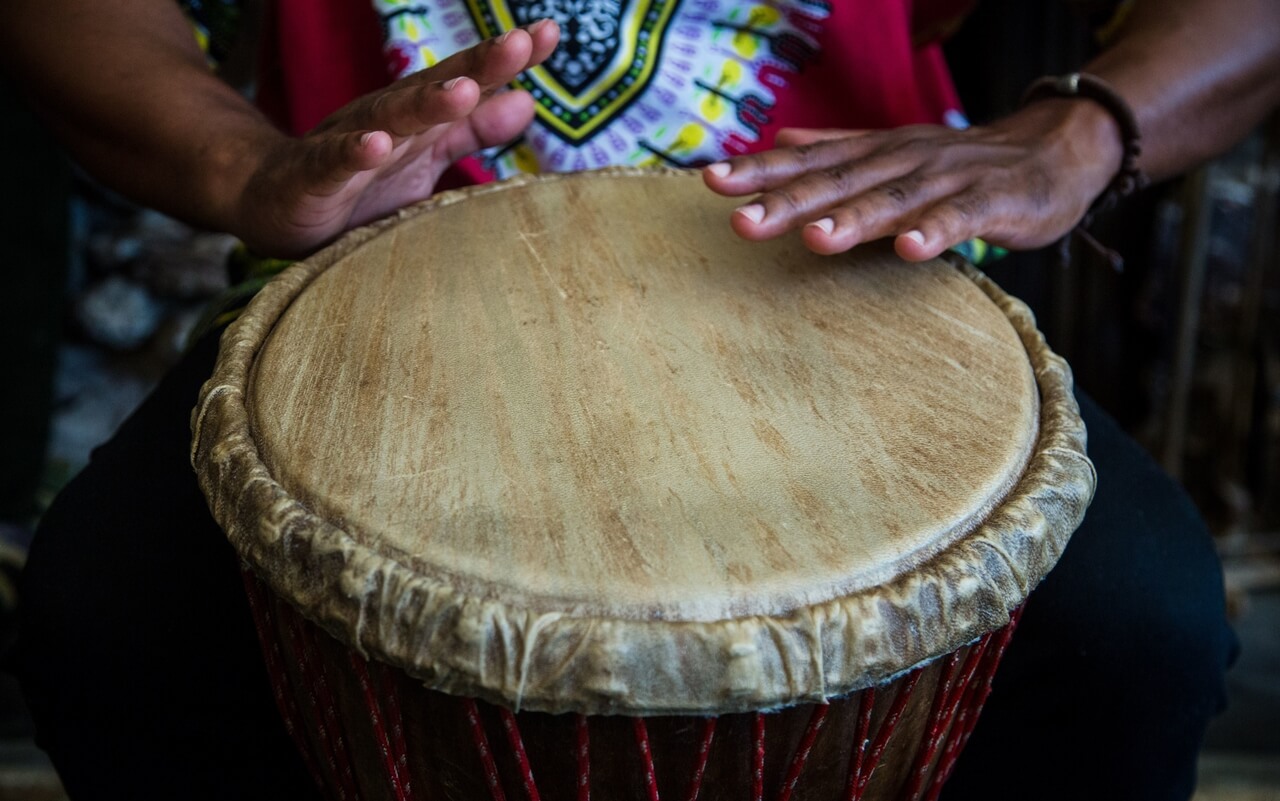
A group drumming circle is a shared, facilitator-guided practice where people play hand drums together to create a collective rhythm (Fancourt et al., 2016).
Last Updated
4 Jul 2026
We are still reviewing this page. Our research team checks every technique page for accuracy and evidence quality before final release. Details may change as that review completes. The evidence badge shows our current reading of the published research.
RECOMMENDED DOSE
A short introductory session is a conservative entry point: one peer-reviewed study observed physiological changes from as little as 15 minutes of drumming, while active drumming sessions in the wider literature run longer (about 40 minutes in), so the upper end blends evidence with a gentle starting range. Frequency of 1–2 sessions per week reflects the schedules used in controlled trials such as once-weekly and twice-weekly drumming programmes.
A typical established session length reflects the 40-minute djembe protocol studied for stress and cardiovascular effects and the roughly one-hour supervised classes used in a music-based training trial. Twice-weekly attendance over several weeks matches the protocols in a West African drum-circle trial for Parkinson's (6 weeks) and a randomised drum-training study (8 weeks).
A longer, maintenance-level commitment mirrors sustained programmes in the evidence base: once-weekly one-hour classes continued for 6 months, a 10-week group drumming programme for mental-health service users, and a 20-session group music-therapy course. Session length of about 45–60 minutes is drawn from the same active-session studies; the minutes-per-session specifics are less standardised than the weekly cadence.
Session length
Session length: 15–30 minutes
15
MIN
How long each individual practice session should last from start to finish.
Frequency
Frequency: 1–2 days
1
DAY
The number of days per week to fit a session into your routine.
Session length
Session length: 40–60 minutes
40
MIN
How long each individual practice session should last from start to finish.
Frequency
Frequency: 2 days
2
DAYS
The number of days per week to fit a session into your routine.
Session length
Session length: 45–60 minutes
45
MIN
How long each individual practice session should last from start to finish.
Frequency
Frequency: 1–2 days
1
DAY
The number of days per week to fit a session into your routine.
About this card. These recommendations synthesise doses reported across drumming and music-therapy trials; per-session minutes are less consistently reported than weekly frequency, so treat session lengths as guidance rather than fixed targets. These recommendations are not a substitute for personalised guidance from a qualified practitioner.
Quick answers to what people most often ask. Each card links to the deeper section below.
evidence
A ten-week controlled study of mental health service users found group drumming lowered depression and anxiety and strengthened social resilience, with gains holding at three months. Single sessions track with short-term stress relief, and immune and inflammation markers shift toward recovery. Most research is small and early-stage, so results are promising rather than settled.
good for
Group drumming suits adults carrying work-related stress and burnout, people using mental health services, and children needing support with social and emotional behaviour, since these are the groups studied so far. A small pilot suggests it supports quality of life for people with Parkinson's disease. It complements rather than replaces treatment for anxiety, depression, or trauma.
Read moresafety
Most healthy adults can join a group drumming circle safely. The fast, loud passages raise arousal by switching on the body's fight-or-flight system, which can feel overstimulating for sound-sensitive, neurodivergent, or trauma-affected people. Vigorous djembe playing works the body like light exercise, so pace yourself if your wrists, hands, or heart health need it.
Read morehow it works
Falling into step with a strong shared beat, called rhythmic entrainment, lets players follow the pattern almost automatically. Brain imaging of groups drumming together shows more aligned activity when players actively synchronise. Fast, vigorous playing raises energy for a charged release, while slower grooves shift the body toward its rest-and-recovery state, leaving people grounded and connected.
Read moreA participatory session in which people play hand drums together, guided by a facilitator or an emerging rhythm, to create a shared collective beat.
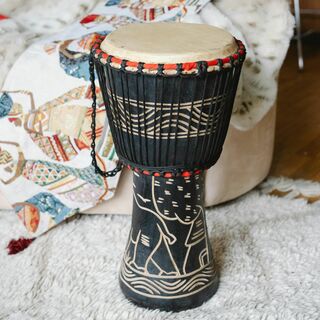
Participants sit in a circle and play hand drums such as the djembe, conga, or doumbek, either locking onto a facilitator's guiding pulse or letting patterns emerge on their own. Sessions often move between vigorous, cathartic passages and slower, settling grooves, and may weave in call-and-response or counting out loud. The practice is communal and largely non-verbal: each player coordinates their strikes with everyone else in real time, so it is done together as a group rather than alone.
A group drumming circle is participatory, meaning everyone plays rather than listening to a performance or resting through a sound bath. It differs from one-to-one music therapy and from solo drumming, and from receptive sound-healing sessions where a practitioner plays while others lie still. It is a wellbeing and connection practice, not a clinical treatment for anxiety, depression, or trauma, and shamanic-journey drumming is a related but separate application.
Not to be confused with
Solo drumming or private drum lessons
Learning drums one-to-one or practising alone builds technique and can aid focus, but it lacks the shared beat and group synchrony that carry a circle's connection and bonding.
Sound bath / receptive sound healing
Lying back to receive gongs, bowls or recorded tones is passive and restful, whereas a drumming circle is active, participatory beat-making that can be energising rather than purely calming.
Percussion performance or drumline
Performance percussion rehearses and presents music for an audience with real skill demands, while a wellbeing drumming circle is process-focused, needs no experience, and has no performance goal.
Group drumming appears to work through rhythmic entrainment, the way body and mind fall into step with a strong shared beat so the pattern is followed almost automatically rather than by effort. When people drum in groups of nine, brain imaging shows more coordinated, aligned activity across players' brains as they actively synchronise their beats, a pattern researchers call interpersonal neural synchrony (Liu et al., 2021). Faster, more vigorous playing tends to raise energy, engaging the body's fight-or-flight branch and producing a charged, cathartic release, while slower, structured grooves lean the other way, toward settling and recovery (Smith et al., 2014). People also describe the circle as grounding and connecting, which may be part of how it supports recovery (Perkins et al., 2016).
Being carried by a shared beat is the felt heart of a drumming circle: as players lock into a common tempo, the rhythm gives attention something steady to follow, and body and mind settle into the pattern with less effort. This is rhythmic entrainment, the way our internal rhythms fall into step with a strong outside pulse, and early brain-imaging work shows that when people actively synchronise their beats in a group, their brains produce more shared, coordinated activity (Liu et al., 2021).
Playing in time with others can bring a felt sense of moving as one unit, and brain imaging of group drumming links that shared groove to more coordinated, aligned activity across players' brains (Liu et al., 2021).
Playing in time with a group gives your nervous system a shared rhythm to organise around, which many people describe as feeling less stuck and more able to move between energised and settled. Brain imaging of drummers coordinating together shows more shared, aligned activity across the group (Liu et al., 2021), and participants often describe the circle as grounding (Perkins et al., 2016).
Fast, vigorous drumming can leave you feeling charged and energized rather than calm. Sustained playing works like light-to-moderate exercise, lifting heart rate and switching on the sympathetic nervous system, the body's fight-or-flight branch, which many people experience as a cathartic release (Smith et al., 2014).
Group drumming has been measured to shift the body's stress chemistry in the recovery direction. After a session, natural killer cell activity, part of the immune system's front-line defence, rose in healthy volunteers (Bittman et al., 2001), and across a ten-week programme markers of inflammation moved lower, among them interleukin-6 and TNF-alpha, which the body releases to drive inflammation (Fancourt et al., 2016), (Fancourt et al., 2015). Blood pressure has also been measured to fall after vigorous djembe sessions in older players (Smith et al., 2014). You do not feel these markers directly, but they tend to accompany the warmer, looser, less-braced feeling many people notice once the playing settles. Evidence that drumming specifically lowers cortisol, the stress hormone, is mixed and not consistently shown (Fancourt et al., 2015), (Bruno et al., 2014).
After playing together, many people feel looser and less guarded. In one study of healthy adults, that settled state came alongside a measured rise in natural killer cell activity, the immune cells that patrol the body for infected or stressed cells (Bittman et al., 2001). This shift runs opposite to the usual stress pattern, though it is not something you feel directly.
If ongoing stress leaves you feeling worn down and physically run-down, this is the marker sitting behind that feeling. Across a roughly 10-week drumming programme, interleukin-6, a protein the immune system releases to drive inflammation, moved lower as part of a wider shift toward a calmer, less inflamed profile (Fancourt et al., 2016), (Fancourt et al., 2015). You do not feel it in the moment, but over weeks of regular sessions it may show up as feeling steadier and less physically depleted.
Long stretches of stress can leave the body feeling inflamed and run-down. Over a ten-week drumming programme, one preliminary study measured a drop in TNF-alpha, an immune messenger that switches inflammation on, in adults using mental health services (Fancourt et al., 2015), (Fancourt et al., 2016). You cannot feel a cytokine beat by beat, but a lower reading fits the steadier, less run-down feeling many people describe after regular sessions.
Once the playing settles, many people feel warmer, looser, and less physically braced, and in one study of djembe players, systolic blood pressure, the top number that measures the push of blood against the artery walls while the heart beats, dropped in older participants after 40-minute sessions (Smith et al., 2014).

There's a moment in a drumming circle when the effort falls away and the rhythm seems to carry your hands along with everyone else's. That is motor-rhythm coordination, the body matching its movements to a shared external beat, and it is the core physical task of the circle, expected to sharpen with practice rather than measured directly, though studies of coordinated group drumming have recorded increased synchronization between players' brain activity (Liu et al., 2021).
Early-stage evidence, mostly from small studies, links group drumming with lower stress and burnout and steadier mood in high-strain workers such as nursing students and social workers (Bittman et al., 2004), (Maschi et al., 2012), and with reduced depression and anxiety and stronger social resilience in adults using mental health services (Fancourt et al., 2016). Single sessions have been associated with short-term drops in felt stress and anxiety (Smith et al., 2014), and separate studies report better social and emotional behaviour in children (Ho et al., 2010) and improved quality of life in a small Parkinson's pilot (Pantelyat et al., 2015). Not yet established: large randomised trials, long-term follow-up, and any claim that drumming replaces treatment for a diagnosed condition. The studies are mostly small and drawn from specific groups, and the evidence that drumming lowers cortisol is mixed (Fancourt et al., 2015), (Bruno et al., 2014).
Playing a shared beat in a drumming circle gives built-up tension somewhere to go. Nursing students and social workers reported lower stress and burnout and steadier mood after regular group drumming (Bittman et al., 2004), (Maschi et al., 2012), and single sessions have been linked with short-term drops in felt stress (Smith et al., 2014).
Playing in time with other people builds a felt sense of being in something together, and drummers often describe leaving a circle feeling more connected and less alone. In early studies with social workers and nursing students, group drumming was linked with greater connectedness and lower burnout (Maschi et al., 2012), (Bittman et al., 2004).
The wound-up, tense feeling can settle within a single session of active drumming. In one study of djembe players, a 40-minute session lowered scores on a stress-and-anxiety measure right after playing, and the physical effort counted as light-to-moderate exercise (Smith et al., 2014).
The exhaustion and cynicism of a demanding caregiving job can build until ordinary rest no longer touches it. Small pilot programmes suggest that regular group drumming, used as a self-care activity, may ease that stress and burnout while lifting mood and a sense of connection with colleagues (Bittman et al., 2004), (Maschi et al., 2012).
Moving to a shared pulse can make effortful movement feel more fluid and turn a session into a sociable, music-filled hour rather than another exercise task. In a small pilot study, adults with Parkinson's disease who took twice-weekly West African drum-circle classes reported better quality of life over six weeks (Pantelyat et al., 2015).
The clearest finding is that ten weeks of group drumming tracked with lower depression and anxiety and stronger social resilience in adults using mental health services, with gains holding at three months (Fancourt et al., 2016). Smaller studies link sessions with short-term stress relief (Smith et al., 2014), with immune markers tied to the body's defences, and with rises in oxytocin, a hormone tied to social bonding (Bittman et al., 2001), (Yuhi et al., 2017), as well as benefits for children and people with Parkinson's (Ho et al., 2010), (Pantelyat et al., 2015). Most of this rests on small, early-stage trials in particular groups, and some findings are mixed, so it is best read as promising rather than settled.
0
Meta-analyses
1
RCTs
0
Systematic reviews
0
Observational
13
Pilot
Studied populations
Effects of Group Drumming Interventions on Anxiety, Depression, Social Resilience and Inflammatory Immune Response among Mental Health Service Users
2016
Finding: Over 10 weeks of weekly group drumming, adults using mental health services reported meaningfully lower depression and anxiety and stronger social resilience than a comparison group that did no music, and those gains were still present three months later. Saliva samples also pointed to a shift toward a less inflammatory immune profile across the programme, hinting that the calmer mood may be echoed in the body. For someone considering a drumming circle, this suggests that showing up regularly to play with others may lift mood and deepen a sense of connection, not just fill an hour. Keep in mind this was a single, early-stage study in which people were grouped by location rather than assigned at random, so the results are encouraging but not yet proof that drumming alone caused the change.
effect = -3.41
Composite effects of group drumming music therapy on modulation of neuroendocrine-immune parameters in normal subjects.
n = 111
Finding: In a study of 111 healthy adults, a structured group-drumming session shifted several stress-related markers in the opposite direction to the body's usual stress reaction: it raised the DHEA-to-cortisol ratio (a hormonal balance linked to recovery rather than strain) and boosted the activity of natural killer and lymphokine-activated killer cells, part of the immune system's front line. Interestingly, those biological changes were not matched by movement on standard anxiety and depression questionnaires, so participants did not necessarily score as feeling less anxious or low after the session. For someone considering a drumming circle, this hints that the practice may engage the body's stress-and-recovery systems even when a mood questionnaire shows little change, though the finding comes from a single trial in healthy volunteers and should be read as an early signal rather than proof of a health benefit.
Group drumming draws on percussion's long place in communal ritual and healing across many cultures, where a shared beat has been a way of belonging, releasing, and marking transitions together. Modern circles adapt that heritage into a participatory wellbeing practice, and some studies note drumming's ancient ritual background as context (Bittman et al., 2001), (Pantelyat et al., 2015). These roots help explain the practice's form, its communal circle and collective pulse, rather than proving any clinical effect.
For most healthy adults, a group drumming circle is a low-risk and often energizing practice, and two situations simply call for a little care. During the fast, loud, high-energy passages, the body's sympathetic nervous system, the fight-or-flight branch that speeds the heart and readies you for action, switches on, so these stretches can feel overstimulating rather than settling if you are sound-sensitive or already keyed up. Softening your playing or resting for a few bars is always fine. Vigorous djembe drumming also works the body like light-to-moderate exercise, warming and working the hands and heart, so it is worth pacing yourself if your wrists, hands, or cardiovascular health need it (Smith et al., 2014). And because group drumming is a wellbeing and connection practice, it is best used to complement rather than replace treatment for anxiety, depression, or trauma.
People who are sound-sensitive or neurodivergent, and anyone working with recent trauma, may find the loud, high-tempo sections activating rather than grounding, because forceful drumming drives sympathetic arousal, the body's revved-up, ready-for-action state. Asking a facilitator for lower volume, a gentler tempo, or the freedom to step out keeps the experience manageable. Anyone with cardiovascular concerns or wrist and hand problems can treat vigorous drumming as they would any light workout and pace accordingly, since sustained djembe playing raised heart rate and shifted systolic blood pressure, the pressure inside the arteries while the heart beats, in older players (Smith et al., 2014). And if you are managing a diagnosed anxiety, depression, or trauma condition, use drumming alongside professional care rather than in place of it.
The loud, high-tempo passages switch on the body's fight-or-flight branch, so they can feel activating rather than grounding if you are sound-sensitive, neurodivergent, or already keyed up. Soften your playing, rest for a few bars, or ask the facilitator for lower volume, a slower tempo, or the freedom to step out. Agreeing you can leave at any point keeps the experience manageable (Smith et al., 2014).
| Technique | Best for | Use with care | Evidence strength | Distinction |
|---|---|---|---|---|
| Community singing / group choir | People drawn to melody, lyrics and voice, or wanting a lower-impact seated group music activity. | If the physical, exercise-like release of striking a drum is the appeal, singing offers little of that. | moderate EVIDENCE | Community singing is a group vocal practice that shares a drumming circle's communal, largely non-verbal bonding, but it carries the music with the voice rather than the hands and beat, and tends to be more seated and lower-impact than vigorous djembe playing. |
| Formal group music therapy | People wanting structured, goal-directed treatment from a trained therapist, often within mental health services. | A drop-in community circle is not a substitute for assessed, individualised therapy when a diagnosed condition needs treatment. | moderate EVIDENCE |
No. A group drumming circle is a facilitator-guided, largely wordless group practice that needs no prior experience or musical skill, you listen for the shared pulse and join in (Fancourt et al., 2016).
+
No. Drumming circles are about taking part rather than performing, so anyone can join: a facilitator either guides the beat or lets a rhythm emerge, and you settle in, catch the pulse, and add your strikes (Fancourt et al., 2016), (Fancourt et al., 2015). A first session can feel a little awkward before the group locks in together, and the sense of flow usually deepens with practice. This describes the practice format, not a clinical or treatment claim.
No. A drumming circle is active, participatory beat-making done as a group, where you play hand drums to a shared rhythm, while a sound bath is receptive: you lie back and take in gongs, bowls or recorded tones (Fancourt et al., 2016).
+
No. The difference is participation: in a drumming circle you actively play a hand drum and lock onto a collective beat, so it can feel energising as well as settling, whereas a sound bath is receptive, you rest and take in the sound rather than make it (Fancourt et al., 2016), (Fancourt et al., 2015). Neither is presented here as clinically better than the other, and evidence for group drumming is still early-stage, so choose by what you want from the session rather than a proven advantage.
The tendency for the body's rhythms, brain activity, movement, heartbeat, and breath to fall into step with a strong external beat, so following the pattern starts to feel almost automatic rather than effortful.
Synchronisation of neural and physiological oscillations to an external rhythmic stimulus.
When people actively coordinate a shared beat, their brain activity becomes more aligned with one another's, not just with the rhythm, which researchers link to the felt sense of being in it together.
The moment-to-moment balance between the nervous system's stress-and-go branch and its rest-and-recover branch, describing whether the body is sitting nearer alertness or nearer recovery.
The relative activity of sympathetic and parasympathetic (vagal) tone within the autonomic nervous system.
Increased activity in the body's fight-or-flight branch, felt as a faster heartbeat, more energy, and heightened alertness, the charged state vigorous drumming can produce.
Heightened activity of the sympathetic branch of the autonomic nervous system, mobilising the body for action.
NK cells are immune cells that seek out and destroy virus-infected or stressed cells; their activity level is one marker of immune readiness that has been measured to rise after drumming.
The cytotoxic function of natural killer lymphocytes, part of the innate immune response.
Chemical messengers the immune system uses to switch inflammation on; lower pro-inflammatory levels reflect a calmer, less inflamed state.
Signalling proteins that regulate immune and inflammatory responses; IL-6 and TNF-alpha are pro-inflammatory markers.
D. Fancourt, R. Perkins, Sara Ascenso, L. Carvalho, A. Steptoe, Aaron Williamon (2016). Effects of Group Drumming Interventions on Anxiety, Depression, Social Resilience and Inflammatory Immune Response among Mental Health Service Users. https://doi.org/10.1371/journal.pone.0151136
Cited in: Benefits, Faq, Research, Use with care, What happens in the body, What it is
Barry B. Bittman, L. Berk, D. Felten, J. Westengard, O. C. Simonton, J. Pappas (2001). Composite effects of group drumming music therapy on modulation of neuroendocrine-immune parameters in normal subjects..
Cited in:
Explore guided sessions to deepen your Group Drumming Circle technique.
As your hands lock onto the group's beat, playing starts to feel smoother and more automatic, drawing on sensorimotor coordination, the brain-and-body linking of movement to rhythm. Studies of group drumming show more synchronized neural activity across players as they settle into a shared pulse (Liu et al., 2021), and a small Parkinson's pilot linked rhythmic drum-circle classes with improved movement-related quality of life (Pantelyat et al., 2015).
When you feel wired but drained, playing a shared beat can leave tension easing and breathing settling into a grounded, connected calm. That points to sympathovagal balance, the moment-to-moment tilt between the body's stress-and-go branch and its rest-and-recover branch; it hasn't been measured directly in drumming, but stress-linked body chemistry shifts the recovery way, with the DHEA-to-cortisol ratio rising and inflammatory markers falling (Bittman et al., 2001), (Fancourt et al., 2016).
Outcomes measured
| Outcome | Effect size | 95% CI | N | Comparator | Source |
|---|---|---|---|---|---|
| depression (week 10) | effect = -3.41 | -4.68 to -2.15 | — | non-music control | Fancourt et al., 2016 |
| anxiety (week 10) | effect = -2.21 | -3.24 to -1.19 | — | — | Fancourt et al., 2016 |
| social resilience (week 10) | effect = 10.59 | 6.94 to 14.24 | — | — | Fancourt et al., 2016 |
| Stress Anxiety Index reduction | reported significant; P<0.01 to P<0.001 | — | — | — | Smith et al., 2014 |
| Total, internalizing, anxiety, and PTSD problems | reported significant; P<.01 to P<.001 | — | — | — | Ho et al., 2010 |
| PDQ-39 quality of life (baseline to 6 weeks) | effect = -5.8 | — | — | — | Pantelyat et al., 2015 |
The research is early-stage and mostly small, with few randomised trials, short follow-up, and participants drawn from specific groups such as mental health service users, care workers, and children, so results may not transfer to everyone and some people may notice more or less than the averages suggest. Some numbers are significance-only, meaning a study reports that a change was unlikely to be chance without saying how large it was. Evidence that drumming lowers cortisol, the body's main stress hormone that many people expect a calming practice to reduce, is mixed, and group drumming can support wellbeing and connection but is not a replacement for care (Fancourt et al., 2016), (Fancourt et al., 2015), (Bruno et al., 2014).
reported narratively
The Impact of Group Drumming on Social‐Emotional Behavior in Low‐Income Children
2010
Finding: Over 12 weeks, fifth-graders in two low-income classrooms took part in group drumming led by a school counselor, and their teachers rated them as showing fewer overall behavior problems, along with lower anxiety, fewer withdrawn or internalizing struggles, and fewer signs of post-traumatic stress, compared with classrooms that had standard lessons. For a child, this suggests that a shared, non-verbal rhythm activity in a familiar school setting may help ease everyday emotional strain without feeling like therapy. The results come with real limits, though: the comparison groups were not randomly assigned, and all the improvements were scored by teachers rather than measured directly, so this is an encouraging early signal rather than proof that drumming treats any specific condition.
reported significant; P<.01 to P<.001
Promoting well-being through group drumming with mental health service users and their carers.
2018
Finding: Talking with mental health patients and carers about their experience of group drumming, this study drew out why the practice can feel supportive: drumming lets people communicate and steady themselves through rhythm rather than words, the shared circle builds a sense of belonging and safety, and because there are no wrong notes, the usual fear of "getting it wrong" falls away. For someone considering it, that points to group drumming as a low-pressure way to feel connected and grounded alongside others, not a solo skill to master. These are lived-experience accounts from a specific group, so they describe how the practice helps people rather than proving a measurable clinical effect.
See full citation in referencesTeam-work, Team-brain: Exploring synchrony and team interdependence in a nine-person drumming task via multiparticipant hyperscanning and inter-brain network topology with fNIRS
n = 180
Finding: When 180 adults drummed in groups of nine while their brain activity was measured, those who actively coordinated their beats with the group, rather than following a metronome or drumming randomly, showed more synchronized activity across their brains and reported feeling more connected and interdependent. This points to the shared rhythm itself, and the attention it takes to lock in with others, as a big part of what makes group drumming feel bonding. It's worth noting this was a short lab task with healthy adults, so it shows how coordinated drumming shifts brain activity in the moment, not that it delivers specific long-term health benefits.
reported narratively
African drumming: a holistic approach to reducing stress and improving health?
2014
Finding: In this experimental study, a single 40-minute djembe drumming session left both seasoned middle-aged drummers and younger newcomers with measurably lower stress and anxiety scores right afterward, and the older group also showed a drop in systolic blood pressure. The researchers classed the drumming itself as low-to-moderate intensity exercise, so a session can double as gentle physical activity while it settles the nervous system. Keep in mind this was a small study that measured changes from one session rather than long-term practice, and there was no randomised comparison group, so it points to a promising short-term lift rather than proof that drumming manages blood pressure or replaces cardiovascular care.
reported significant; P<0.01 to P<0.001
Making music for mental health: how group drumming mediates recovery.
2016
Finding: In interviews with 39 mental health patients and carers in the UK who had recovered while taking part in group djembe drumming, participants pointed to a few consistent ingredients behind the benefit: rhythm let them communicate and feel grounded without needing words, the group offered a sense of belonging and safety, and the inclusive setup meant there were no wrong notes, so "mistakes" simply dissolved. For someone considering a drumming circle, this suggests the value may lie as much in the shared, non-judgmental space as in the drumming itself. Because this was a qualitative study of people's own accounts rather than a controlled trial, it describes how drumming may support recovery but does not measure or prove a clinical effect.
See full citation in referencesDRUM‐PD: The Use of a Drum Circle to Improve the Symptoms and Signs of Parkinson's Disease (PD)
2015
Finding: In a small pilot trial, people with Parkinson's disease who took twice-weekly West African drum-circle classes for six weeks reported a meaningful lift in quality of life, while a comparison group who didn't drum stayed about the same. Most of the physical and thinking-related measures the researchers tracked, including walking, didn't change significantly, so the clearest gain was in how people felt about daily life rather than in motor symptoms. With only about ten participants per group, this is very early evidence, and drumming should be seen as a possible complement to, not a replacement for, physical therapy.
effect = -5.8
Salivary Oxytocin Concentration Changes during a Group Drumming Intervention for Maltreated School Children
2017
Finding: In a small exploratory study of maltreated children living in a group home, saliva samples showed that levels of oxytocin, a hormone tied to social bonding and trust, rose on average after sessions of Taiko, a Japanese style of group drumming. The change was uneven, though: some children showed clear rises, others little or no change, and the difference between drumming and ordinary free play held up mainly for boys aged 8 to 12. So while playing drums together may help some children feel more connected, this early research points to a possible effect rather than a reliable one, and it hasn't been tested beyond this specific group.
reported narratively
Group drumming and well-being: A promising self-care strategy for social workers
n = 73
Finding: In this pilot study, 73 social workers took part in a two-hour group drumming session and afterward reported lower stress along with a stronger sense of empowerment and connection to others, with the improvements landing in the medium range. For someone in a demanding, people-facing job, that hints group drumming may offer a quick, sociable way to reset and feel more energised and connected to colleagues. Keep in mind this was a small, single-session study that compared each person against their own starting point with no comparison group, so it points to promise rather than proof, and the gains rest on how people rated their own feelings.
reported narratively
Recreational Music-making: An Integrative Group Intervention for Reducing Burnout and Improving Mood States in First Year Associate Degree Nursing Students: Insights and Economic Impact
2004
Finding: In this study, nursing students who took part in Recreational Music-Making group drumming sessions reported lower burnout and less mood disturbance afterward, pointing to group drumming as a practical way to blow off steam and reset during high-pressure training. For someone drawn to the practice, that suggests regular drumming circles may help ease the emotional wear of a demanding job or program while offering a shared, energizing outlet. Keep in mind this was an early pilot without a comparison group and relied on participants rating their own moods, so the results are encouraging rather than definitive, and drumming is best treated as one supportive self-care habit rather than a guaranteed fix for burnout.
See full citation in referencesGroup Drumming Modulates Cytokine Response in Mental Health Services Users: A Preliminary Study.
2015
Finding: In a preliminary 6-week programme of weekly group drumming sessions with adults using mental health services, saliva samples showed a shift away from a pro-inflammatory immune profile toward a calmer, anti-inflammatory one over the course of the programme. Notably, the same study found no drop in cortisol, the body's main stress hormone, so the appeal of drumming together looks more about a gradual change in immune signalling than an immediate stress-hormone effect. This was a small, early-stage study without a strong comparison group, so treat it as an encouraging hint rather than proof, and see the practice as a shared, enjoyable activity rather than a medical treatment.
See full citation in referencesThe use of group drumming-based music therapy with male adolescents in a school violence prevention program in Korea: A pilot study
2022
Finding: In a small school pilot with teenage boys in Korea, one class took part in a group drumming program while another had a standard character-education class, and the drumming group came out lower specifically on anger, the emotional heat behind aggression. The other measures the study tracked, physical aggression, verbal aggression, and general hostility, showed no clear difference between the two groups. So if you are drawn to drumming, this hints it may help take the edge off anger in particular, rather than reshape aggressive behaviour broadly. Keep in mind this was one small, early-stage trial in a narrow group of adolescents, so it is a promising signal rather than settled proof.
See full citation in referencesExploring shamanic journeying: repetitive drumming with shamanic instructions induces specific subjective experiences but no larger cortisol decrease than instrumental meditation music.
2014
Finding: This study had people listen to 15 minutes of either repetitive drumming or instrumental meditation music, then measured cortisol, a hormone the body releases under stress. Drumming did not lower cortisol any more than the meditation music did, so there was no stress-hormone benefit unique to the drumming itself. For anyone drawn to drumming, this suggests the calming payoff may come from the broader act of listening and settling in rather than from the drum rhythm specifically, and because the test was a single short session, it says nothing about what a regular group drumming practice might do over weeks or months.
See full citation in referencesVigorous djembe drumming works the body like light-to-moderate exercise, warming and working the hands and heart and raising heart rate. If your wrists, hands, or cardiovascular health need care, warm up with gentle taps, treat the fast passages as you would a brisk activity, and pace yourself, easing off when your hands, wrists, or breath signal fatigue (Smith et al., 2014).
Forceful, high-tempo drumming drives sympathetic arousal, the body's revved-up, ready-for-action state, which some people working with recent trauma may find activating rather than grounding. Ask a facilitator for lower volume, a gentler tempo, or the freedom to step out, and use the circle in a way that stays grounding. This is a caution inferred from how the practice works, not evidence of harm (Perkins et al., 2016).
Group drumming is a wellbeing and connection practice, so it is best used to complement rather than replace care. If you are managing a diagnosed anxiety, depression, or trauma condition, keep drumming alongside professional treatment rather than in place of it (Fancourt et al., 2016).
A group drumming circle is best approached as something you shape to your own comfort rather than a performance to keep up with, so let yourself ease in gently and stay tuned to what your body is telling you. A sensible starting format is a facilitated circle where softening your playing, resting for a few bars, or stepping out for a moment is always welcome, which gives sound-sensitive players and anyone pacing their heart, hands, or wrists room to enjoy the energy without being overwhelmed by it.
Sit comfortably in the circle, let your shoulders drop, and listen for a beat or two before you join, so your first strikes land with the group rather than against it.
Start with soft, easy taps and gentle wrist circles before any forceful playing, which protects the small joints and muscles that do most of the work.
You do not have to match the loudest or fastest player. Strike more softly, play every other beat, or drop out entirely whenever the sound feels like too much.
Fast, forceful drumming raises heart rate and works the body like light-to-moderate exercise, so treat energetic stretches as you would a brisk activity and ease off if your heart, breath, hands, or wrists signal fatigue.
Agree with the facilitator that stepping back, resting, or leaving the circle for a moment is always welcome. This matters most if you are sound-sensitive, neurodivergent, or working with trauma.
Use the circle for connection, release, and wellbeing, and continue any treatment you rely on for a diagnosed anxiety, depression, or trauma condition rather than substituting drumming for it.
This information is educational and is not medical advice. This practice is not a substitute for professional care and should not replace prescribed medication or treatment for any medical or mental-health condition. If you are managing a health condition or taking medication, talk with a qualified health professional before changing your practice. If you are in distress or crisis, seek professional support.
| Music therapy is a clinician-delivered treatment tailored to assessed individual goals, whereas a drumming circle is a facilitated wellbeing activity open to anyone, not a prescribed clinical intervention with a trained therapist directing the work. |
| Shamanic drumming journey (solo, receptive) | People seeking inward, trance-like or spiritual experiences on their own. | emerging EVIDENCE | Shamanic journeying uses steady, repetitive drumming, often listened to rather than played, to induce a trance-like inner state and imagery. Its aim is individual and contemplative, quite unlike the communal, active beat-making of a circle. |
| Group cognitive behavioural therapy | People who want an evidence-based talking treatment targeting specific anxiety or depression symptoms. | Choose structured therapy over a drumming circle when symptoms need targeted clinical treatment. | strong EVIDENCE | Group CBT works through structured talking and skills practice aimed at specific thoughts and behaviours, while drumming works non-verbally through rhythm and shared activity, so the two reach wellbeing by very different routes despite the shared group setting. |
Likely, in a limited way. Small early studies link group drumming with short-term drops in felt stress and with lower stress and burnout in high-strain groups like nursing students and social workers (Smith et al., 2014), (Bittman et al., 2004). It reads as promising rather than proven, and it is not a substitute for care.
+
Likely, within limits. Single sessions have been linked with short-term drops in felt stress and anxiety (Smith et al., 2014), and regular sessions with lower stress and burnout in high-strain groups such as nursing students and social workers (Bittman et al., 2004), (Maschi et al., 2012). The picture is suggestive, not settled: the studies are mostly small and drawn from specific groups, and evidence that drumming lowers cortisol, the body's main stress hormone, is mixed (Fancourt et al., 2015), (Bruno et al., 2014). It may support stress relief and connection, but it is not a replacement for treatment.
Not reliably. Evidence that drumming lowers cortisol, the body's main stress hormone, is mixed and has not been consistently shown, so it is best treated as an open question rather than a settled finding (Fancourt et al., 2015), (Bruno et al., 2014).
+
Not reliably. Some studies report stress-related shifts after drumming, but the specific claim that it lowers cortisol, the hormone the body releases under stress, has not held up consistently, and the research is early-stage and mostly small (Fancourt et al., 2015), (Bruno et al., 2014), (Fancourt et al., 2016). Drumming may still support a felt sense of stress relief even where a measurable cortisol drop is not demonstrated, so the honest read is a calming experience for many people, not a proven cortisol-lowering effect.
Possibly. In small early studies, a single session was linked to a rise in natural killer cell activity, part of the immune system's front-line defence, and a ten-week programme tracked with a less inflammatory profile (Bittman et al., 2001), (Fancourt et al., 2016). This is a suggestive association, not proof that drumming boosts immunity or prevents illness.
+
Possibly, though this is an early signal rather than a confirmed effect. Small studies have measured a rise in natural killer cell activity, immune cells that target infected or stressed cells, after a drumming session (Bittman et al., 2001), and a ten-week programme tracked with lower pro-inflammatory markers such as IL-6 and TNF-alpha, chemical messengers the body uses to switch inflammation on (Fancourt et al., 2016), (Fancourt et al., 2015). Evidence that drumming lowers cortisol, the main stress hormone, is mixed (Fancourt et al., 2015), (Bruno et al., 2014), and in at least one study immune changes appeared without matching shifts on mood questionnaires (Bittman et al., 2001). These are early-stage associations in small samples, not a clinical immune treatment.
Likely because your body syncs with the group. When people actively lock onto a shared beat, brain imaging shows more aligned activity across players, called interpersonal neural synchrony, and drumming has been measured to raise oxytocin, a hormone tied to social bonding (Liu et al., 2021), (Yuhi et al., 2017). These are small, indirect studies, so read it as a plausible explanation, not settled proof.
+
Likely because rhythm pulls several nervous systems into step at once. In a nine-person drumming task, players who actively synchronised their beats showed more coordinated, aligned brain activity with one another, interpersonal neural synchrony, not just alignment to the rhythm (Liu et al., 2021). Group drumming has also been linked with rises in oxytocin, a hormone associated with social bonding, though this was measured in children (Yuhi et al., 2017). People in drumming programmes describe the circle itself as grounding and connecting (Perkins et al., 2016), (Ascenso et al., 2018). These findings come from small, indirectly measured studies, so they help explain the felt sense of togetherness rather than prove a clinical effect.
Yes, it can. The loud, fast passages raise arousal by switching on the body's fight-or-flight branch, so they may feel overstimulating rather than settling if you are sound-sensitive or already keyed up. Playing more softly, resting a few bars, or asking for a gentler tempo keeps it manageable (Smith et al., 2014).
+
Yes, it can. Vigorous, high-tempo drumming drives sympathetic arousal, the body's revved-up, ready-for-action state, and works you like light-to-moderate exercise, so the loudest stretches can feel activating rather than grounding for sound-sensitive or neurodivergent people (Smith et al., 2014). This is a mild caution inferred from how the practice works, not evidence of harm. Practical steps help: soften your playing, rest for a few bars, ask a facilitator for lower volume or a slower tempo, or step out. Participants describe the circle as most supportive when it stays grounding rather than overwhelming (Perkins et al., 2016).
Just show up and listen first. Sit comfortably, catch the shared beat for a bar or two before you join, start with soft taps to warm up your hands and wrists, and set your own volume and tempo, you can play every other beat, ease off, or step out anytime.
+
Just show up and listen first, no experience is needed. Find the group's pulse before you play, warm up with gentle taps and wrist circles, and pick a volume and tempo that suit you rather than matching the loudest player. Because vigorous djembe playing works the body like light-to-moderate exercise and can raise heart rate, pace the fast, forceful passages as you would a brisk activity and rest if your hands, wrists, or breath signal fatigue (Smith et al., 2014). Agreeing with the facilitator that you can step back or leave at any point keeps a first session feeling manageable.
A drumming circle is a facilitator-led, drop-in wellbeing activity open to anyone, while music therapy is clinician-delivered, individually assessed, goal-directed treatment. A circle can support connection and release, but it is not a substitute for assessed therapy when a diagnosed condition needs care (Fancourt et al., 2016).
+
The core difference is the setting and who leads. A group drumming circle is a shared, facilitator-guided session where people play hand drums together for wellbeing and connection, with no assessment, treatment plan, or clinical goals (Fancourt et al., 2016), (Fancourt et al., 2015). Music therapy is delivered by a trained therapist who tailors the work to an individual's assessed needs. This is a descriptive distinction, not a claim that either matches the other in effectiveness; when anxiety, depression, or trauma need treatment, a drumming circle should complement rather than replace professional care.
A hormone tied to social bonding and trust, which has been measured to rise after group drumming sessions in children.
A hypothalamic neuropeptide involved in social affiliation, bonding, and stress modulation.
A brain-imaging method that records several people's brain activity at the same time, used to see how coordinated their activity becomes while drumming together.
Simultaneous functional near-infrared spectroscopy recording across multiple participants to measure inter-brain coupling.
A structured, facilitator-led group drumming format designed for wellbeing and stress reduction rather than musical performance.
A standard questionnaire measuring how much Parkinson's disease affects a person's day-to-day quality of life.
The 39-item Parkinson's Disease Questionnaire, a validated health-related quality-of-life instrument.
Ping Ho, Jennie C.I. Tsao, Lian Bloch, Lonnie K. Zeltzer (2010). The Impact of Group Drumming on Social‐Emotional Behavior in Low‐Income Children. https://doi.org/10.1093/ecam/neq072
Sara Ascenso, Rosie Perkins, Louise Atkins, Daisy Fancourt, Aaron Williamon, Ascenso Sara (2018). Promoting well-being through group drumming with mental health service users and their carers.. https://doi.org/10.1080/17482631.2018.1484219
Cited in: Faq, How it works, Research
Tao Liu, Lian Duan, Ruina Dai, Matthew Pelowski, Chaozhe Zhu (2021). Team-work, Team-brain: Exploring synchrony and team interdependence in a nine-person drumming task via multiparticipant hyperscanning and inter-brain network topology with fNIRS. https://doi.org/10.1016/j.neuroimage.2021.118147
Cited in: Faq, How it works, Research, What happens in the body
Carine Smith, Jeandré T. Viljoen, Lauren McGeachie, Smith Carine, Viljoen Jeandre T, McGeachie Lauren (2014). African drumming: a holistic approach to reducing stress and improving health?. https://doi.org/10.2459/jcm.0000000000000046
Cited in: Benefits, Faq, How it works, Research, Use with care, What happens in the body, Who should use care
Rosie Perkins, Sara Ascenso, Louise Atkins, Daisy Fancourt, Aaron Williamon, Perkins Rosie (2016). Making music for mental health: how group drumming mediates recovery.. https://doi.org/10.1186/s13612-016-0048-0
Cited in: Faq, How it works, Research, Use with care
Alexander Pantelyat, Candace Syres, Suzanne Reichwein, Allison W. Willis (2015). DRUM‐PD: The Use of a Drum Circle to Improve the Symptoms and Signs of Parkinson's Disease (PD). https://doi.org/10.1002/mdc3.12269
Cited in: Benefits, Research, Roots and tradition, What happens in the body
Teruko Yuhi, Hiroaki Kyuta, Hisa-aki Mori, Chihiro Murakami, Kazumi Furuhara, Mari Okuno (2017). Salivary Oxytocin Concentration Changes during a Group Drumming Intervention for Maltreated School Children. https://doi.org/10.3390/brainsci7110152
Cited in: Faq, Research, What happens in the body
Tina Maschi, Thalia MacMillan, Deborah Viola (2012). Group drumming and well-being: A promising self-care strategy for social workers. https://doi.org/10.1080/17533015.2012.748081
Barry Bittman, Cherie Snyder, Katharina Bruhn, Fran Liebfreid, Christine Stevens, James C. Westengard (2004). Recreational Music-making: An Integrative Group Intervention for Reducing Burnout and Improving Mood States in First Year Associate Degree Nursing Students: Insights and Economic Impact. https://doi.org/10.2202/1548-923x.1044
Daisy Fancourt, Rosie Perkins, Sara Ascenso, Louise Atkins, S. Kilfeather, Lívia A. Carvalho (2015). Group Drumming Modulates Cytokine Response in Mental Health Services Users: A Preliminary Study.. https://doi.org/10.1159/000431257
Cited in: Benefits, Faq, Research, What happens in the body, What it is
Eun Sil Suh (2022). The use of group drumming-based music therapy with male adolescents in a school violence prevention program in Korea: A pilot study. https://doi.org/10.1177/03057356221108431
Cited in: Research
Gingras Bruno, Pohler Gerald, Fitch W Tecumseh (2014). Exploring shamanic journeying: repetitive drumming with shamanic instructions induces specific subjective experiences but no larger cortisol decrease than instrumental meditation music.. https://doi.org/10.1371/journal.pone.0102103
Cited in: Benefits, Faq, Research, What happens in the body
Editorially curated. Tracks are not themselves clinically studied; evidence on the page applies to Group Drumming Circle as a technique.
Beginner content for Group Drumming Circle

★ 4.8
·
Music
·
15 min
Matías Borracine
How hard is Group Drumming Circle?
Group drumming keeps a real physical floor on top of the modality default, so it lands above the gentler sound rows.
3
Mental Effort
2 / 4
▾Emotional Depth
1 / 4
▾Physical Intensity
3 / 4
▾Prior Knowledge
2 / 4
▾