Welcome to your practice.
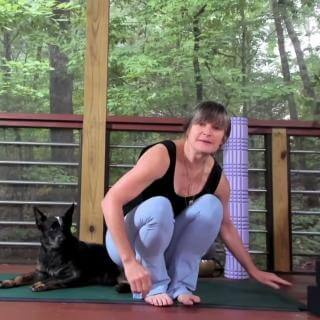
I'm Rebecca and I've got Nova here and hopefully she'll move for me.
Gather your props.
Two myofascial release balls,
If you have those,
Or tennis balls.
A foam roller,
But if you have the balls,
You don't need the foam roller.
But if you want to try the tooth,
It's always nice to have.
Blocks.
Yoga blocks if you have those.
A bolster.
Potentially,
We might need it.
A blanket just for some support and a strap if you don't have the balls this might be a nice thing to use.
Okay,
Well,
Let's arrive.
And just noticing how your body feels.
Noticing.
The right side of the body.
Breathing into the right nostril.
And breathing out through the nose.
The right nostril.
And then breathing into the left side of the body,
Into the left nostril.
And breathing out through the left nostril.
And breathing out through both nostrils.
Breathing in through both nostrils.
Filling up,
Just noticing how you're feeling.
And any tension that might bubble up.
Or thoughts or anxieties.
Just noticing.
And then letting them go on the exhale.
Beautiful.
So along the practice today,
The invitation to use your breath anytime tension bubbles up.
You can notice and then let it go.
And just the idea of letting go.
Awesome.
And let's start with an acupressure point today,
Right below the collarbones,
If I can speak,
Below the collarbones.
Start tapping there.
This is kidney 27 and it's a really nice.
Place for an energetic reset.
So I'm just at the soft space underneath the collarbones.
This is tapping.
And you can go above the collarbones if you wanted to.
We're getting into the lumps,
The ducts,
The lump ducts.
Where the lymph returns back towards the heart to clear out.
Beautiful.
And you can go down towards the center of the heart,
Conception vessel 17.
If that feels okay at the sternum.
Beautiful,
And just pause and feeling those vibrations through the body.
Okay.
So let's start with some tools.
So I've got the Myofascial Release Balls.
Hi Poonam,
It's so good to see you.
I've got the myofascial release balls,
And we'll start today at the,
Let's start at the glutes,
Right at the center of each buttocks.
We'll start at the piriformis.
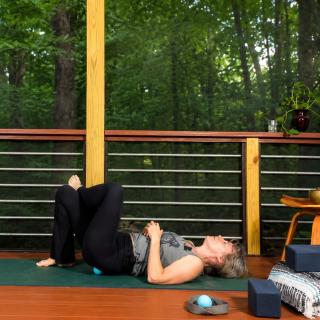
So you're going to lie down in constructive rest.
So the knees are up and you're lying on your back.
If that doesn't feel good,
You could use a chair and sit in the chair and place the balls right at the center of each glute.
So it would look like this.
I'm sitting in my chair.
I'm going to place the balls under and sit.
And if you don't have balls,
You can use your foam roller.
And you would kind of lie on your foam roller.
Like this.
And you can kind of windshield wipe your knees and stuff like that.
Okay,
So foam roller or the balls.
I'm coming into constructive rest.
So at the center of each.
Buttocks,
I'm going to lift up into bridge and then just place the balls there.
And lower back down.
And just notice how that feels if this is something that you've Have it done before?
Just notice.
And you can keep your knees together,
Feet out wide.
Or you could straighten your legs out and just notice how that feels.
I like my feet together and my knees out wide,
But you can play around with what works.
For you today.
The invitation is to be really kind to yourself.
You're not trying to hurt or push too far,
You're just being gentle and listening to the body.
And less is more for myofascial release,
In my opinion.
So you could stay still.
This is an acupressure point gallbladder 30.
And it's a great place,
I consider it,
Clearing the slate.
And it's also great for grounding.
Great if you have anxiety,
Bringing in calmness.
You can stay still or rock the knees side to side.
My feet are hip width apart and I'm just windshield wipering my knees side to side.
To side.
And if you're sitting in the chair,
You could do the same thing.
Or on your foam roller.
And we're getting into the piriformis and the glute max.
But the piriformis is this band-like muscle.
That's connected to the outer,
The widest part of the outer hip and the sacrum.
If you have low back issues or hamstring issues,
This is a great place to work,
Or of course,
The hips.
Beautiful.
If you find that one side wants a little more attention,
You can pause.
So my knees are towards the left and I'm just pausing and there's more weight on the left side.
And the right side might be lifting off the ball a little bit,
And that's fine.
You can pause here.
I even like to move my.
My left knee is kind of out further with the weight underneath the ball,
And I might just move my knee a little bit back and forth,
Just bringing a little bit of shearing.
Beautiful.
And if you feel that tension bubbling up.
Noticing and you just can imagine letting it go.
And slowly coming back to center.
And go to the other side if you're pausing at one side.
So I'm bringing my knees to the right.
My feet are about hip width apart.
And I'm just pausing with more weight on the right side.
And maybe you lift and lower the right knee.
Bringing and sharing.
To the connective tissue.
Which helps hydrate the tissue.
And one of my teachers.
Jill Miller says,
Motion is lotion for the body.
Beautiful.
Come back to center.
And now.
.
.
From here,
If you're up for it,
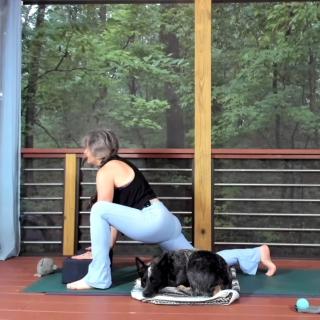
Bring the right knee into the chest.
And drape the right ankle over the left.
I'm going to turn so you can see me.
And you can do this sitting in the chair too.
So I'm bringing the right knee towards my chest,
And then I'm going to drape the right ankle over the left,
So figure four.
I've got the ball there.
If you're sitting in the chair,
You can just come into that figure four position.
And if you're doing the foam roller,
You can The foam roller is going to be underneath both glutes.
Sets of glutes.
So yeah,
Just notice how this feels.
You can stay still.
You can stay still and just kind of rock your,
So your ball's not moving and your hips not moving,
But you're just.
Moving your knee.
A little bit side to side and the ball just getting in deeper in that one spot.
Or You can roll from the sacrum,
So I'm rolling towards the inner part of the body,
And then you can roll towards the outer hip.
Back and forth.
So you're just rolling your body over the ball.
And if there's a spot along the way that you want to hang out in,
Then pause.
You could also do this up like this.
In a figure four,
It takes a little more effort because you're holding yourself up.
But it might be a little bit easier to roll around.
So you could try that and see what works.
That is another invitation.
Just try different positions to see what works for your body because our bodies are all so different and something that works today might be different for tomorrow.
So just being really kind to yourself.
I'm just going to lie back down because I like that.
Yeah.
Just clearing out.
Anything that you've picked up along the way that you don't need.
And I'm just taking my fingers and moving the ball.
A little bit up or down.
If I'm rolling around and it might move out of the spot.
And for me,
The outer hip,
Always the outer side of the.
.
.
The hip always needs a little more tension.
So I might pause there.
Beautiful.
You're amazing.
Okay,
Slowly come back.
Down.
Release the ball.
Unthread the leg so it's down on the mat.
And you can stretch your legs out long.
And just notice.
And there might feel like a little more warmth or tingling in the right side.
And you could stretch your arms long,
Get really big.
Beautiful.
Okay.
And now let's do the other side.
So I'm going to bend my knees.
So I'm going to lift up like I'm coming into bridge.
I'm just going to take the ball onto the left side.
The right side doesn't have a ball.
The right knee comes into the chest.
And I'm going to drape the right foot over the left.
I'm sorry,
The left knee comes into the chest.
I'm going to drape the left foot over the right.
Me.
So the opposite side that we were doing before.
I'm going to turn so you can see me.
Yeah,
And just notice how this side feels.
And you can stay still.
And even add that little kind of rocking,
Rocking that knee and the ball staying right where it is and you're getting deeper.
Or you can roll to the outer hip.
Until I enter heaven.
I've even done this at the wall,
Standing.
So figuring out what works for you.
And you can decide if you press down a little more as you roll,
It's going to be a deeper pressure.
Or you can come off of it and you can even take the ball away if it doesn't feel good.
Because you're in charge.
Beautiful.
I'm kind of hanging out on the outer hip because for me that's where I'm feeling a little more tension today.
And it's kind of like a dull little ache.
But you don't want anything sharp or electric.
It kind of like hurts so good,
But you can still breathe.
Beautiful.
Let's find one or two more spots.
So I was hanging out on the outer part.
So now I'm going towards the sacrum a little bit.
And I might get close to the sacrum and kind of rock a little side to side there,
Just getting into those attachments.
Her glute max and the piriformis.
Attach.
And then maybe one more spot.
Beautiful and you could still play around with that,
But when you're ready just slowly remove the ball Release the left leg and stretch.
The legs out long.
And notice the two sides.
And your feet might kind of.
Feel different and your knees just kind of noticing the whole body.
So you can bend your knees.
The next place we're gonna go is.
.
.
If you bring your hands down.
And you can feel those pokey bones of your hips.
So,
You know,
Below your navel,
Down towards your hips.
Above your pubis bone and outside.
There are those pokey bones on each side.
Of the hip.
Here they are on me.
And so where we're going to go next is we're going to go to the side.
Of the hip.
And I'm using that pokey bone as a guide so I know where it's at.
And you can think of the seam of your pants coming up.
That's where we're going.
We're getting into glute medius and minimus.
And this is a really great place to work if you have low back pain.
Hip issues,
SI joint issues.
And if you want to,
Grab your bolster as a little support.
And if you are using the chair and you don't want to get down,
You can stand up.
And come to the wall.
And you'll bring the ball there or the foam roller and you can move back and forth like this at the wall.
So you're kind of doing the same thing that we're going to do on the floor and you can also lift that leg that's closest to the ball and add a little more like weight.
Make it a little bit deeper.
And the foam roller too,
Just against the wall.
And move back and forth.
It's fun.
It feels really good,
Actually.
So you've got that.
But if you want to come along with me,
I'm going to lie down.
And you could also use the foam roller here.
So I'll show the foam roller.
I just don't know what tools everyone has,
So I just want to make sure I kind of give some different options.
So here's the foam roller.
And it's just like the ball.
Okay,
So now we've got the ball.
I've got my hip points,
I'm feeling down,
I'm going to go to the side.
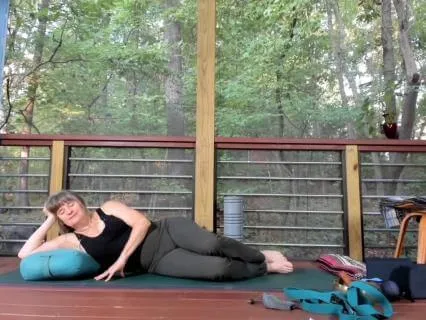
I'm just kind of side-lying like this and I'm going to place the ball and then I'm going to roll the knees so I'm coming into a kind of like a loungy position,
But you could also come up and then place the ball and lower down this way.
So any way that feels good to get into it.
If it's intense,
You can use two balls to make it a little less intense.
Stay upright or you can kind of come down and use your elbow on the mat as support.
So you decide what feels good.
And you might play around with it a little bit.
So I'm side-lying.
It's like you can think about your mat as like a raft and you're on this calm body of water,
Very calm.
And then you might feel these ripples of hot air.
Little tiny waves and your raft might move a little side to side.
So you're just rolling a little bit side to side.
Your ball's not moving.
You're just rocking.
So you can stay like that or.
You could straighten your legs out long and see how that feels.
And maybe rock a little side to side still.
So these tiny movements.
Or I'm going to kickstand my left foot.
So it's the top foot is coming behind me and the knees up and I'm going to lift.
And lower the bottom leg.
And you can make circles.
If you have a foam roller you can do this.
The foam roller is nice because it's more like a palm.
It's a little less intense compared to the thumb.
If you're like.
.
.
Thinking of massage.
Beautiful.
And then If you feel up to it,
You can just lift up and move the ball a little bit up or down or you can roll your body up or down and find a different spot and do it again.
Make movement,
Or stay still.
Staying still is very powerful.
The longer you stay,
It's kind of like a yin posture,
When the longer you stay,
The deeper you get into the connective tissue.
So the ball is just going deeper and deeper in.
And you could just kind of rest here if that felt good.
And so I'm moving my leg and I even might be rocking a little bit back and forth.
And you can always come up like this and roll a little bit back and forth on the ball.
Or around,
Kind of make circles.
With your body over the ball.
So anything goes here,
You're in charge and make it fun if you want to.
And you could even kind of get back into that piriformis again and then kind of roll back to the side.
And it's fun,
Right?
We're rolling around on balls or foam rollers.
We'll be here for maybe three more rounds of breath,
So decide if you want movement or stay still.
That exhale is a release valve,
So anything that's bubbled up.
You can kind of imagine like.
Something even dark kind of bubbling up and then you're just letting it go on the exhale and it's turning back into the clear air.
You're just releasing it and it's going to turn into something different.
Beautiful.
Okay.
For me,
It's so relaxing.
Myofascial release.
It makes me,
Like,
So calm.
When you're ready,
Take your hands and just bring yourself up.
I've removed the ball and I'm going to stretch my legs out long.
And just kind of notice the right side and the left side,
You know,
The different sides.
And you might even feel it in your shoulder.
And then we're going to do the second side.
So again,
I'm going to find that pokey bone of my hip.
You can take your hand and feel it.
Then I'm going to slide to the side to that side lying to that inner seam or outer seam of the pants and the ball is going to go there.
And then you can lie down like this.
Or you can kind of roll onto it.
Whatever feels good.
And you could also be at the wall.
And you could use your foam roller.
So here I am lying on it and I've got my.
Bolster for support.
Each side is so different,
So this side might be completely different than the other side.
If it's really intense,
You can take two balls.
And it's kind of spreading out.
The.
Intensity,
You can stack them on top of each other or beside each other,
So you decide.
And that just feels a little different and you might get into a little more area.
So you decide what you like to do.
You're lounging on your your raft.
And even sitting up like this,
And I've got my elbow down,
I can kind of circle my body around the ball.
And I'm not really even,
It's not much movement.
I'm just kind of moving like I'm kind of going with the flow of the water,
If you like to imagine.
So you could stay like this.
Straighten both legs out long.
You could also.
Lie down a little bit more.
The bolster like this is nice.
Or you can bend there.
The right leg,
The top leg.
So it's going to be a kickstand and then I'm going to lift and lower my bottom leg and maybe make circles.
Being really kind because if it doesn't feel good,
If it's sharp or it's really uncomfortable like on your neck.
Then you might not want to do it,
Or maybe you want to stand at the wall.
And sometimes what you can do is really clench your muscle and press into the ball.
Get really,
Really tight and then exhale,
Release and soften.
And that gets it a lot deeper and also prepares your body and kind of this also calms the nervous system.
There's so many benefits to myofascial release.
It's supporting the lymphatic system.
It's a.
.
.
Helping the immune system.
The nervous system.
Helping.
Proprioception,
Like how,
Where we find ourself in space.
It kind of helps like your GPS system.
Rebooting that so you know where you are,
Which is important.
Okay,
So decide if you want to move or stay still.
It feels really good to stay still right now for me.
Beautiful.
And I'm talking a lot,
But if you're doing this by yourself,
Just that quietness.
Is really nice.
And if you want to,
You can move to a different spot.
So I'm just going to kind of roll up or down or to the side,
Just a tiny movement.
Even like this is nice,
Kind of like both knees are bent and I'm kind of in this weird little.
It feels good too.
And you could roll towards the piriformis and kind of get in there again and then roll back towards the outer hip.
Which feels really good.
So nothing,
It's all about exploring and you can make shapes that work for your own body and it might be something I've never thought of.
So yeah,
Whatever you're offering is perfect.
We'll be here maybe two more rounds of breath.
This is my dog Nova and she's.
.
.
Amazing.
I love her so much.
Okay,
When you're ready,
Slowly help yourself come up.
Remove the ball.
And you can stretch your legs out long.
And feel that,
You might even feel like you're plugged into the earth a little bit more,
Like your sit bones are rooted down.
And you're recharging yourself.
One more point before we move on.
Let's grab the blocks.
And we're going to get into the.
I think it's the issue of tuberosity.
I might be saying the wrong thing because all of a sudden I can't remember,
But where we're going is between the tailbone and the sit bone.
So the tailbone is at the end of your spine.
So that's right at the center.
And you're going to go out just a tiny bit.
Before you get to that sit bone,
Which is kind of like that divot that some people have those divots in their back of their,
Kind of close to their.
Glutes.
Okay,
So we're finding this spot that's awkward to get into,
But just try it.
You could sit in the chair.
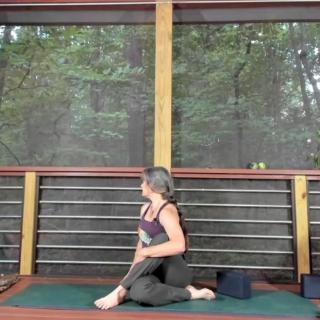
I've got two blocks.
I'm going to move my body to the side and I'm going to bring the ball in between the tailbone and the sit bone.
So you just don't want it on the tailbone.
You don't want it on a bone.
You can.
Stretch your legs out long or just stretch that right leg out long.
You're going to have it kind of on the right side.
So between the tailbone,
It's not on the tailbone,
And the sit bone,
That area in between.
And you could lean against the wall if you have that,
Or just bring your hands down.
Stay still or move your foot.
So you're moving your toes like side to side towards the right.
And then towards the left.
And just noticing how that feels.
And you could be sitting in a chair.
And you could also kind of move around the ball,
Making kind of circles with your body.
Just teeny tiny.
This is teeny tiny.
An awkward place to get massaged.
But so helpful.
Getting into that connective tissue.
Between the tailbone and the sit bone.
You could even windshield wiper the knee a little bit side to side.
And you could stretch out both legs if that felt okay.
And just notice the two sides while you're on the ball.
And you could also sit up and not lean back and do that too.
Leaning back gives it more pressure.
Okay,
And then just slowly come up and you're going to remove the ball.
And while you're on your block or your chair,
You can just stretch your legs out and notice the two sides.
And that right side might feel really connected,
Because if we just got into the piriformis,
Which is up higher,
We got into the outer part of the hip,
And now we're getting right into the center.
And now we're trying the other side.
So I'm coming to the left between the tailbone,
That center of the spine.
The spine and the back.
And the sit bone.
So you're right at where the tailbone ends,
Basically,
And the sit bones and the glutes.
So now I'm going to change legs.
So my left leg is reaching out long.
And I'm leaning back because I like that pressure,
But you could also come up.
For me,
This is a tender area.
It might even make you sweat a little bit or like.
.
.
Feel a little panicky.
So if that doesn't feel good,
You can take it away because you're in charge.
But if it feels okay to explore.
You can move your foot side to side.
And if it doesn't feel good today,
You could always come back to it and try it another day and your body will remember and be like,
Oh,
Okay,
That wasn't so bad,
Let's try it again.
Beautiful.
Maybe even kind of bend your knee a little bit more.
The knee that's extended and maybe rock a little side to side.
Beautiful.
You can always let me know what's going on in your body if you need help or anything.
When you're ready,
Slowly walk yourself up if you're leaning back,
Remove the ball.
And just notice.
It might feel tingling and warm and just thinking about that.
Fluid moving back and clearing things out.
The next point we're going to go to is the psoas.
So today,
We're going to just get into the whole hip area.
So again,
Find those pokey bones of your hip.
Can remove the blocks to the side.
So there's a couple different suggestions I'm going to show you.
So you could use your foam roller.
If you used a foam roller.
You're going to bring it across the side.
You could use a blanket roll.
If you try what I'm going to offer and it doesn't feel good,
What you do is roll up the blanket roll like a burrito.
Or a towel and it's going to go from the navel down towards the knees.
So you're going to lay on it.
Or I've got the ball.
And where we're going is the pokey bones of the hip.
We're going in and down just a little bit.
So we're going in,
So you're not on the bone,
And then you're going down maybe an inch.
Depending on your body.
And so that's,
We're gonna get into the psoas and the iliacus.
So the foam roller would be across.
You could try that.
I love the balls.
So we're going to lie down on your belly.
Watch out for your dog.
Right on your belly.
And then you're going to place the balls in the So you're going to go inside the bone of the hip and down just a little bit on each side.
I'm on my forearms.
So my elbows are down on my forearms.
Kind of like Sphinx pose.
Stay still.
You can even lie down with your head down.
I stack my hands on my on top of each other and then you can rest your third eye on your hand.
Or you can stay upright.
Take a deep breath in.
To the balls.
And press into the balls,
Like kind of get really tight.
And then exhale,
Soften.
As the balls nuzzle.
Into the tissue and the muscle.
Breathing in,
Pressing into the balls.
Exhale,
Soften and release.
The psoas is a beautiful muscle.
It connects the.
.
.
Legs to the torso,
Which is so cool,
Right?
Some people call it the muscle of the soul.
I just love those little tidbits.
It also is attached to the diaphragm.
So when you breathe in.
The diaphragm drops just a little bit.
And as you breathe out.
The diaphragm lifts and it pushes into the lungs and it lifts the heart,
Which is beautiful,
Right?
But if your diaphragm,
If your psoas is really tight.
Your diaphragm can't lift.
As much and release the air as easily.
So you really want that nice exhale to let go of things.
So you can stay still just like this.
Or you can bend your knees and windshield wiper side to side.
So I'm just bringing more weight on one side.
The other side.
You could even put your elbows down and rest your head in your hands.
Another option.
Is to bring your toes underneath your heels,
Lift your knees,
And you're going to,
So you're almost like a.
.
.
You're lifting your knees so they're off the mat,
And then you're going to roll a little bit back and forth.
And this is my favorite,
But you can decide.
If you like it or not.
You're in charge.
But it's fun to try it.
And if it doesn't work,
Then just take it away.
If this place does not feel good to you,
You don't have to do it.
So that's that,
And if you.
I'm going to show the other options.
So you're either rolling,
Staying still,
Or windshield wiper on your knees.
If that doesn't feel good,
You could take the blanket roll.
So I've got that little burrito.
I'm coming to my navel.
So I'm gonna.
.
.
I've got the.
The blanket's starting at the navel and it's going in between my legs.
And you can lay down.
And just rest here.
Breathing in,
Pressing into the blanket roll.
And then exhale,
Softening and releasing.
And this is a great place you could stay for a few minutes.
You could also have the blanket roll like this and then lie down.
On it like that.
It doesn't get as deep.
Which is fine.
The other area is the foam roller,
Which I don't ever do very often,
But we can try it now.
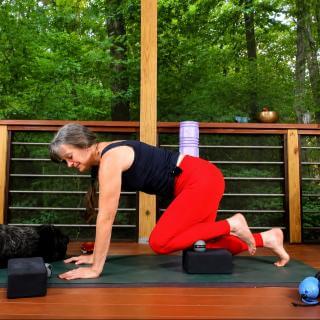
So I've got the foam roller and I probably bring my toes underneath my heels and roll back and forth and then go up and down.
Very much.
Um,
Lighter than the balls.
But it feels good.
And it's fun to try different folds.
We'll be here for maybe two more rounds of breath.
Whatever you're choosing,
Just know it's amazing.
If you didn't choose any of them,
You're still,
It's awesome.
You can just bring your awareness to that area and that makes a huge difference.
Our awareness is a very powerful tool without any other tool.
Except our breath.
The breath and the awareness,
Number one tools.
Beautiful,
Okay.
When you're ready.
Hands down.
Just walk yourself up.
Come up.
And maybe you want to come into a down dog,
Just notice how it feels.
Or you could do a little cat cow.
Noticing the psoas.
Beautiful.
One more point before.
I'm going to show you some things for headaches up in the upper right.
Part of the head just as kind of a finishing off.
But I wanted to show one place.
Um.
.
.
Yeah,
I know.
At the CAF,
Which is another place to work for headaches.
Might be surprising.
So where we're going is.
A third of the way.
Between.
The ankle and the knee,
So you're going closer to the ankle.
You're going to place the ball So you're not quite at center,
But you're above the Achilles.
And you're going to take the ball.
Just a little tiny bit to the outer part of the leg.
So I've got the ball and then it's just tiny bit towards the outer part of the leg.
And you can lie down.
Or you can just keep up like this,
Or you can lean against a wall.
And just notice.
This is called bladder 58.
It's a great place to work.
For headaches,
Foot pain.
Heel pain.
Lower back pain,
And jaw pain,
Which you wouldn't think about,
Right?
So you can stay still or move your foot around.
So I'm just moving my foot around my ankle and that's going to move the muscles and the connective tissue around the ball.
Say like this or stack.
The top leg,
The leg that's.
.
.
Hanging out on top of the leg that's got the ball on it.
You decide what you'd like to offer.
But it's.
.
.
It goes pretty deep and I just can't recommend this point enough.
Pretty amazing.
That exhale is a release valve.
You could even kind of use your block.
And your bolster to make a runway and kind of lean back.
While you did this.
And maybe I'll show that on behalf of class tomorrow.
For our Shavasana.
Okay,
And now we're just going to do the other side.
So I'm just moving the block to the other side and I'm finding that place a third of the way up,
Well from the ankle.
It's like a third of the way,
Yeah.
It's below the center of the calf,
Down just a little bit,
And out a tiny bit out to the side.
And just notice how this side feels.
You can circle your foot around the ankle.
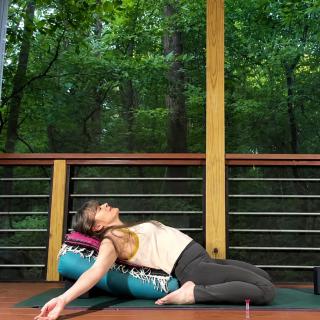
You could lie down on your bolster,
Kind of opening your heart while you just held this spot at your calf and you don't even have to move your foot.
Or you could take the top leg over.
The bottom leg,
Which brings more pressure.
I like it without it today.
So this is bladder 58.
Good for foot pain,
Headaches.
Heel pain.
Low back pain,
And jaw pain.
Beautiful.
Sometimes you might feel that you're like,
You don't even realize it,
But you're kind of tense right there where the ball is.
And if you just bring your awareness and maybe relax,
It might get a little bit deeper.
Beautiful.
There might be a dull ache.
Which is good.
Nothing sharp.
When you're ready,
No rush,
Just slowly remove your leg.
And lower it down,
This is a great place to drop into Shavasana.
And you could just.
If you wanted to go to sleep,
This is a great time to go to sleep.
Do a meditation.
So stay there.
I wanted to show just a couple points for headaches before we close the class.
So the calf is a great place to work for headaches.
Next,
Another place to work.
Is the upper traps,
Where we do a lot in class.
So between the neck and the shoulder,
Bringing the ball there.
So we'll do that.
And then I'm going to show you a point at the jaw and then at the temporalis.
You can decide if you want it to rest after the calf or You're going to lie on your back and I've got a block nearby.
I've got the balls.
And you're going to take your opposite hand and bring it back like you're going to pat yourself on the back or where you'd want to kind of rub your shoulder when it kind of feels like it hurts.
And we're going to go in that point between the neck and the shoulder.
So lying down,
And I've got my block or a blanket or a bolster.
I've got the balls,
I've got one in each hand.
And if you don't have that,
You could use the foam roller.
I'll show the foam roller real quick and you're just going to kind of bring it you might roll off of it,
But you're going to bring it kind of in that spot.
Okay so I've got the balls and I'm going to place one on the right side like I'm patting myself on the back.
And then one on the left side.
And that might be enough pressure for you.
We're using this today for headache relief.
Gallbladder 21.
It's a great place to work.
If you've got headache.
Shoulder,
Neck issues.
Also,
It's a very calming point.
And acupressure.
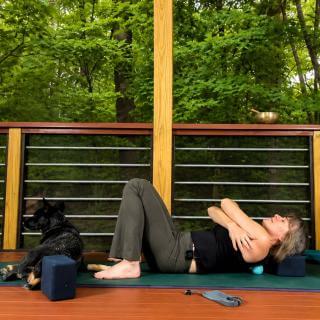
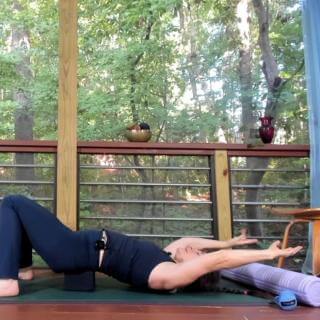
You can slowly lift the hips and bring the block underneath your sacrum.
So I'm offering it for the headache,
So I'm just gonna say.
Relax your arms down by your side or on your belly.
But if you know about this,
You can move your arms like you're making snow angels.
Letting the exhale release valve.
So great place to work headaches.
Tension.
You could cover your eyes.
You could even stretch your legs out long if that felt good.
Beautiful.
You're doing great.
Two more rounds of breath.
One more inhale.
Exhale the release valve,
Letting go.
When you're ready,
Slowly lift up,
Remove the prop underneath your sacrum.
Remove the balls and just stretch out and notice.
And you might feel warmth in the shoulders.
Kind of this release.
Hug your knees into your chest.
Give yourself a hug.
You're amazing.
Your body is so precious.
And these tools just help.
Get rid of tension or stagnation or helps break that cycle of pain.
Slowly roll to your side and press yourself up.
I'm going to offer those last two points.
Ciao.
Maybe circle the shoulders a little bit.
And I'm sitting cross-legged.
You could sit in a chair.
If you wanted to,
You could grab a block just in case you need it.
And the next place we're going is if you feel your jaw.
You can feel that deep muscle in the jaw,
The masseter,
Which is like the strongest muscle in the whole body.
If you don't have a ball or you don't want to use your balls,
You can take your finger and just use your fingers and take your finger to one side and just hang out there or use your knuckles.
Like I'm bending my fingers and just using that area to kind of hold,
Or you can use your ball.
And you could always wrap your ball in like a clean sock.
So I'm using my elbow on my hand.
Leg but you could also take the block and bring it closer so it's not so hard to get to or if you're like on your desk you could sit with your elbow on the desk.
And close your eyes.
Stay still.
You could even move your jaw around,
Moving like the bottom part of the jaw around.
You can open your mouth and close it.
A great place to work if you've got tension in your head,
Jaw pain,
Like maybe if you sleep and you're kind of gnawing and you get really tight.
Here called TMJ.
Or work's been really stressful.
Or you have a headache.
You're just going to stay here for maybe 20 more seconds,
But you could stay here longer,
Of course.
Each exhale,
That release out,
That letting go.
When you're ready,
Slowly come up.
Kind of notice the two sides.
Next place we're going is the temporalis.
So kind of like where you might even rub your.
.
.
So when you did feel like there's a headache coming.
So you can use your fingers.
Even like the palm,
The heel of your hand could press there.
We're the bomb.
So it's in my hand,
I'm just holding it there.
And I'm kind of leaning on it and I've got the block for my elbow.
Making it as relaxing as you can.
You can stay still with the ball or this tiny movement.
Or even turning your head,
Moving your head a little bit.
That exhale,
Release vowel.
To 20 more seconds or so.
When you're ready,
Take your care,
Just come on up.
Release the balls and kind of notice how your face feels.
Your eyes might even feel a little brighter.
I'm going to do the other side.
I've got my block.
If that block feels good,
You don't have to use the block and you could also use your desk.
You can even lie down on your side and put the block,
The ball,
On your jaw that way using pillows or.
.
.
Blanket for support.
Stay still,
Or I'm kind of using my hand to circle the ball around.
You can open your jaw,
Close your jaw.
Can kind of move it towards the ear and then back.
Any movements that feel intuitive to you are probably right.
And I also like to press my jaw into the ball and then kind of move my jaw.
A little bit.
So you decide how much pressure you want.
One more area.
Well,
Let's come out of that and just notice how it feels.
You kind of open your mouth and close it.
And then when we do that temporalis,
Like above the jaw,
Across from the eye,
You can circle it.
Or use your ball.
Kind of pressing my head into the ball.
You could also circle the ball around.
Beautiful.
We went a little over today,
But I just felt like to offer these extra points today.
When you're ready,
Slowly come up.
Notice how you feel.
Maybe circle the shoulders and you can stretch your arms like you're just waking up from a long nap or you're just ready for the next part of your day,
Letting go of tension.
Thank you so much for practicing with me today and hopefully some of those were helpful.