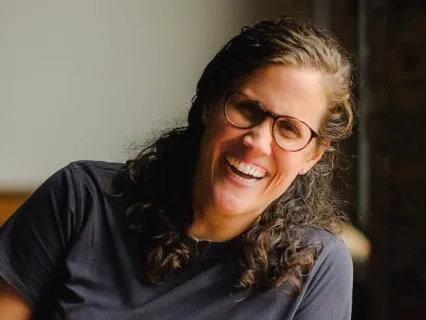
I'm Olivia Piltz,
And I'm a licensed mental health counselor specializing in trauma attachment and codependency.
I work with this every single week in my practice,
And I just want to give you a kind of a clinical framework that most content never really gets to.
So what is people-pleasing,
Really?
People-pleasing is not a habit.
It's not rudeness or avoidance.
It's not even low self-esteem,
Though it's that often comes with it.
At its core,
People-pleasing is a FON response,
One of four survival responses the nervous system uses when it perceives a threat.
Like you've heard of the fight response or the flight response.
FON is less talked about,
But it is just as automatic.
So when the nervous system learned early,
Like before you probably even had words,
That conflict is dangerous,
That disappointing people had real consequences,
That love was conditional on your behavior,
It adapted.
It found the safest path.
It became agreeable.
You stay small,
Anticipate what others need before they ask,
Remove friction before it even starts.
It's not a character flaw.
It,
In a way,
Is an incredibly intelligent adaptation to an environment that required it.
We call it a survival behavior,
An adaptable behavior.
The problem isn't that your nervous system did this.
The problem is that it's still doing it.
In relationships,
At work,
With your family,
In situations where you are no longer a child and the original threat no longer exists,
And that's what's crazy,
Is what was adaptable for you as a kid becomes,
In your grown-up years,
Usually the thing that drives distance or pushes people away,
And usually it's the people who are closest to you and matter the most.
From an attachment lens,
People-pleasing often develops when a child's sense of safety and belonging becomes tied to their performance.
Not who they are,
But like what they do,
How helpful they are,
How little trouble they cause,
How well they manage the emotional climate of the people around them.
Some of you are so good at this.
It's kind of like a superpower,
Right?
You can walk into a room and feel the temperature of the room and know exactly what everyone's thinking and feeling before you even introduce yourself to anyone.
And this is the part that is so confusing because people pleasers also I'm one,
Are often genuinely kind,
Warm,
Caring people.
So how do you know if what you're doing is coming from a place of love or abundance,
An overflow,
If you will,
Or that it's actually coming from a place of fear?
Here's the distinction that I like to use clinically.
Kindness comes from a full place.
You give because you want to.
You help because it aligns with your values.
You can say no without it costing you your sense of safety or really your belonging.
People-pleasing comes from a contracted place.
You give because you're afraid of what happens if you don't do it.
The yes isn't a choice,
It's a reflex.
And somewhere underneath it,
Often invisible even to you,
Is resentment.
The tell is always the same.
If your yes has a hidden cost,
If it comes with quiet resentment,
With feeling drained,
With the sense that you've just given something that you cannot afford,
That's not generosity.
That is fawning.
The key difference between kindness and people pleasing is not what you do.
It's what it costs you and whether you actually had a choice.
So when I work with clients on people pleasing,
Which is a lot of what I do,
The first thing that we do is we get curious about what's happening in our bodies.
And we don't want to necessarily focus on the thoughts.
We get there.
But like the body,
It's usually the thing that we don't pay attention to.
People pleasing does not live just in your mind.
It lives in your nervous system.
And this is where somatic work becomes very important.
So when a people pleaser is about to set a limit,
When someone asks them for something that they do not want to give,
You should watch what happens in the body.
There's often a tightening of the chest.
They're holding their breath,
A kind of collapse in the shoulders,
A heat that kind of rises before the automatic,
Sure,
Of course,
Kind of comes out.
Maybe the mouth says yes before the mind even has a chance to kind of weigh in.
It's not weakness.
It's the nervous system doing exactly what it was trained to do to keep you safe.
But you're not 10 years old anymore or 7 or 12.
In my work,
We look at how these patterns kind of get encoded.
The nervous system doesn't operate on logic in our kind of executive mind,
Right?
It operates on pattern recognition.
And if it learned early enough that a piece kept you safe,
It will keep running that program until something intervenes at the body level.
IFS,
Internal Family Systems,
Gives us another layer.
So when I work with clients using IFS,
We often find a part of us that is doing all the people pleasing.
A part that really believes that if I stop managing this,
Everything's going to fall apart.
If I disappoint this person,
I will lose them.
If I say no,
I will not be loved.
That part is not wrong.
It learns something real and we don't shame it out of existence.
We get curious about it.
We find out how old it is and we want to start to show it slowly and safely that things are different now.
Using the tactics that were often used on us,
Like shame,
To get us to stop doing a particular behavior might fix the behavior in that moment,
But it's not going to last and it's not going to get to the kind of the heart or the depth where that lives.
There is a part of you that learned,
Two people please,
Because at some point it was the most loving thing that you could do for yourself.
The goal isn't to get rid of that part.
We need that part still.
The goal is in a way to kind of help update it,
To bring it up into 2026 so that it's aligned with you now and you kind of are in control of it now as opposed to it running you.
So let's talk about how does this look in like real life?
Like how does it show up?
Because people don't necessarily call me.
They're like,
Hey,
People,
Please,
I need to come to therapy.
You know,
Sometimes,
But most of the time it's we get into it and they're like,
Yeah,
I definitely struggle with that.
People pleasing isn't as clear cut as like someone who just can't say no sometimes,
But it's usually a little quieter than that.
Maybe you find yourself apologizing constantly for your opinion,
For taking up space,
For having a need at all.
I have found myself being like,
Why am I apologizing for that other person?
Like I didn't do the thing and I'm apologizing for them.
Maybe you edit yourself before you speak,
Like you're running the calculation.
Them?
Will they think less of me?
Is this too much?
Am I too much?
" You over-explain.
A simple no becomes a paragraph of justification because your nervous system believes that no alone isn't enough to keep you safe or to keep you in good standing or to keep you kind of belonging to that kind of social group or in that unit.
You feel responsible for other people's emotions.
If someone is upset in the room,
You assume it's about you and you feel compelled to fix it.
I do this still.
When my best friend or my husband is upset,
I'm always like,
What did I do?
Did I do something?
I know I didn't do anything,
But I think I might have done something.
You give until you're empty and then you're surprised by the resentment or the rage because it had nowhere else to go.
Like you don't know what you want,
Genuinely,
Because for so long you've organized your life around what everyone else wants and your own preferences have gone quiet.
That's a big one for a lot of,
I have found,
Women in their 50s,
60s plus,
Are out of the house and they're just left with their partners and they're like,
Who am I?
What do I like?
What do I want?
It's always been predicated on what my kids want,
What my kids want to do,
Right?
It points to something deeper than behavior.
It points,
Like I said,
To that identity.
When you've spent years making yourself small,
Agreeable,
And needed,
Who are you without that role?