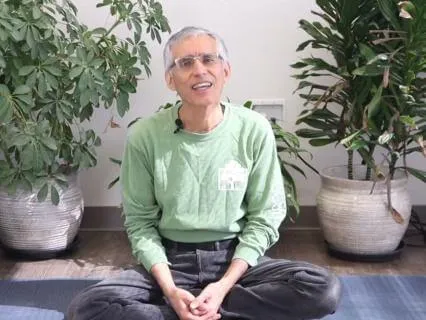
Hi,
I'm Dr.
Manish Chawla from Lifestyle Docs.
So many of my patients are curious about mindfulness meditation.
So in this video,
We'll cover the basics of mindfulness meditation,
And then we'll do a short practice.
So what is mindfulness meditation?
I'm going to break it down into three parts.
So first part is just being present in the present moment.
Then whatever the present moment brings with it,
Whether it's joy,
Discomfort,
Pain,
Doesn't matter.
We're just aware of it and we're accepting of it.
We're nonjudgmental with it.
We're not trying to change things from what they are.
So to view the world in this way takes some practice.
So one of the things we're trying to do is we have a stimulus,
Let's say pain,
And our reaction is to get frustrated,
To say,
Why is this happening?
And we want to change that to,
Okay,
This is the way things are.
How can I have a more skillful response to the stimulus?
So that's what mindfulness allows us to do.
And we can do this exercise by just looking at our breath.
So in this exercise,
I'm going to ask you to just focus on your breath.
And you will notice you're focusing your breath as I'm going to give you the instructions.
And within a few breaths,
Maybe longer,
Your mind is going to wander.
So this is going to give us an opportunity to practice mindfulness.
So as soon as you become aware that your mind has wandered,
You're actually practicing mindfulness.
And when you come back to the present moment,
Come back to the breath,
Without any judgment,
Accepting the way things are,
Then you're developing this attitude,
Developing this skill of not being frustrated,
Just being accepting,
Acknowledging,
And coming back.
Over and over.
If your mind wanders five times,
Ten times,
It doesn't matter.
Think of it.
You are building that muscle of acceptance,
Building that muscle of not getting frustrated,
Building that muscle of letting things be as they are.
And if you can focus for a few breaths,
You're building that muscle of focus.
So as you can see,
There's really no wrong way to do mindfulness meditation.
You acknowledge the way things are.
And if you can focus more on one day and become more aware and accepting on another day,
That is perfectly fine.
So.
Let's begin.
Everyone can join me.
You can just sit in your chair,
Sit on the floor,
Doesn't matter,
Wherever it's comfortable.
Just take a moment to just notice where your hands are.
If there's any tension in your neck or back or shoulders.
Right now we're just noticing.
And also just take a moment,
How your feet or your sitting bones,
How are they making contact with the ground?
So the first part is being present in our body,
Just being physically present.
So when we bring the body to the present moment,
It makes it easier to bring our mind to the present moment.
Before I actually start with the mindfulness practice,
Typically I'll do some breathing exercises with my patients or folks who come to our Saturday morning meditations.
So let's do some breathing exercises and then we'll start with the mindfulness portion.
Okay?
The first breathing exercises I'd like you to try is called 4-6 breathing.
We're going to breathe in for a count of four and breathe out for a count of six.
So breathing in this manner allows us to relax,
It lowers our sympathetic nervous system,
And actually boosts our parasympathetics.
So this has the effect of lowering our stress hormones.
So let's do a few together.
So I'm going to count and you can join me.
Breathing in.
Two.
3 4 Breathing out.
2.
3 4.
5 6 Breathing in 2 3 4,
Breathing out 2,
3,
4,
5,
6.
Last time in 2,
3,
4,
Out 2,
3,
4,
5,
6.
Okay.
Hopefully you're feeling a bit more relaxed.
If it feels good to you,
You can roll your shoulders up towards the back of the room and really settle in.
And we're going to do one more breathing exercise,
And this is deep belly breathing.
So in the first exercise,
We focused on the length of the breath.
In this exercise,
We're going to focus on the depth.
We're going to try to engage your diaphragm,
Which activates our parasympathetics in a different way.
It turns on the vagus nerve which lowers the sympathetic tone,
Reduces our stress hormones,
Allows us to be a bit more relaxed.
I like to put my hands on my belly.
And you can again just kind of check in with your posture make sure that you're comfortable.
You can close your eyes or look down or leave them open.
Whatever works for you.
So we're going to take a few deep breaths together.
So take a slow deep breath in.
And slow deep breath out.
Another slow,
Deep breath in.
And slow exhale.
I want you to continue at your own pace.
I really want you to engage your belly so when you breathe in,
It pushes against your hands.
And when you breathe out,
Just empty out completely.
Just guide the belly towards the spine.
And do it as slow as possible.
So we're going to do a couple more together.
So slow breath in.
And very slowly breathe out Last time in.
And.
.
.
Okay,
You can again kind of roll your shoulders back,
Kind of settle in.
We'll go ahead and move to the mindfulness meditation part.
In this first part,
We regulated the breath.
You know,
We were very intentional with our breath.
In mindfulness meditation,
When we use the breath as a tool,
We're just going to watch our breath.
Instead of trying to control anything,
All we're going to do is watch the natural flow of respiration.
We're just going to watch when the breath comes in,
When the breath leaves.
This is going to be our anchor to be in the present moment.
Okay,
So again,
I invite you to just be in a comfortable position,
Your back relatively straight,
You can sit in the chair,
On the ground,
Whatever feels comfortable.
Just take a moment to just kind of check in with yourself.
You know,
Where are my feet right now?
Is my neck and shoulders relaxed?
So it really doesn't matter what the body is doing at this moment.
We're just noticing.
Okay?
And if it feels good,
You can close your eyes or look down.
And just notice the breath.
Breathing in,
Know that you're breathing in.
Breathing out,
Know that you're breathing out.
Just wash the breath.
As it comes in,
As it goes out.
So I'm actually gonna give you three choices on where to focus on the breath.
The first part we will do is pay attention to the breath in the area around the nose.
I'm going to spend about a minute here,
Then we'll take the focus to the upper chest and shoulder area,
And finally the belly.
So close your eyes or look down,
Whatever feels comfortable.
We're just noticing the breath as it comes in,
As it leaves.
Our focus is in the area at the nostrils,
Space between the nose and the lips.
Anywhere in this area.
We're just going to be like a guard at the gate,
Watching the breath come in,
Watching the breath leave.
Keep your eyes closed,
But I want you to now make the focus in the shoulders and the upper chest area.
Just notice what happens to this part of the body as the breath comes in,
As the breath leaves.
So this is going to be your anchor and we'll practice this for about a minute.
Lastly,
I'd like to invite you to bring the focus towards your belly.
How does the belly rise and fall with inhalation and exhalation?
Just notice what happens when you're observing the natural flow of the breath and the focus is at the belly.
And let's do this for about a minute.
And now I'd like you to choose whatever focus is working the best for you right now.
Whatever focus works today,
Whether it's the space around the nostrils,
In the nose,
Or if it's the upper chest and shoulder area,
Or if it's the belly or the abdomen area.
Just pick one focus and we'll use that as the anchor,
Use that as the focus for the next five minutes.
And at the end of five minutes,
We'll do loving kindness meditation.
You you Thank you.
You may relax yourself,
But keep your eyes closed and repeat in your mind.
May I be safe,
Happy,
Healthy,
And peaceful.
May all beings be safe,
Happy,
Healthy,
And peaceful.
May I forgive all beings for any harm they may have caused me,
Knowingly and unknowingly.
May all beings forgive me for any harm I may have caused,
Knowingly and unknowingly.
May all be happy.
May all be happy.
May all be happy.
Thank you for joining.