Hello,
This is Malcolm.
This is a practice for anyone who has been told to follow the breath and found that it didn't help.
Relatable,
Right?
For some of us,
Paying attention to the breath changes it.
The chest gets tight or we start managing every inhale.
For some of us,
It's a bit dull.
The mind gone in four seconds.
And for some of us,
The breath is just too close on a hard day.
None of that means you're bad at this.
It may mean the breath isn't your anchor,
Or it isn't today.
An anchor is a place for your attention to rest and come back to.
We're going to try three of them.
Sound,
Sight,
And touch.
Then you'll pick one and stay with it for two minutes.
A couple of choices before we start.
You can sit on the floor or in a chair,
Or you can stand.
Your eyes can be open or closed,
Though you'll want them open for the second anchor.
You can stop at any point.
Stopping,
Shifting around,
Skipping one of the three.
All of that counts as the practice.
Start by looking around the room you're in.
Find the door.
Find the farthest wall.
Notice what's holding you up.
Floor or the chair.
10 seconds to look around.
We'll start with sound because it's farthest from the body and it arrives on its own.
Listen to whatever is here.
A refrigerator.
A voice down the hall.
You don't have to name the sounds or like them.
If the room is very quiet,
You might listen for the hum underneath the quiet.
And if sound isn't useful to you,
This is a fine one to skip.
When your attention wanders off and it will pick up the next sound that arrives.
That's the whole job.
I'll be quiet for about 30 seconds.
How was that?
Easy?
Irritating?
Somewhere in between?
Make a note of it.
Next,
Sight,
With your eyes open.
An anchor you can see has one advantage.
You always know whether you're still looking at it.
Pick one thing that isn't moving.
A doorknob.
A mug.
The corner of a picture frame,
A patch of light on the floor.
Something pleasant or neutral,
And nothing with words on it or you'll start reading.
Rest your eyes there.
Blinking is fine.
Look at it the way you'd look at something across the room,
Not the way you'd read a label.
When your eyes drift,
Or your mind does,
Come back to your one thing.
About 30 seconds.
And how was that one?
Make a note!
Last,
Touch,
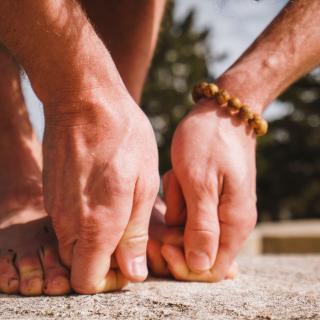
And we'll use the hands.
If your hands aren't the place for this,
Any place where skin meets fabric will do.
Let one hand rest in the other,
Or lay your hands on your legs.
Notice where they meet,
Warm or cool.
Dry or damp.
The weight of one on the other.
Sometimes it's easier to feel the hands with a little movement.
You might slide a thumb slowly across a fingertip.
Or along a seam in your clothing,
And follow that.
This is the closest of the three to the body,
So if it's a bit much,
Go back to sound or to your one thing.
About 30 seconds.
So it's time for a quick check-in.
That was three anchors,
Sound,
Sight,
And touch.
Which one was the easiest to come back to?
Not the most impressive,
The easiest.
If it's a tie,
Pick any.
None of them did much.
Pick the least annoying.
And if you'd rather stop here,
This is a complete practice.
Now,
We stay with your pick.
Settle on your anchor.
The sounds,
Your one thing,
Or your hands.
The next stretch so quiet will be for two minutes,
Which is longer than anything so far.
Your attention will leave.
Maybe 10 times,
Maybe 40.
Each time,
Come back.
Coming back is the practice.
And leaving is just what minds do.
If two minutes turns out to be too long today,
Look around the room and rejoin whenever you like.
Or don't.
I'll speak again when the time is up.
That's two minutes.
You can leave your anchor now and look around the room.
Find the door in the farthest wall.
Name a few things that are here,
Three or four,
Silently or out loud.
We'll take about 10 seconds.
Time to move something.
You could stretch your fingers,
Roll your shoulders,
Stand up if you've been sitting.
You've tried three anchors that aren't the breadth,
And you know which one you'd pick today.
Tomorrow it might be a different one.
The breath is a fourth option.
Some people come back to it later and some never do.
Either is fine.
That's the whole practice.
Thank you for practicing with me.
The End you