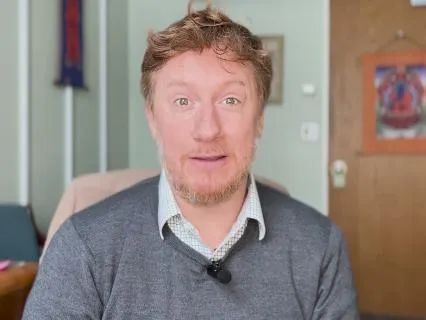
Hello and welcome to the Life Skills with Louie video series.
I'm Louis.
And I'm creating this introduction for you to return to whenever you feel a little lost or need direction on.
.
.
Which skills to use when.
I'll organize this introduction into a few sections.
Why have I created this?
How have I created it?
What is within it?
And then how to use that.
So first is the y.
I have a passion for learning and for learning ways to suffer less.
I do have the experience that pain is not optional in life.
But suffering is,
And when I first encountered Buddhism about 20 years ago or more.
That was a huge revelation to me.
And so I've been learning from as many people as possible ways to reduce suffering for myself and others.
There are many different people I've learned from and it's been a privilege and I know not everyone is able to.
Have the experiences that I've had,
So I want to pass on as much as I can in as clear a way as I can.
The how of creating this is that over the years I've studied with a lot of different people using a lot of different modalities.
I practice psychiatry.
Before that,
I started to learn Buddhism and Tai Chi.
Then in medical school I received my own therapy and in my training to be a psychiatrist I learned a lot of different types of therapy.
And all of that influences this video series.
The.
Key structure of this comes from DBT,
Dialectical behavioral therapy.
That's the backbone of all of this.
And people who are familiar with that type of therapy will see that this video series is organized very much related to that.
I changed the names of the sections to make them a little more generalizable to everyone and easier to understand.
The structure is the same,
And I'll always try to reference where a skill comes from,
Where I learned it from.
Everyone to learn more.
So that's how I created it.
Now what is in this video series.
.
.
I like to use little charts.
And so.
.
.
The first thing that I want to emphasize is that A good way to think about using skills is to think in terms of three zones,
Red,
Yellow,
And green.
Our nervous system has three modes that it's in,
And polyvagal theory has outlined this really clearly.
The red zone is when you're at what DBT calls a skills breakdown point.
You can't think clearly,
You can't use very complex skills.
You feel overwhelmed and your mind is shutting down.
You're feeling urges to do behaviors that are going to cause you or others harm.
Always,
If you're at a skills breakdown point,
Go to the connecting to column skills.
That's critical.
Just go there first.
And I'll explain more in the introduction to that.
Video series.
If you're in the yellow zone,
That is.
.
.
More of regular life we all have things happen to us throughout the course of the day,
Emotions come up.
And we're calm for moments and then we're in a bit of fight or flight,
There's so many stimuli that affect us.
If you're in the yellow zone,
The skills to use are the getting to great skills.
If you're in the green zone,
Where you're close to feeling great or feeling great,
This is a great time to practice the learning to love skills.
There are two other sets of skills.
That I want to mention.
The Being beyond skills are mindfulness skills.
These I put as brown because that's the earth upon which we walk.
These skills can be used at any level of emotional intensity from 0 all the way to 100.
And then the last set is what I call connecting to clear.
If you're practicing all the skills and you're finding that you're still creeping up in your distress,
You may be attached or are probably attached to behaviors that are continuing to cause you stress and that detaching.
From those types of behaviors is where the connecting to clear skills come in.
So I hope that this video series helps to point you in a direction towards less suffering and more happiness in life.
Thank you very much for watching this video.