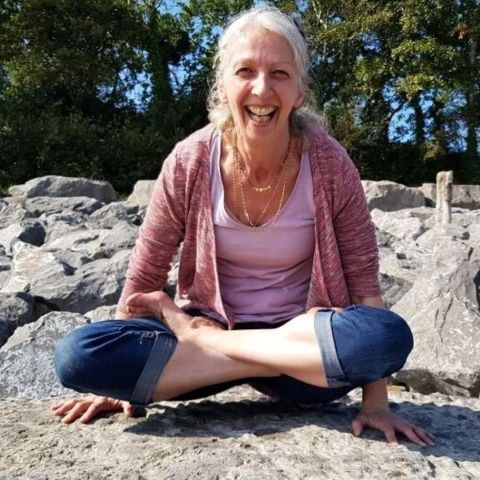
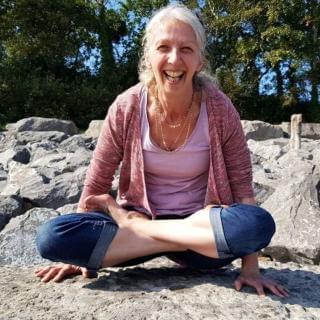
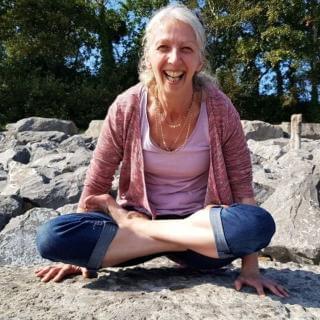
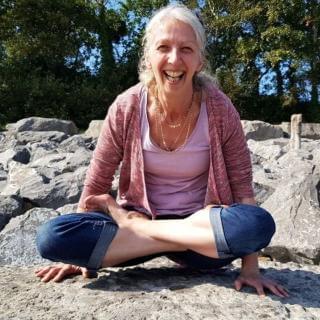
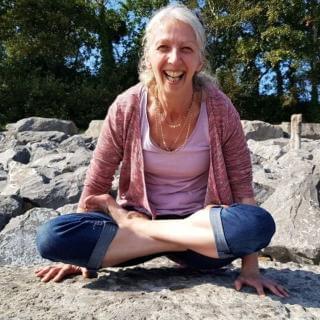
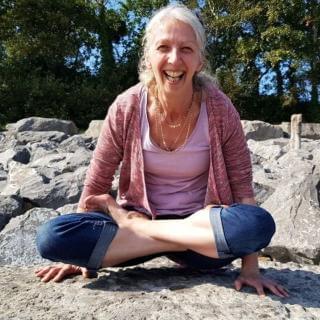
I'm Katja Patel,
Ayurvedic Diet and Lifestyle Educator,
Yoga Teacher and Teacher Mentor.
Today,
I want to talk about consistency.
More specifically,
I want to talk about why knowing what helps you doesn't always mean you do it.
You've surely noticed this yourself.
You know you feel better when you move.
You know yoga helps your back,
Your mood,
And how to feel more grounded on a busy day.
You know you feel steadier when you eat a proper lunch.
That beats looking up at 3 p.
M.
Realizing you're starving and reaching boredom.
Reaching for whatever is in the drawer.
And You know going to bed earlier makes the morning easier.
So you start the week with good intentions.
You plan a yoga practice before work.
You buy the fruit for proper lunches.
You decide that this is the week.
Following stays out of the bedroom.
Then Tuesday happens.
Work runs late,
Someone needs something from you,
You feel tired and the practice you'd planned suddenly feels too long.
And So you leave it.
Lunch gets pushed back.
By the evening you fed us.
Starting again tomorrow feels much easier.
I'm pretty certain that this sounds familiar.
And you're not alone with that.
Most women I work with already know a great deal about what supports their health.
The harder part is returning to it often enough.
For it to make a difference.
And this problem is much older than our busy modern lives.
Here's where it gets specific.
Consistency sits right at the heart of yoga.
Potentially speaks about it very early in the Yoga Sutras.
In Sutra 1.
12.
In Sutra Book 12 he says The movement of the mind settles through practice and non-attachment.
Apias means sustained practice.
It's the repeated effort of returning.
A couple of sutras later,
In 114,
He gets even more specific.
Practice becomes firmly grounded when it continues for a long time without interruption.
And with sincere dedication.
There's something wonderfully ordinary about that.
People thousands of years ago.
Also needed reminding that doing something once wasn't enough.
Throughout the yoga tradition,
You also find a pattern.
When the ideal practice isn't available.
Another route is offered.
If this isn't possible,
There's another way.
And if that's not possible,
There's something else you can do.
The threat keeps going.
So.
.
.
Maybe the useful question has never been.
Can I do my perfect practice every day?
A more useful question is this.
What can I return to today?
And that's.
.
.
One worth pausing on.
The body responds to repetition.
I learned this en masse in my own body.
Long before I learned this from a book.
I remember when I did my first bridge pose.
It felt wobbly,
Weak,
Shaky.
I kept practicing.
Then one day I noticed my bridge was steady.
I could hold it comfortably.
I could even explore variations.
No single extraordinary practice had changed everything.
My body had responded to all the ordinary practices that came before.
That appears in action.
This is where the pieces start to line up.
Consistency usually falls apart at one particular moment.
When the version you planned is no longer possible.
Say you've planned 30 minutes of yoga in the morning.
Then you wake up late.
And the 30 minutes aren't there.
And this little voice says,
10 minutes isn't really worth it,
Right?
The practice disappears altogether.
Or you've decided to cook a proper lunch every day.
Wednesday gets busy.
You keep working.
You miss the moment you were hungry.
And suddenly it's mid-afternoon.
You are starving,
And so the snacks come out.
Or you know that being in bed by half past 10 makes you feel better.
One evening get away from you.
Within a few days,
You're back.
To going to bed after midnight.
These moments are worth noticing because they tell you something.
When the planned version isn't possible?
Do you adapt it?
Or does the whole thing disappear?
This isn't something you're doing wrong.
It's the rhythm that hasn't been set up yet.
That's all this is.
Let's shift into the practical side of this.
A consistent yoga practice can look different every day.
One day you might have time for full practice.
The next day,
It might be three rounds of Surya Namaskar,
Salute to the sun.
Another day,
Five minutes of Nadi Shaddan,
Is what fits in.
I do that all the time.
Three Surya Namaskar are the minimum The rest is the bonus.
Sometimes even it feels like luxury.
And there may be a day when the practice available to you is only this,
Lying down.
Closing your eyes and following your breath.
But you're still returning.
And returning is the practice.
In the Sutra 1.
13 Patanjali describes Abhyavas as the effort towards steadiness.
And it keeps the emphasis there.
On the steadiness rather than on one particular form of practice.
So look at what's possible in the life you have today.
Do that.
Then notice how it makes you feel.
And whether it changes how you experience the rest of the day.
This applies far beyond the yoga mat.
You probably already know the one thing that makes a difference for you.
It might be a regular lunch because you feel steadier afterwards.
It might be 10 minutes outside.
Because it changes your afternoon.
It might be the five minutes.
Of yoga before breakfast.
It might be putting the phone away at 10 o'clock because sleep comes more easily.
Choose only.
Gone.
Make it small enough.
To repeat.
Then give it a place in your day.
Your five minutes of yoga can follow brushing your teeth.
Your lunch can come before your one o'clock meeting rather than whenever work finally allows it.
You are not a shaitan.
Can happen as you get into bed.
That small action becomes an anchor.
And here's the important part.
Let that be enough.
You don't need to fix breakfast,
Lunch,
Sleep,
Movement,
And your morning routine all this week.
Stay with the one thing.
Give your body enough repetition to recognize it.
Repetition is what teaches the body it can trust the day and you.
This is where yoga's idea of practice becomes particularly useful,
Because You stop relying on motivation alone.
You practice and you notice.
Does your body feel different?
Do you have a little more energy?
Are you less irritable by the end of the afternoon?
Thus digestion feels steadier.
Do you fall asleep more easily?
Or can you meet the unexpected with a bit more steadiness.
Your own experience starts to give you a reason to return.
That matters.
Because motivation comes and goes.
Experience is much more convincing.
Once you felt what one steady anchor does for you,
Returning to it becomes easier.
And when you miss it because you will sometimes you simply return to it again.
That's the practice.
This is one of the reasons I talk so much about rhythm.
Many of the women I work with have tried yoga,
Meditation,
Supplements,
The morning routines.
That they know a lot.
What they share is finding it hard to fit all of those helpful things into an already full life.
Trying harder usually gives you another short burst of good intentions.
The Rhythm.
Gives you somewhere to return to.
One lunch.
One morning practice,
One evening anchor.
Repeated often enough.
That your body begins to know what comes next.
So here's the one thing worth carrying with you.
Knowing what helps is only the beginning.
Steadiness comes from returning again and again.
To something small enough to repeat.
So choose one thing you already know helps you.
Make it small.
Give it a place in your day.
Start small.
Body will meet you there.