Okay guys,
I want to read you something.
You have power over your mind,
Not outside events.
Realize this and you will find strength.
Have you ever heard of that quote before?
Most people have.
It's on quote cards and gym walls and on the inside of a fair few forums.
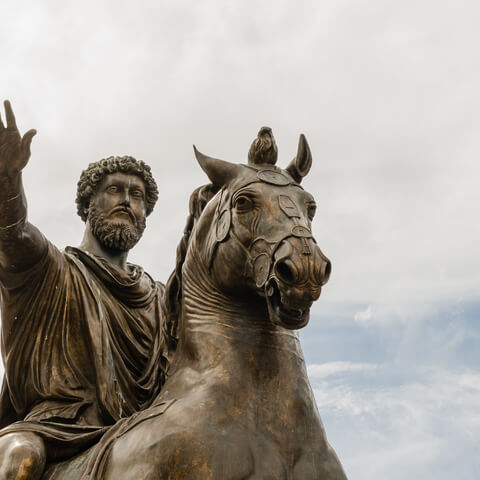
If you search for Marcus Aurelius right now on the internet,
It'll probably show up as one of his most famous quotes in most languages.
But.
.
.
Marcus Aurelius didn't write this.
It is not in the meditations,
Not in Haze,
Not in Hard,
Not in Farquharson,
Not in George Long,
Not in the Greeks.
People have gone looking,
Donald Robertson has gone looking,
Gregory Sadler has gone looking,
And nobody has ever found it.
Because as far as anyone can tell,
It was never there,
It's not his quote.
It's actually a 20th century paraphrase that got a dead emperor's name attached to it,
And then went to work over many years.
So today's episode is about the fake quotes.
There are more than you'd think,
And I've used some of them myself.
So let me be honest about why I'm opening with that particular one.
I teach stoicism,
I create guided meditations,
Courses.
I build.
I have a stoic community.
And I love this philosophy,
I find it so useful.
And over the years,
I've used that quote a few times in some of my workshops.
And then when I was doing research one day and improving my stoic knowledge,
Which I always like to do,
It's a never-ending learning process,
I saw that I could not find the original source of this quote.
And I don't think this is trivial.
Stoicism is,
Before it's anything else,
A philosophy about seeing clearly,
Right?
That is what Stoicism is all about.
You're distressed not because of what happened,
But because of the judgment that you're attached to what happened.
And the way out is to look at the judgment and check whether it's actually true or not.
Every technique in the system runs on that specific premise.
So a philosophy of accurate perception spreading through the world on the back of quotes that people didn't verify is doing something a bit strange.
It's undermining itself as it works.
We're being told to check our impressions by people who didn't check theirs.
And the second thing,
The fakes aren't neutral.
They pull in a certain direction.
Almost every one I'm going to read to you tilts stoicism towards something smoother,
More individual,
More flattering than the actual tech support.
The real Marcus is stranger and harder than the internet Marcus.
When you settle for the fake version,
You're not just getting a wrong attribution,
You're getting a lesser kind of philosophy.
Okay,
So let's go through them.
Number one is the one I opened with,
You have power over your own mind,
Not outside events.
Not in any Marcus Aurelius text you can find the closest genuine passages are things like book 5,
Section 16,
Where he says the soul takes on the color of its thoughts.
It's a related idea,
Completely different sentence.
The smooth,
Aphoristic version appears to have been assembled somewhere in the 20th century and backdated 1800 years.
Number two,
What we do in life echoes in eternity.
That's Russell Crowe.
That's Gladiator.
The year 2000 screenplay by David Franzoni and John Logan and William Nicholson.
It's a really great line,
And I love that movie.
But it's not a Roman line,
And I've seen it attributed to the meditations in books,
In articles,
And on the wall of a gym that I used to train at.
3.
Difficulties strengthen the mind as labor does the body This is usually pinned on Seneca,
To 19th century English aphorism.
Seneca does write something in that territory,
In On Providence,
But not that,
And in not those words.
Number 4 Luck is what happens when preparation meets opportunity.
I've said that so many times over the years.
And attributed to Seneca,
But again.
Best anyone can trace,
It's an American salesman around the turn of the 20th century,
2,
000 years off.
Still a good quote though.
Now notice the pattern.
The fakes are all smoother than the real thing.
And this is the tale that we're looking for.
Marcus actually writes in fragments.
He repeats himself constantly.
He gets irritable.
He'll write one line that stops your heart and then three that go seemingly nowhere.
Because he was a tired man scribbling to himself in a tent on a war frontier and he was not writing for you or for likes or for book sales.
The fakes sound like they were built for a slide.
Balanced,
Quotable,
Nothing rough about them.
So if a stoic quote lands too perfectly,
That's not evidence that it's good.
It's evidence that somewhere along the lines,
It was polished.
The outright fakes are quite easy,
But the next lot is a bit more interesting because these are real.
And they still go slightly wrong.
Okay so the first category is a real quote that's got smooth.
Waste no more time arguing about what a good man should be.
Be one.
Waste no more time arguing what a good man should be,
Be one.
So this is genuinely Marcus,
Book 10,
Section 16.
But the punchy version is Gregory Hayes doing what Hayes does brilliantly,
Which is to turn Marcus into arresting modern English.
Hard's translation gives you no longer talk at all about the kind of man that a good man ought to be.
But be such.
George Long,
Spend your time no longer in discoursing on what are the qualities of the good man,
But in actually being such.
It's the same thought,
But it's a bit more awkward,
And the awkwardness is Marcus.
I'm not knocking Hayes,
I love Hayes,
But if the only Marcus you've ever read is Hayes,
You've read a Marcus who is more quotable than the one who probably existed.
And that's just worth knowing.
The second category is the real quote that's been sort of amputated.
So,
We suffer more in imagination than in reality.
This is Seneca,
Letter 13,
But the actual passage is doing more work than the slogan.
He says,
There are more things likely to frighten us than to crush us.
And then he goes on,
Some of our torments come to us too early,
Some too late,
And some when they shouldn't be torments at all.
That's a proper taxonomy of how anticipation malfunctions.
The slogan keeps the headline and throws away the argument.
Category 3.
This is my favorite because it's so perfectly iconic.
I could hardly believe it when I started looking into it.
Anger is a brief madness.
Every stoic account of anger uses that line.
I've used it.
It gets attributed to Seneca on anger because that's where people meet it.
But if you go and read Robert Castor's translation of On Anger,
Book one,
The opening,
Here's what Seneca actually writes.
According,
Some wise men have said that anger is a brief madness.
Seneca is quoting somebody else.
He's flagging it.
He's doing the citation properly.
And the somebody else is almost certainly Horace.
The Epistles.
Book 1.
Poem 2.
Line 62.
Era Fura Braavos Est.
Anger is a brief madness.
A poet,
Not a Stoic,
Writing decades before Seneca picked it up.
So the most quoted Seneca line about anger is Horace and we know it's Horace because Seneca told us it wasn't his and nobody read the sentence properly.
So 2000 years of people skipping forwards.
Now,
The one I got wrong for years,
And got wrong publicly as a stoicism teacher,
Is amor fati,
Love of fate.
There are people with this tattooed on them.
It's the name of merchandise.
It's treated across the modern Stoic world as a core Stoic concept sitting alongside Memento Mori like they're a matched pair from the same shelf.
But Amor Fati is Nietzsche.
It appears in print in the Gay Science,
Section 276,
Published in 1882.
It's his phrase,
He coins it,
And the thing he builds around it is,
Distinctively his,
The idea of eternal recurrence,
Of saying yes to your life so totally that you'd will every second of it back again,
Identically as it has been,
Forever.
There's real continuity here.
I'm not saying that Nietzsche made it out of nothing.
Marcus writes in book four,
Whatever is harmonious to you,
Oh cosmos,
Is harmonious to me.
Epictetus in the Incaridion says,
Don't wish for things to happen the way you want them,
Wish for them to happen the way they do happen.
And it's sort of the same concept.
Pierre Hadot traces the whole lineage carefully in the inner citadel,
And he's clear about what Nietzsche did with it.
He took a stance of acceptance and turned it into an act of affirmation.
Says this is how it is and I consent.
Nietzsche says this is how it is and I want it again.
They're slightly different.
One is a bit more austere,
One is almost ecstatic.
And the Latin belongs to the second one.
Now you could reasonably say,
John,
This is pedantry,
Right?
If the line is useful,
Transformative,
It helps me,
Who cares?
Who said it,
How they said it,
And the specific details around it.
No translation is perfect anyway.
Fair,
But let me give you three answers,
And the third one is the one I care about the most.
Number one.
Accuracy is not a side quest in Stoicism.
It's the discipline.
The Stoics divided philosophy into three parts.
One of them was logic,
Which meant the study of what's true and how you can tell.
Chrysippus,
Who ran the school in the 3rd century BC,
Was one of the two great logicians of the ancient world alongside Aristotle.
This is not a tradition that treats getting things right as optional.
If you're going to practice Stoicism,
Checking your sources is part of the practice.
It's not just admin on the edge of it.
Probably make mistakes again,
But the most important thing is that I'm aiming to make less mistakes and aiming to constantly be checking my sources and citations.
So good habit to build in.
Two,
The fakes are often far worse than the originals.
Every single one I've read to you is thinner than the real material sitting next to it in the same book.
You have power over your own mind is a flattering line.
It tells you that you already have the thing.
But compare it to what Marcus actually writes in book 12,
Section 17.
If it is not right,
Do not do it.
If it is not true,
Do not say it.
Shorter,
More iconic,
And it asks something of you rather than just reassuring you.
The fake tells you that you have power.
The real one tells you what to do with it.
And that's the trade you make every time you just pick a smooth version of a quote.
And this is the one that probably bothers me the most.
The fakes pull in a consistent direction,
They pull individual,
They pull inward,
They pull towards self-mastery and away from everything else that philosophy contains.
You'll notice that no fake stoic quote ever seems to be about our obligations to strangers or about the cosmos being a single living system or about the fact that stoic senators die deposing emperors.
Those bits don't make good quote cards.
So what circulates is a stoicism that's been quietly narrowed into a personal optimization system and then people read the narrowed version and repeat it and then narrowing compounds over time.
And those are the things that make social media.
That's not a quoting problem anymore.
It's a philosophy that's slowly being diluted and translated and replaced to be a more marketable and less accurate and rich version of itself.
Okay,
So what can we do about this?
Four things.
Number one,
Check the smooth ones.
You don't need to fact check everything you read.
You need one trigger.
When a stoic line lands just too perfectly,
Too neatly,
When it's balanced and quotable,
And you could probably find it on a mug,
That's your cue.
Search for the actual test.
Perseus has the Greek.
Wikisource has full public domain translations of all three Romans.
It takes,
Honestly,
A few seconds.
Second thing you can do is demand chapter and verse.
If you can't find a book number and a section number,
Don't pass it on as theirs.
You can still use the line,
Just don't put a Roman's name on it.
Third,
Name your translator.
Marcus Aurelius Meditations 520 Hays Translation is an honest sentence.
Marcus Aurelius on its own is doing a small amount of lying because it implies you're quoting Marcus when you're quoting a translator's interpretation of Marcus.
And finally,
Read the actual books.
This is the real recommendation.
Sit with how strange they are.
Let Marcus be repetitive to you.
Let Epictetus be bossy at you.
He was a teacher shouting at his students in the lecture room in Nicopolis,
And it reads like it.
These were not aphorism machines.
They were people working something difficult out in real time,
And the working out is the part worth having.
So I'll leave you with the one that survived the audit.
Marcus,
Book 12,
Section 17.
His own words,
His own book,
His own handwriting as far as we can reconstruct it.
And I've said it before and I'll say it again.
If it is not right,
Do not do it.
If it is not true,
Do not say it.
He wasn't writing about quotations.
He was writing about how to be a person.
But it works for this too.
If it isn't true,
Don't say it.
Including about him.
If you want to start practicing this stuff rather than collecting quotes about it,
The Stoic Power Challenge is accessible.
And it is a seven day course,
One practice a day,
No fluff.