One of the baseline foundational views of Stoicism is this question of what constitutes a happy life?
You know,
How can we live well?
And it's a really tricky question,
You know,
Because you have things like the experiencing self.
This is the work of Daniel Kahneman.
You have the experiencing self.
So the self that is experiencing this moment right now,
Like how do you feel right now on a scale of one to 10?
But then you also have this idea of the remembering self.
So,
For example,
You might care for someone who's not very well,
And during the care process,
It might be very unpleasant.
Your experiencing self might not like it,
But when you look back on that time period,
You have a sense of deep gratitude and meaning because you know that you spent it well.
You spent it looking after someone you loved.
So sometimes we can dislike the moment,
But then be very happy about the way that we spent that moment.
So that we have the experiencing self and we have the remembering self.
And it's a tricky thing.
How do we live a good life?
Some of the ancient sages said that we don't know if you've lived a good life until we're about to die,
Because that's when we can truly look at our life and go,
Well,
Did I spend it wisely?
And you might have had a lot of fun.
You might have,
You know,
Lived a very hedonistic life and,
You know,
Had a lot of pleasure.
But then when you look back on your life when it's about to end,
You might go,
Yeah,
I didn't really,
You know,
Go into that relationship that was meaningful to me.
I didn't spend enough time with my children.
I worked too much,
You know,
The regrets of the dying.
Um And the Stoics,
They recognize that one of the ways that we often seek happiness in life is by chasing things.
Right?
Like,
We all do it.
Even people who are philosophical and spiritual still chase things.
We might not chase Ferraris or sports cars or fancy clothing,
But we might chase that next insight,
Or we might chase that next book that we want to read.
If only we can get this new thing,
Then we'll be happy.
Then we'll be complete.
And so a lot of us go through life thinking,
Well,
I'm not where I want to be now.
If I can pursue this goal and achieve this thing in the future,
Then I'll be happy.
Then I'll have what I want.
There are a few problems with this mode of being.
The main one is that if we're always chasing something in the future,
Then we're always going to be dissatisfied with where we are right now.
So speaking personally,
If you look at your life,
Are you someone who is constantly chasing something?
Are you very sort of future focused and you've always got to be getting to the next goal?
Or are you skilled at just appreciating where you are right now?
Are you skilled at just accepting the emotions and the circumstances in your current life?
If we are constantly chasing a state and we're not currently in it,
We are constantly dissatisfied.
William B.
Irvine,
Who's a Stoic writer,
He calls this the gap theory of happiness.
So here we are standing and there's a gap in front of us.
And if we can close the gap,
Then we'll be finally happy and have this happily ever after fairytale life.
The problem is,
Do any of us have the happily ever after life right now?
We've all chased things.
We've all gotten things.
We've all pursued pleasures and gotten pleasures.
Have we reached this end goal of I've done it?
I've arrived.
Or is there a set a new thing that we're chasing?
Have we adapted?
And the Stoics recognized that there's a way to overcome this gap theory of happiness.
And that is to learn to want the life you already have.
It's a very counterintuitive thing,
But this is deep radical gratitude,
As I call it.
And it goes so much further than counting your blessings.
There's a lot of research now on the power of gratitude.
The problem is with just counting your blessings is,
Well,
What happens when you have the worst day of your life?
What if you have burnout?
What if you're experiencing a low-level state of depression or extreme anxiety and you find it really hard to see anything that you're grateful for?
What do you do then?
Stoicism and Spirituality.
Are training tools for the worst day of your life,
As I see it.
If someone asks me,
Why do you meditate?
Why do you practice stoicism?
On the deepest level,
It's preparation for when things don't go to plan.
And that will always happen at some point,
Sooner or later.
So then the question is,
If the secret to being happy is to learn to want the life you already have,
What are the strategies to do that?
How do you learn to want the life you already have?
Maybe you're experiencing relationship difficulties.
Maybe you're not really happy with the kind of work you're doing.
Maybe you're having money struggles.
How can you want the life you already have when there are so many problems with your life?
And should you even want the life you already have?
Well.
.
.
The first thing to remember is if we are in a state of desperation,
If we're in a state of emergency physiologically,
If we're really anxious and unhappy with where we are,
We're not going to make good decisions.
If you think about the decisions you've made in your life over the last decade,
How many really,
Really good decisions were made when you were highly emotional,
When you were feeling desperate?
Versus how many good decisions did you make when you felt clear-headed.
If you're in a state of emergency and desperation,
You're going to take high risks that isn't going to help you.
So it's actually much better for you,
Even if you're not really satisfied with where you are in life,
To learn to appreciate it so that you can take the steps to problem solve with a clear head.
I'm just going to run you through a few different stoic frames.
So frame control is a stoic concept.
The idea is that you have reality,
But you don't have a true understanding of reality,
Because as human beings,
We're not built to see things completely objectively.
We're not built to see things like the true nature of reality.
The idea of practicing reason and logic is that we can get a slightly better grasp on reality.
Someone who is very irrational in their thoughts and can't think straight is ultimately losing grip of reality.
And by practicing stoicism and meditation,
The idea is that we're starting to get a better grip of reality.
And if we see that we have irrational thoughts,
Then the grip that we have becomes closer to reality.
But we can never actually truly understand reality because we're not built to do that.
We built for other things.
So a stoic frame technique is this idea of you can't see all of reality.
So much of reality is completely invisible to you.
If you could see everything in reality,
Then you would lose your mind.
That's the idea of it.
I used to suffer with really bad anxiety many years ago,
And walking down the street was very difficult for me,
You know,
Especially at nighttime,
Because I would be so aware of everything.
Things that most people would just screening out and blocking out,
I was aware of those things.
I was aware of the potential dangers and all the different people that were like standing around in the darkness,
Things that I should have been filtering out,
I couldn't because I was so anxious.
So a healthy mind on some level is blocking a lot of things out.
If you become super aware of everything,
Then it's going to be overwhelming.
And so a stoic frame technique is when you're faced with an event or a situation,
And then you examine things that you're not noticing,
Based on your instinct,
And choosing things that might be constructive to think about.
And we do this all the time.
If you have a friend that is going through a hard time,
What you might say to them is something like,
You know,
Yes,
I know you're going through a hard time,
But so-and-so has it much worse than you,
You know,
Or it could be so much worse.
The cliche advice,
We try to cheer people up,
It often doesn't work.
Nobody really wants to hear that when they're going through a hard time.
It could be so much worse.
But it is true on some level.
It is absolutely true.
It could always be worse.
And the Stoics would say that there's some truth to that idea that things could be worse.
But rather than think about it in a shallow,
Cliche way,
We should deeply contemplate this idea.
And so one technique that we can practice is the idea that our lives right now are absolutely someone else's dream life.
Absolutely someone else's dream life.
You might be complaining about a certain relationship you have.
There are many,
Many people right now,
Even people in your neighborhood,
You don't have to go to far corners of the earth.
People in your neighborhood,
Due to some kind of medical issue perhaps,
Have never had a relationship.
Right?
But we don't,
We block it out.
We block it out.
Well,
The Stoics would encourage you to don't block it out,
To actually think about that,
To empathize with that individual,
And to see how lucky you actually have it,
That yes,
Your relationships aren't perfect,
But you still have experienced this in life.
The same is true for health,
You know,
Maybe we have a health issue,
Maybe we've got a recurring problem.
There's people that are severely paralyzed or have spent most of their life back and forth to the hospital.
And it's important that when we think about this,
It's not in a kind of.
.
.
In a pitying way,
Because you could also find their life to be someone else's dream life too.
But it's just to recognize that whatever you are complaining about in life,
There are people that would actually want your problems.
There are people that don't have access to clean water.
There are people that don't have,
Millions of people actually,
That don't even have wooden floor or carpet.
They have dirt for floor.
They don't have an indoor toilet.
You know,
There's a lot of,
A lot of poverty.
I'm bringing up a child at the moment.
And sometimes,
You know,
Days are long and days are hard bringing up a child,
Three-year-old.
And.
And then I sometimes think that there are people doing exactly what I'm doing,
But with,
Instead of one child,
Five children on their own.
And they might be bringing up their children in a literal war zone.
And the simple recognition of that.
It really brings me back down to earth.
You know,
And actually makes me appreciative of even the difficulties.
I want to share a quote with you right now,
And this is a quote from the German philosopher Friedrich Nietzsche.
It's a slightly counterintuitive quote,
And it might stir up a lot in you.
And as I read it,
I want you to tell me what you think it means.
Okay,
So this is a quote that Nietzsche was talking about in relation to his friendships.
So he said,
That one endures.
Interesting line that Nietzsche is saying that he wishes suffering upon his friends.
How does that land for you?
Do you think that that's a perspective that is cruel?
Do you think nature is not thinking straight when you're saying that?
The key line is at the end of the quote.
That one endures Nietzsche says.
So Nietzsche is not actually saying that suffering is good in and of itself.
He's saying that to overcome suffering is good.
To endure suffering is good because that's how we get to know ourselves.
That's how we get to see what we're made of.
As a practicing stoic.
The environment is not really good or bad.
At least we don't think of it in those terms.
What we consider to be good or bad is our thoughts,
Our intentions,
Our actions.
Our character.
And the question is,
If you are never put under pressure.
.
.
If you never have to face adversity,
Suffering,
Or problems to solve,
Will you ever get to see what you're made of?
Will you ever get to see who you really are?
And so here we are,
You know,
We're all interested here in self-improvement,
In spirituality,
Mindfulness,
Philosophy.
Do you genuinely want a life with no problems?
Is that what you're looking for?
Do you think that would be a good life?
From now until the end,
You never have a problem again.
Or do you think that what you really want is the ability to have problems and overcome them?
I don't think that a life with zero problems would be a very good life.
Just like watching a movie when the main character has no adversity wouldn't be a good movie.
We go to the cinema,
We watch TV shows where the main character has a goal and then has tests and trials and tribulations and has problems overcoming the goal and then eventually achieves it.
If you just watched the beginning of the movie and the main character got their goal and was just chilling,
You wouldn't think it was a good movie.
And the Stoics would say,
Well,
Why don't you think that way about yourself?
Manageable problems,
Yes.
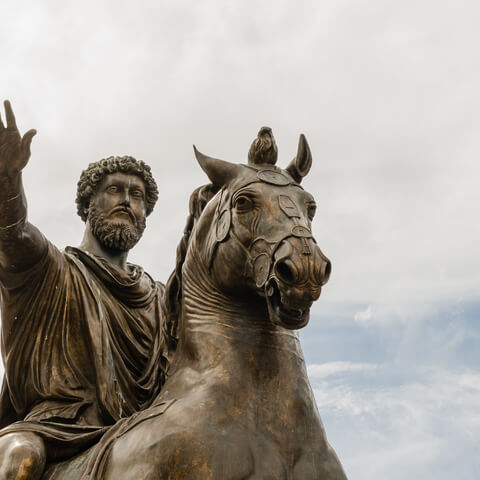
So Marcus Aurelius,
The Roman emperor and one of the most famous Stoics,
He wrote a book called Meditations.
HWUH He said that when things came along that challenged him,
Instead of saying,
This is misfortune?
" He would say instead,
This is not misfortune,
But instead,
To handle it well is good fortune.
And so he was seeing himself as someone who is training in his spiritual practice,
In his philosophy practice,
Training and almost hoping for challenges in life.
If you,
I love the idea of a martial artist.
I practice martial arts myself.
If you're training in martial arts.
Maybe hitting a bag or practicing moves in a very controlled environment,
At some point it would be good to,
In a safe way,
Of course,
To test the skills that you've been building.
And in the same way,
If we're practicing in stoicism,
In building our resilience,
In increasing our gratitude for life.
It would be kind of a shame to never get to try that out when there's difficulty that comes along.
So most people,
When they think about gratitude,
The first level to gratitude is something nice happens.
And you noped it,
Okay?
Like,
Went for a nice walk,
Nice.
Had a nice conversation,
Nice.
Noped it.
Count my blessings.
The next stage is to count your blessings,
And then when quote-unquote negative things happen,
You accept them.
Okay?
So like,
You don't see it as good or bad,
But you just kind of accept it.
I'm letting go.
You know,
The classic letting go technique.
But the end goal,
The third stage,
And this is where we want to get to.
Is that we don't just accept the negative things that happen to us and count our blessings,
But all of life becomes a blessing.
Everything on some level becomes good.
And this brings me to the Hermes' magic wand technique.
So this is a quote by Epictetus,
So Epictetus knew suffering well,
And he was an ex-slave,
So he really knew suffering well.
And he said,
With Hermes' magic wand,
Which is a,
Hermes is a Greek character,
A Greek god,
Who had a magic wand,
And did various things with his magic wand.
He uses this as a metaphor.
He says that,
With Hermes' magic wand,
You touch it to anything you like,
And the wand will turn it to gold.
He says,
When it comes to me,
I'll make things good,
Whatever it is.
Bring me disease,
Bring me death,
Bring me poverty,
Bring me insults,
Bring me punishment for high crimes.
All of these things will be made beneficial.
By Hermes' magic wand.
This is a big ask.
How can you turn death,
Poverty,
Insults,
Punishment for high crimes,
Disease into something good?
Well,
I don't think that we should start there when we're training.
Just like when we're training martial arts,
We shouldn't start with a world champion in a competition.
You know,
We should build our way up.
But we can practice this frame by practice turning adversity into advantage.
By training the skill of saying good when something difficult happens.
So let me give you a few examples.
You're stuck in traffic and you're late for something important.
What's the thought process that goes on in your head?
What's the thought process that goes on in your head?
Are you?
Typically,
Are you telling yourself that you're a victim?
Are you trying to kind of somehow speed up the traffic by your anger and frustration?
Yeah,
Are you feeling sorry for yourself?
Or are you able to say.
.
.
I'm glad that I'm going to be late.
This is good.
This is good that I'm late,
Because,
I mean,
Why wouldn't you think that?
Because there's nothing you can do about it anyway.
I'm good that it's late.
It's good that it's late.
What am I going to do instead?
Oh,
Cool.
There's this audio book that I wanted to listen to for a while.
Or it's good that I'm late,
I can practice handling the frustration that I'm feeling right now and being okay with it.
This is good practice for being mindful,
For being present and get to know myself.
I can practice true calm.
The Stoics saw that you can't really show good sides of your character unless there are temptations to show bad sides.
You can't really claim to be disciplined unless you have a lot of temptation to not be disciplined.
You can't really claim to be deeply honest and have high integrity unless you have temptation to lie.
You know,
Like someone could claim to be the world's most honest person.
But then have they ever been in a situation where they had a really big incentive to not tell the truth and nobody would find out and they'd gain a lot by doing that?
That would exhibit true honesty.
The same for things like moderation and justice and wisdom and has anyone ever triggered you and you had every reason to lash out and to get extremely angry but you restrained yourself,
You used patience and you waited,
That shows maturity.
If you never get triggered,
You never really get to test what you're made of.
And so in that sense,
Whatever happens to you,
If you get stuck in traffic,
If you have a bad day,
A stressful day.
That is an opportunity where you are presented with two paths.
There's the path of being a victim.
And you're welcome to follow that and we're all human beings and we will all follow that from time to time and there's no problem with that.
No,
We're not going to beat ourselves up about it.
But then there's also the path of,
How can I transmute this difficulty into something that gives me an advantage?
How can I use this difficult situation to reveal something noble and virtuous and wise about myself?
And that's the idea.
So another example would be,
Say that you slip and you injure yourself.
A couple of years ago,
I broke my ankle.
Small break,
But I was in a cast for 10 weeks.
I couldn't drive.
And I couldn't travel,
Couldn't do anything.
Did I like Break a Miracle?
No.
Did I like seeing that the x-ray showed there was a break there and the doctor telling me I'd be in a cast for 10 weeks?
Was that really great?
No,
It wasn't great news to me.
But I also recognized that I wasn't able to unbreak my ankle.
This is it.
Like I can't change this.
This is what it is.
Like I'm going to be in a cast for 10 weeks.
And so how can I.
Choose it.
Instead of this situation choosing me,
How can I instead learn to choose this situation myself?
And another really powerful Stoic frame is this idea of the obstacle is the way,
Popularized by Ryan Holiday.
And it's this idea that what stands in the way becomes the way.
And so.
During lockdown,
Right,
We've all experienced lockdown,
I couldn't train martial arts,
Right,
Which is something that I was doing a lot,
Very good for my mental and physical health,
And the gym is just closed.
And I,
You know,
Everyone thought that this skill level would go backwards with,
You know,
Over the next three,
Four,
Five months.
My question I ask myself is how can I make my skill go up because of the lockdown?
How can I make it so that this lockdown is the best thing ever for my martial arts?
And so I developed new ways of studying,
You know,
Using flashcards and active recall.
Changed my room into a training room I found a partner to train with.
And I did learn more during lockdown than when the gyms were open.
And I thanked the lockdown for it.
I didn't get better in spite of the lockdown.
I got better because of the lockdown.
The lockdown helped me.
And that was a choice,
And you can always do that with whatever happens.
So if you break your ankle,
Okay,
Maybe you can't do all those things that you were planning to do,
But maybe now you can actually study for the first time in a long time.
Maybe you can actually go into your to-do list and start taking off those things that you've been promising people for the last six months.
Obviously,
When we die,
There will be a last time for everything that we do.
Okay,
That's obvious.
But throughout our lives,
We often experience a last time with things and we don't even know it at the time.
So an example would be.
When was the last time you used a rotary phone?
It's done.
When was the last time you used a jump rope?
When was the last time you played hopscotch?
When was the last time you played a video game?
When was the last time you.
.
.
Made pancakes?
When was the last time you made a milkshake?
I could go on and on.
When was the last time you played a game of cards?
Maybe some of those things that I just mentioned,
You will never do again.
But at the time you did them,
You had no idea that it would be the last time.
With some of the things I listed,
It might not matter to you.
Like,
I don't care if I don't play cards again.
But what about the things that do matter?
What about certain friendships that you have that you might have interacted with that person for the last time and you might not even be aware of it right now?
I think about this in relation to parenthood.
There might be a time when I read.
My son a bedtime story for the last time and I might not know it.
There might be a time when I brush his teeth for the last time and I might not know it.
And even with things like him waking up in the middle of the night,
Even though that's uncomfortable and hurts my sleep,
There will be a last time for that too.
And that actually adds a certain poignancy to it.
How one day in the future,
I might definitely look back at being sleep deprived and being woken up in the middle of the night.
And appreciated that that was actually a beautiful time in and of itself.
And so those little struggles that you're going through,
You might be thinking,
I want to get past it,
I want to get through it,
I want to get over it.
But the way that life often works is that when you look back with the remembering self,
To past epochs that you've experienced.
Sometimes even the periods that were tinged with difficulty and stress and challenge were beautiful in their way,
But at the time you didn't see it.