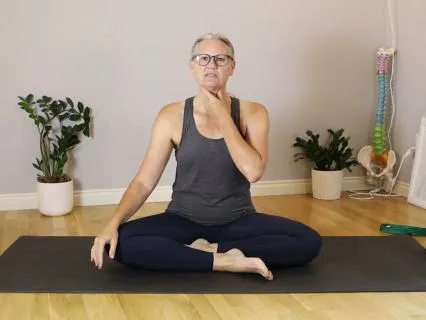
So we're going to start seated or you can begin laying down and we're going to work on ujjayi breath.
Ujjayi breath is that ocean breath.
It makes sound in the throat.
We've been working on it.
So just as a little refresher,
We're taking that inhale and you're just Putting a little bit of awareness into your throat as you inhale.
And then as you exhale,
And I always say it's like breathing like Darth Vader.
You're just putting that little bit of constriction in your throat to make that sound.
Now,
Remembering,
Ujjayi breath is not a loud breath,
Necessarily,
Like Darth Vader.
When we begin practicing it,
We do want to hear that sound,
But as we get into our practice,
You will find that the sound lowers a little bit,
It becomes a little softer,
But it's something that you can still hear.
So taking Couple minutes right here.
You can sit,
You can lay down,
But we're just going to focus on Ujjayi breath.
Keeping that breath going,
We're going to lay down on our mat and move into a panasana.
You're going to lay down.
Feeling the length of your spine on the floor and bringing your knees up towards your chest.
Now,
This is where I want you to be curious.
Feeling the length of your spine on the floor.
Tendency is we can hug the knees in and flatten the lower back onto the floor.
How does that feel?
You can also try it by just sinking into your hips,
Allowing your spine to remain nice and long,
Neutral on the ground.
And just taking the knees out to the side.
You can also bring the knees into the center.
Depending on how your abdomen feels today,
You may find one position is a little more comfortable than the other.
Find what feels.
Like a little hug to you and find that ujjayi breath.
Feeling how the body can sink into the ground,
Releasing tension.
Allowing for a little bit of space with the inhale.
We're going to bring the legs in together,
And you're going to take them over to the left.
As you move the knees over to the left.
It might be a lot of a rotation if you want to take it into a little more comfortable rotation.
You can have your feet on the floor and knees move to the side from there.
Either way,
What I want you to find is this rotation up through your spine.
This isn't us trying to get our legs to the ground.
It is feeling how this rotation happens.
It's not a forced twist in the waist.
I want you to feel how.
The rotation happens up through your torso.
If it's comfortable,
You can take your head,
Turn to the opposite side.
But again,
Finding Wu Zhai breath.
Noticing that as you inhale,
It allows for space in the body.
If it feels like you can find a little bit more stretch,
You can use that inhale.
Otherwise,
You can also use your exhale,
Feeling the body soften into the ground.
Taking a couple more breaths.
And then bringing the knees up.
You can bring them up one at a time or both at the same time,
Taking your knees over to the right.
Knees go over to the right again,
That full rotation up through the body,
Knees do not need to touch the floor.
That is not the goal of this.
The goal in this asana is to find our rotation,
Feel how the entire torso can be seen as this cylinder that it has this nice easy rotation all the way up to the shoulders.
Again,
Finding that Ujjayi breath.
Maybe even noticing with this rotation.
There's a bit of restriction in the belly to find the breath.
We don't need to push that far.
Again.
This is not about pushing as far as we can.
It's about moving the body and being curious where those edges are and how we can breathe into it.
Bringing the knees up.
We're laying on our back.
Find that nice center line.
Feet are planted.
We're going to take this into Little Bridge.
With Little Bridge,
We're lifting from the belly button all the way up.
Tendency is we tuck the tailbone and lift up from here.
I want you to imagine from your belly button,
You're lifting and coming up into your little bridge.
This is where I want you to find your belly breath.
Really try and get that belly to fill.
Allowing for that massage of the organs.
Allowing for that space.
And allowing for this release.
Lowering down,
We are going to lift into Little Bridge one more time.
Bringing this up.
Setubandhasana.
Finding that belly breath.
Feeling that anchor towards the shoulders,
The length in your neck.
The strength of the back of the body,
And then lowering down.
We're going to be taking this and rolling it.
We're going to roll and get onto all fours.
But when we roll,
I want you to stretch your legs out.
Arms out.
And I want you to find how you can take your right arm,
Lift your head and reach over to your left hand.
Lower it back down.
Left arm comes up,
Lift your head,
Reach over to your right hand.
Just to get the core engaged.
And to feel again that rotation lifting up.
Reaching across.
And rolling back.
This time,
Lift that left arm,
Reach up,
Roll over to the right side.
Use the legs.
And come right up into a cat cow position.
We're on the hands.
We're on the knees.
I want you to find your neutral spine.
That's not always the easiest thing to do because the body wants to tuck the tailbone and push into the floor.
Sink into the shoulders,
Point your tailbone straight back,
And imagine there is a mother cat picking up her kitten by the scruff of their neck.
Same thing here,
Feeling the blank space.
Through the back of your neck.
This is your neutral position.
If we move into cat,
We tuck the tailbone,
We round the spine,
You tuck your chin,
Look back towards your navel.
And then lift your tailbone moving into cow,
We arch the spine,
We lift through the collarbones and we look forward.
Moving into cat again,
Tucking the tailbone,
Remembering your breath,
Feeling how you can create that space in the back of your body.
Lifting that tailbone,
Moving through your spine,
Lengthening.
Taking that into cow.
One more time,
Moving through the back of the body,
Find that position,
Press into the hands,
Breathe into your back.
And moving back into cow.
Lifting,
Looking forward.
This is a good chance to open the front of the body.
Now from here,
We're going to take this into hero's pose.
Knees are going to go a little bit wider.
Keeping that Ujjayi breath nice and steady,
You can touch your toes behind you,
And you're going to start reaching back.
As you reach back,
You might find your knees,
Maybe your ankles,
Don't like this.
That is not something we push through.
I want you to find your range of movement,
Which means If you're here and you point your toes and start to sit back and you feel that stretch or pressure in your knees,
You can rock back and forth.
Just moving on that whisper edge.
We're not trying to force this.
If it's feeling comfortable and you can sit back,
Arms reach forward.
And allow that belly breath to happen again.
You can feel how you can sink back into your hips.
We're not tucking the tailbone right now.
We're lengthening through the spine.
The knees are nice and wide.
We're going to take the left hand,
Reach over to the right hand.
Give yourself a small lateral bend.
Breathe into that space.
Bring that hand back to center.
Take your right hand over to your left hand.
Breathe into the right side of the body.
Allow your inhale to create that space.
Coming back to center.
We're going to take this into Cobra.
We're going to be moving forward.
Do move slowly,
Sometimes sitting back on the knees.
The knees aren't super happy about that.
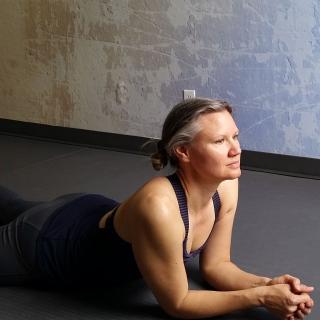
We're going to come down onto the forearm.
Lay yourself down on to your mat.
Let your forehead rest on your hands for a moment.
Find that Ujjayi breath.
We're going to bring the elbows beside us.
And I want you to lengthen and look forward.
You could almost imagine that your toes are anchored behind you,
And your arms are kind of pulling the front of your body forward.
Again,
Whisper edges.
We're not looking for forced movement.
We're just exploring the space we have,
Depending on how your abdomen feels today.
That might be a movement where you can come up a little bit more.
It might be a movement of just putting pressure,
Feeling the belly on the ground.
That's okay too.
But we are breathing.
And if laying on the floor with your belly on the ground is too much pressure,
You can always move back into hero's pose that we just did.
Either way.
Ujjayi breath.
Getting the back of the body to do that work.
Lengthening the front of the body.
And then hands go under the shoulders,
Pressing yourself up.
And coming into.
A seated position.
Excellent.
We've got two more asanas to work on.
We're going to take this into septu baddha konasana,
So reclined bound angle pose.
You're going to take your knees out to the side.
First things first,
Hands are behind you.
I want you to just feel how your knees can drop to the side.
If it's comfortable.
You can take this back onto your elbows.
If you're comfortable here,
You can lay this back on your back.
Sometimes that's not super comfortable if you have back pain,
Or the hips might not have that same mobility.
Totally fine.
Lean on your hands.
We're working on opening up the space on the inside of your thighs.
Allowing for that space in the front of the pelvis.
Ujjayi breath.
Hanging out wherever this might feel comfortable.
And then gently bringing the knees together.
And before we get into the next asana,
We're going to bring one knee in,
Get into the hip,
Just like that knees to chest pose we did up in asana at the beginning,
Just to move into those joints.
Rolling over.
Now we're going to work on a squat.
Okay.
When we work on a squat,
You're going to take your toes out to the side.
Okay.
Toes out to the side does give you more range of movement in your hips.
If your feet are parallel,
Like a gym squat,
You'll find you have range of movement restrictions.
So take those knees out to the,
Or toes out to the side,
Do point the same direction as your toes.
Now,
By all means,
You can do this from a standing position.
You can work on your squat as to getting into a seated position like into a chair.
Because if I stand up,
You're not going to be able to see me.
I'm just going to work on it from this position.
But by all means,
You stand,
Toes go out to the side,
Knees point same direction as your toes.
And what you're going to do is work yourself into a position where you can get.
I'm going to turn here.
Your elbows inside your knees.
And sink into this now.
There's a few different ranges of movement that we need to find to be able to get into this squat position.
One is the hips.
We've been working on that a little bit.
The other one is the knees.
When we went into hero pose,
Same thing.
We worked on moving into the knee joints.
Your knees might not get into this position.
Surprisingly,
The other joint angle that we're working on is the ankles.
The ankles need to have some range of movement for you to keep your balance in a Malasana squat.
So play with this.
I always recommend when you're brushing your teeth,
Do some squats.
We're keeping the collarbones fairly lifted.
We're looking forward.
We're moving into the squat position.
Now,
Hanging out here,
I will say,
Does take some practice.
Because if you hang out here for a while,
Your knee joints go,
I don't want to stand up from here.
You can always sit down.
Either way,
Squats are a super easy workout.
Awesome movement to work on.
You don't have to get into that deep squat.
You might just be working on sitting in a chair like we've been doing in class.
But finding that range of movement in your hips,
Your knees,
And your ankle joints helps build that strength through your torso and is a great exercise to do while you brush your teeth.
As I mentioned,
I'm partial to it.
All right.
We're going to take this and move into some breath work.
So finding a comfortable seated position.
All right.
We're going to take this into three physiological sighs.
Remembering those physiological sighs.
It's a big inhale.
Two more extra inhales.
And then a nice all the way out.
We're going to do it three times.
So finding that seated position,
Big inhale.
Two more.
And.
.
.
Big release of a sigh.
Two more times.
Big inhale.
Little exit inhales.
One more time,
Big inhale.
Two more inhales.
And that big exhale.
Nice.
Remembering you have that as a tool anytime.
I do recommend not doing it while you're driving.
It's a little bit too much,
Could disorientate you.
Okay.
Next breath we're going to work on is box breathing.
We've been working on building up the length of our box breathing.
We're going to start with two box breaths at a count of three,
And then we're going to lengthen it out.
Depending on your count,
We can go up to four,
We can go up to five.
So sitting nice and tall,
Finding that count of three.
Holding top of the inhale.
Exhaling.
Holding at the bottom of the exhale.
Inhaling.
Holding.
Exhaling.
Folding Now lengthening it out to four.
Inhaling.
Holding.
Exhaling.
Holding.
Inhaling.
Holding.
Exhaling.
Holding.
Working on a count of five,
Inhaling.
Holding.
Exhaling.
Holding.
Inhaling.
Holding.
Exhaling holding.
Inhale.
Huh?
Exhale.
Oh.
Excellent.
Finding that neutral breath.
And just sitting here for a moment,
If you want to lay down you can.
We're allowing that breath to just come back to an easy.
Soft breath,
No need to control it.
And I want you to notice.
How at the bottom of your exhale,
There's this momentary pause as your exhale turns into your inhale.
I want you to use that pause not to hold it like we just did,
But to feel how you can settle in it for just that moment.
The mind,
The body feels that moment of stillness,
That moment of presence.
And then your inhale just happens.
Again,
We're not holding the breath like we just did.
We're just noticing the bottom of the exhale.
You may find your body pauses a little longer.
But we're not holding.
So.
Right here,
Just paying attention to the breath.
And just feeling how your inhale turns into your exhale.
And now at the bottom of your exhale,
There's that momentary pause.
And then it turns into your inhale.
We're going to sit here for a minute,
Listening,
Paying attention to our breath.
Feeling that moment of stillness,
Your mind may wander.
It's just like watching the clouds drift across the sky.
Noticing as the clouds drift,
There's that moment of blue sky.
That's that moment of stillness.
And just allowing your breath.
To go at a nice easy pace.
And then wiggling your fingers,
Wiggling your toes,
Wiggle those shoulders,
You can rock the hips.
Waking up to your body,
Maybe giving yourself a big hug.
And a rotation through the torso.
Namaste.