So your roll,
Whether it's your felt pad,
Which would be a thin roll,
Or your towels,
Is going to go into that middle space of your thoracic spine,
Where that shoulder,
The tip of the shoulder blade comes down,
Okay?
Right there,
It's about bra strap level.
And you can use two more towels rolled up,
Or if you have a black strap,
You use a black strap.
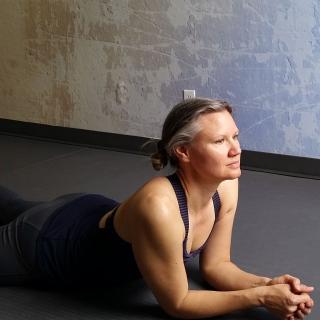
And when you lay back,
Wiggle yourself into that right spot,
Okay?
Notice how it's just in the middle of the thoracic spine,
Not too low,
Not too high up on my shoulder blade,
Okay?
You take your,
Bath towels or your black strap comes down.
You lower with your shoulders,
Not your head.
So this is lowering with my shoulders.
This is lowering with my head.
Notice how my head ends up here rather than the shoulders doing the movement.
And then my head ends up in a little better position.
Hands can be on your lower ribs.
They can be out to the side.
They can also be up in this cowboy stick-em-up position.
But if you do have your hands up here,
Your wrist needs to be on the ground.
Your hand can't be hanging in space.
It puts a bit too much strain in the shoulder joint and the muscles end up gripping a bit too much as a reflex to protect the joint.
So we want the arm to be able to relax,
Whether it's out to the side or hands on the lower ribs.
Remembering we're using the breath,
That heaviness.
Play with the edge of your breath because the deeper your breath is because this role is in your thoracic area where your lungs are in your ribcage there's going to be a strong edge.
We don't need a super deep breath.
We want to play the edges,
Not force anything.
So hang out here,
Play with the exhale,
Play with your inhale.
You may notice that movement down through into the pelvis.
You may notice the length through your neck.
Play with it,
See how it feels.
The movement is bringing the feet together,
Legs together,
Knees together,
Which ends up stabilizing the pelvis down so that we can allow for the rotation of the spine.
If we have our feet apart and we move our knees side to side,
A lot of the rotation ends up from the hip sockets rather than the spine.
So feet together,
Glued together,
Remember that little mono ski we buckled our feet into?
Right.
Just a little bit for the first one.
About one o'clock position.
And then the knees will move to the left to about that 11 o'clock position.
Okay.
Notice one side is going to be different than the other.
Totally fine.
Don't answer.
Just notice it.
And then we continue to move a little bit further.
Now you can go back and forth with this as long as you want.
Okay.
Nice and slow.
And eventually we create a more flowing movement.
But as we move further to the right,
We end up on that outside edge of the foot and the left foot comes up off the ground.
Okay,
And then the knees come up and they move over to the left.
Noticing how I'm on the outside edge of my left foot,
My right foot comes up off the ground.
That rotation moves up through my spine.
If you notice there's an area in your spine where it just goes and you're twisting in only one spot of your spine,
Really try and move slowly into it so that you're stabilizing that movement and you can allow for that twist to move through the spine and not just in one spot.
And you can go one side to the other,
Hang out there,
But again,
Play on the edges.
When those edges do dissipate,
You've got two choices.
One,
You can deepen your breath.
Two,
You could move a little bit further.
Again,
Play with that,
See how it feels.
And hopefully.
.
.
You had a nice long rotation through your spine.