Hi,
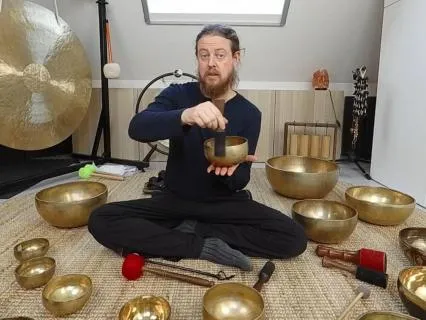
Here's a little video about um.
.
.
Overtones on singing bowls and how mallets and different mallets affect these overtones.
So first of all you have a lot of different mallets to play with.
So this is a big one,
This is a very soft one.
This one is slightly harder.
Bit harder too.
So there's a whole range within the hardness of your mallet.
And the harder your mallet is,
The more overtones you will create.
You also have these ones.
These are actually used to stroke around the rim of the pole.
They're pretty hard and have felt around it.
You can use them to hit it as well.
I will show you the difference.
You can hear this very well.
On a big ball when I hit with the soft mallet.
You hear the lower tones?
Not many overtones.
When I use a slightly harder minutes.
Hear that brightness coming to it?
That's more overtones that you're hearing.
And when you hit it with an even harder mallet you get.
.
.
Bitmorphed.
This is exaggerated,
That's a lot.
So that's basically the theory.
About it,
The heart of the mallet.
The more overtones you have.
That's only when you hit the ball,
When you throw the ball like this,
That's a different thing.
It's just building up.
And as long as it's not starts to vibrate against it.
You won't hear many of our tones.
So I hope that's useful.
Of maybe something.
Little extra.
When you use these strokers they have different sizes as well slightly larger.
This is a very big one.
The big ones are used.
For bigger balls,
So that's.
The theory behind that.
So let me know if you have any questions about it and I hope this is clear and Elsa let me know if you have anything.
You want to ask about.
Have a lovely day.
Bye.