But when you see mitochondria inside a living cell,
What you see is their dynamic movement,
And it's like an organism,
Right?
A distributed organism,
Just like your body is a cell collective.
Right.
What makes your body function is every cell is connected to every other cell.
And that's what allows you to be healthy.
And healing in a way is.
The body reconnecting itself,
Right?
And every cell kind of entering into this state of coherence where every cell is working with every other cell towards a shared goal,
Right?
And that's what makes a great organizations,
Great research labs,
Great families,
Right?
Where you have everyone working together towards a shared goal.
And that's what a healthy body does.
Every cell working together coherently,
Just like a laser,
Right?
Every cell working together in harmony.
And then wholeness is realized.
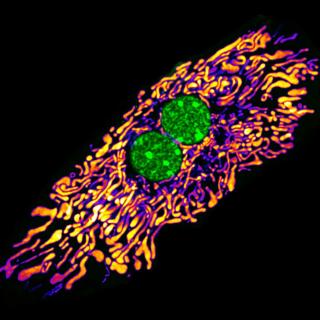
So when you look at mitochondria inside a cell,
You see that wholeness.
You see like all the mitochondria are there and some of them can come together and fuse.
So you have two shorter mitochondria that come together,
Fuse,
They become a longer one.
And that's like mitochondria getting married with each other.
And then they move around and then at some point,
One small part of mitochondria,
You know,
Buds out.
And that's called mitochondrial fission.
And now this component maybe isn't needed anymore.
It gets degraded and then this leftover one can grow again and then make other babies.
So there's this life cycle of old mitochondria dying out and new mitochondria being born.
Very often,
Mitochondria surround the nucleus.
Right.
The nucleus is this organelle,
This part of the cell that houses all of their genes.
So half of your genes from mom,
Half of your genes from dad,
All of those are packaged inside the nucleus of the cell.
Generally,
It's like a little sphere.
The mitochondria often just are all around the nucleus.
It's like a beautiful cloud,
But it's dynamic.
You know,
They're moving about.
And mitochondria are receiving signals,
Hormones,
Right?
Or other signals that are coming from other cells,
From the rest of the cell collective.
Can reach the mitochondria.
So there are many signals that need to go through the mitochondrial collective around the nucleus and then the mitochondria kind of interpret that information.
So it's a bit like an intracellular brain.
Mitochondria receive input and then by their interaction with each other,
They talk to each other and then they can integrate that information and then collectively they can produce a signal that tells the genes in the cell nucleus,
Grow,
Right?
Let's divide.
It's time.
There's food around.
Everything is good.
And we're receiving the signal.
It's time to divide.
Or if the mitochondrial collective receive signals that says things are dangerous,
There's cortisol,
There's low food and let's conserve energy.
And then the mitochondria even have a veto on cell life and cell death.
So if the mitochondrial collective decides we need to die for the greater good of the whole body,
It will do that.
Yeah,
Might have gone to have this kind of very privileged.
Positioning,
A topological positioning inside the cell in between the outside world and the inside world of the genome,
Or the epigenome.
So they control a lot of what the genes end up hearing and end up doing.