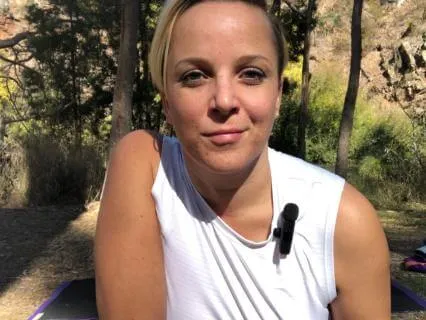
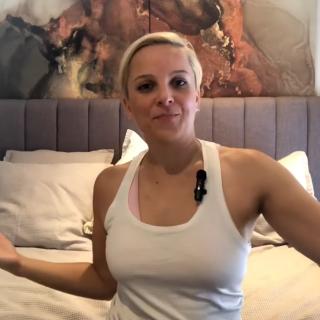
My name is Emma and welcome to your yin yoga for if you are feeling a bit unwell,
If you're feeling a bit sick.
This yin yoga class I've designed for basically for myself.
I was a bit unwell probably in the last week or so and found myself doing this sequence of yin yoga movements in bed.
And I found that it really helped to activate that kind of healing response,
That relaxation response in my body that made me feel like I'd done little bit of yoga got things moving without you know stressing my body out or exerting any energy or large amounts of energy.
So I thought I'd like to make a class and teach that today.
Enjoy.
So for this particular yin yoga class we won't really need that many props.
You're welcome to use a pillow or something soft that you can prop between your legs during one of our poses that we're going to do.
I actually forgot the blanket that I wanted to bring so I'm going to use my jacket.
I've just rolled up my jacket and that at some stage will be popping between my legs for a twist we're going to do.
So it's fairly easy and I always suggest people to drink water throughout the class as they feel guided to and especially if you're feeling unwell you're going to need that hydration.
So feel free to have a sip of water in between poses if you want to pause the class or whenever you feel that you need to.
So it's going to be a fairly simple class.
We'll do about three to four yin yoga poses.
And we'll finish off with a Shavasana at the end,
Just to relax and integrate.
I hope you enjoy this and know if you find that you've pushed yourself a bit too hard,
Which hopefully will be difficult to do in this class.
Feel free to just stop and rest and maybe finish up the class whenever you like.
So be gentle with yourself,
Take care of yourself,
And I hope you enjoy.
Okay,
So to start off.
.
.
We're going to start lying on our backs.
So,
I mean,
Ideally for you,
Maybe doing this in bed would be great,
But if you're up and out and out of bed and stuff,
You can do this on any surface.
Lying on your back.
And we're going to start with just reaching.
Our arms overhead.
So you're just bringing your arms back behind you.
Now I'm on a slight incline,
I'm outdoors,
So there's a slight hill.
So if I'm wriggling a bit,
That's just because I've got to find some balance so I don't roll myself down the hill.
But for you once you're steady.
You can just rest.
The arms are coming overhead.
And just adjust your arms.
To feel which amount of stretch works for you.
So you might have them straight up overhead,
Or you might bend your elbows a little bit and bring them more down by your side so that stretch through your chest is a little more through your shoulders,
Opening up your inner arms.
But just feel around what feels best.
You don't want to push too hard.
And with yin yoga,
We're just finding that gentle point of stretch where it's just enough.
We feel a stretch,
But you're not causing any pain or pinching.
So it's got to be comfortable.
That means you're going to be able to go deeper and actually open up that healing response in your body.
So once you're comfortable.
Just relax your arms.
And become still.
Close your eyes.
We're just going to stay still for a few minutes here and breathe.
Now I'm just moving my own arms around to find what works best with one of my shoulders at the moment but for you keeping both arms overhead or wherever fits perfectly is fine.
So you don't have to literally watch where I'm putting my arm right now.
This is really a stretch to open up through the middle of our body and through our chest.
And can be quite strong actually.
I found this one to be very strong.
It looks very passive but it can be very strong.
The eyes are closed.
Once we're comfortable we're staying still.
And if you find you want to go deeper into the stretch,
You can stretch your arms out or straighten them up a little bit.
Or you can actually ease out of the stretch a little bit if you want to soften it up.
If it's too much,
Bend your arms a little bit more.
You could even bring them down by your sides if you find that stretch to be too much.
To staying here.
And I'm going to stop talking for a couple of minutes so we can deepen into this stretch.
When it's time to come out,
You'll hear my voice again,
Basically.
Remembering to breathe.
I know I said you wouldn't hear my voice,
But I remembered that you might need that reminder as well.
Adjusts if you notice that.
Your breath got a bit tight or short or you were holding your breath a little bit,
You're up in your head.
Just remember to relax into your breathing.
We're going to stay here for about 30 more seconds.
If you find you've had enough or it's a bit too much for you,
You're welcome to bring your arms back down by your sides gently to finish up quicker,
But for now a little bit longer.
Couple more breaths here.
Okay,
So as you're ready,
Very gently just wriggle through your fingers and toes a little bit and bend your elbows,
Bringing your arms down by your side.
And bending through your knees.
Bringing your feet about hip width apart and we're going to press our hips off the floor.
Of the ground,
Bringing your hips over to the right side and dropping them back down and allowing your knees to fall over to the left side.
So this is a position where I mentioned before with this you could use like a rolled up blanket or I'm using my rolled up jumper.
I want to place this between my knees just to support my knees because sometimes the stretch can be a bit strong on the right side of your hip or thigh.
And you just play around with what depth of stretch works for you.
And you can play around with where your feet are as well.
That once you find the right twist,
Rest there and you can rest your arms.
Out to the sides where you can bend through your elbows and gently twisting your head over to the right side.
So it's a gentle twist.
Through the side of your body.
Gentle angle.
And once you're comfortable,
The goal is to kind of stay still.
Move around a little bit until you find that point of comfort for you.
But when you're there,
When it's not stretching too strong,
We've got enough of a stretch without actually causing any pain.
We're going to stay still for a couple of minutes and just really relax into our breath,
Allowing our body Rest into this twist.
And that stretch to deepen,
Relaxing our muscles.
Going deep into those tendons and connective tissue.
Breathing into your belly,
Close your eyes.
Gentle twist here.
Remember if you find you want to go deeper into the stretch,
If it's not enough,
You can adjust yourself.
Or if it's too much you can ease out and find a better way to have your arms and legs.
Once you're comfortable with stay still.
The goal is to really find that sweet spot in any of the postures that we do where we get just enough of a stretch but then deep relaxation starts to occur.
We're going to take just a few more breaths here,
So just focus on your breathing.
Allowing your body just to settle here that little bit longer.
Very gently wriggle through your fingers,
Bringing your knees back to centre.
Lifting your hips up,
Bringing back to the middle and then over to the left side.
And we're just going to change that twist,
So allowing your knees to fall over to the right side.
If you're using a prop,
You can place that support between your legs.
You can even have,
Either have it between your knees or your upper inner thighs,
Depends where you need that support or how big the pillow or prop is,
So you'll sense into where you need to put it.
Because I'm on a bit of a heel it's going to pull my stretch a bit deeper so I might need to adjust my support a bit,
Make it even stronger,
That's better.
And my arms because it's wringing my arms even deeper into a stretch So once you find that point of comfort,
Letting your head fall over to the left side that little bit for stretch here.
It's a gentle twist.
You can adjust your feet around.
Remember to adjust whether you want them further down the mat.
Or bringing them up closer to your buttocks area.
As to what feels best,
What stretch in your legs feels best.
But once you're comfortable,
Once your shoulders are comfortable,
The neck is comfortable.
There's just enough stretch without causing pain.
And we're going to stay still and just breathe here.
Remember to kind of allow your breath to flow into your belly area.
That's going to help to expand and open up through that middle twisting area,
Relaxing the muscles through your belly,
Opening up through your hips.
I'll be here about a minute longer.
Really allow yourself to relax into this stretch.
Okay,
As you're ready,
You can place your palms facing down.
Use that to press a little bit,
Bringing your knees back to centre.
Bring your hips back to centre.
So your knees.
Back to centre here.
We're going to hug our knees into chest and just ease off through our lower back with gentle rocking left to right on the spot.
To massage through your lower back.
Breathing into your belly.
So this rocking left to right really helps regulate your nervous system.
Anything that crosses over the midline of our body helps to really balance the parasympathetic and sympathetic nervous system.
I think it has to do with the left and right sides of our brain as well.
Now if I look like I'm swirling down the hill,
It's because I quite literally am.
So pay no attention to that.
Okay,
So from here we're going to Place our feet a little bit more than hip width apart.
Just a tiny bit more than hip width apart,
Maybe about hip width.
Check what feels best for you and we're going to turn our knees.
In towards each other.
This is going to really relax through our lower back.
It's very calming for your nervous system.
So especially if you're not feeling well,
It can start to really regulate you,
Calm your nervous system down.
Looks very passive.
So palms facing down.
But you can also have them up if that feels best,
But I find this one with the palms facing down quite groundy.
So you could turn your toes in a little bit towards each other or you could let them kind of point forward.
Just see how that feels in your hips because it can be surprisingly deep stretch in your hips when you point them right in.
So just feel into what feels best.
So when you're comfortable,
We're going to close our eyes and stay here for a couple of minutes.
Just really settle into this,
Staying still.
Really allowing your body to relax,
Letting your nervous system kind of go through its process.
Sometimes you might feel a bit of a wave through your breath.
As your nervous system starts to regulate and relax like this wave of energy flows.
From the base of your spine up to your lung area,
Or it's just the way the breath starts to open up through your middle torso.
That may not happen for you,
But I've noticed it within myself.
And it's always a positive sign if that's happening.
Just really allowing your breath to deepen,
Really.
Your body starting to breathe you in a way.
Okay,
So staying here,
Eyes closed,
Relaxing through your face,
Just breathing.
And one reason also,
I'll be quiet in a moment,
One reason also it's good to relax our nervous system when we're feeling unwell.
Our body tends to go into kind of a fight and flight response when we're unwell because our immune system is fighting off what it perceives as a danger,
It's trying to protect our bodies.
And so I often notice,
At least in myself,
My body can go into a bit of fight and flight.
And you know,
Obviously it's best when our body's relaxed,
Our resources are stronger,
Our immune system is stronger.
So finding ways to relax your body when you're not feeling well is going to support your whole health and recovery.
Just in my experience.
Just breathing here a minute or two more.
Letting your body really relax into this.
We're going to stay here for about four more breaths.
So you have a sense of time.
Really allowing yourself to naturally breathe,
Relaxing into your breath.
Okay,
Very gently opening your eyes.
I have lots of birds playing around me right now.
Opening your eyes and we're going to come down into Shavasana,
Which is the lying down pose.
At the end of a class.
This pose,
This class has been obviously and intentionally very passive because this is for when you're not feeling well,
When you don't have a lot of energy,
When we're really nurturing and supporting our bodies.
Nourishing our system rather than trying to do deep strong physical stretches.
So we're coming to Shavasana.
Feet a little bit more than hip width apart.
Let your feet kind of fall open.
Let your palms face up.
The sky,
The ceiling.
Just gently tuck through your chin,
Elongate to the back of your neck and just move your hips and your shoulders around to make sure that you're comfortable.
And once you are,
Eyes are closed again,
Just for a couple of minutes here,
Just to rest and integrate.
Any of that stretching that we did,
Those movements that we did,
Any energy that we moved around,
Letting it all settle and letting ourselves like emotionally,
Mentally,
Physically integrate.
We're going to breathe here,
Staying still once you're comfortable.
And when you feel like you're ready and gently wriggle through your fingers and toes.
Bring some movement back in.
You might want to roll through your ankles.
Turn your head left to right.
And gently bend through both knees.
Roll over to your right side,
Placing your left hand on the ground and press yourself up.
Into a seated position.
Okay,
At some point you may have noticed that I had a jumper appear on my body,
The magic of editing.
But a bit cold and the sun was no longer on the mat.
Have some water after that class,
Especially if you're not feeling well,
Would have moved some things around,
Probably shift some toxins through your bloodstream or shifting it through your digestive system ready to be released from your body.
So Drinking plenty of water is going to help you when you're not feeling well and in any type of yoga,
Especially yin yoga.
All types of yoga actually in fact.
I hope you enjoyed that class.
I hope you got a bit of relaxation,
Relief.
Maybe you're feeling a little bit better,
At least emotionally,
In your energy,
Just the subtle parts of your body.
And I would love to know how you went.
If you want to leave a comment below or.
Okay.
Thank you so much for being here.
I will see you next time.