Hi,
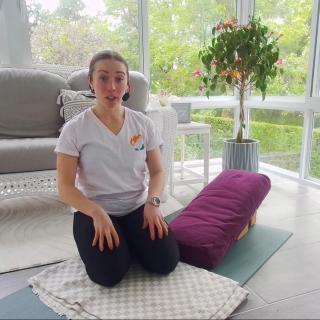
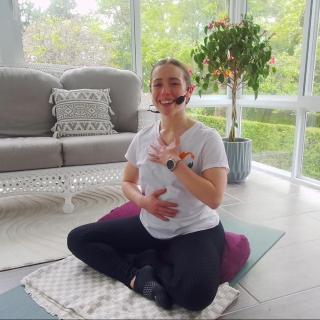
My name is Ashley and thank you for joining me for this mini workshop on meditation.
Meditation is something that a lot of people think they know what it is.
But really,
They kind of know the idea of it rather than actually experiencing it in their lives.
Meditation simply is the act of single-pointed concentration.
A lot of people have this image in their mind of what meditation should be.
Let's think of somebody sitting with their eyes closed,
Holding the mudra,
Maybe chanting Aum.
And really,
Meditation can be something more than that.
And it can be something more approachable than that that can fit into our everyday lives.
So I hope this little mini workshop today will help you understand how you can take meditation and make it fit into your life.
So today we're going to be diving into a specific type of meditation called the breath awareness meditation.
So breath awareness meditation,
What is it?
It is one of the oldest forms of meditation where your single point of concentration is the breath and the experience of breathing.
So you could choose to do either a natural breath or maybe a specific breath practice that does variations on timing or the type of breathing.
This can also be referred to as pranayama.
But the whole point is so that you become fully immersed in the breath,
And that's going to help you enter that meditative state.
Some of the benefits of this type of meditation are improved concentration,
Mental clarity,
Focus,
Decreased stress,
Worry,
Or anxiety.
Increased self-awareness,
And positive thoughts.
The ability to control your emotions.
On the physical side,
It also strengthens the brain density and increases the gray matter in your brain or those folds that we picture when we think about our brain.
And finally,
It can allow us to create healthy breath patterns.
And there's a reason why I chose to share this method with you all.
So I was someone who did not know they did not have a healthy breath pattern.
I consider myself a healthy individual.
I have been really active and eating healthy ever since I was in my teens And I was deep into my 200 hour yoga teacher training when I realized that I don't have a healthy breathing practice Which was really crazy to realize Breath was something I kind of took for granted.
I never really noticed it until we actually had to practice pranayama during our training So we were in our training me and my fellow trainers knees and we were sitting together and trying to practice pranayama a specific breath practice where we had to inhale for a certain amount of time hold the breath and then take a controlled exhale for a certain amount of time and I found that beyond four seconds,
I could not extend my inhales and exhales.
So the most I could do was maybe four seconds on the inhale.
And then instead of being able to control my exhale,
I was just letting the air kind of flow.
Like fall out of my lungs instead of having a controlled.
Exhalation just as controlled as my inhalation.
So.
.
.
When I discovered this,
At first,
Of course,
I was nervous,
Kind of,
Like,
Shameful about it.
Like,
Why can't I breathe?
Because it's something we do every day.
But as I got to practicing and just noticing and realizing that this was a problem,
I was able to then fix my breath patterns.
Finally,
Be able to inhale controlled,
Hold it,
And exhale for longer than four seconds.
And when we were training,
What I discovered was my hang up was that when I was exhaling,
I actually wasn't letting the air completely empty out of my lungs.
So even though I thought I was done breathing at the bottom of an exhale,
I still had a few more seconds of breath to let go.
And that,
In turn,
Did not give myself enough space to inhale for longer than four seconds because I was always about this much full.
So once I realized that,
I connected it back to anxiety because if you think about it,
Your body will hold on to breath because that is the life force energy.
And if it doesn't feel comfortable,
It's always going to hold on to that little bit just in case.
So as soon as I was able to notice the problem and let go of the expectation,
I was finally able to fully take a big,
Long exhale,
Get all of the air out of my lungs,
And then feel comfortable enough to take a full inhale,
Pause,
And take a controlled full exhale.
So that's going to be a big part of our practice today because you,
Like me,
Might be that person who didn't realize that their breathing pattern was actually contributing to stress in their body.
So now my inhales and exhales can be eight seconds or more if I'm really practiced.
And if I notice that I can't do that,
Then I make some change or act in such a way to calm myself down so I can get into that state.
So it's really made me more aware.
And I hope our workshop today actually helps us do that as well.
So here are some other reasons why I picked the style as our workshop is it's a simple and effective and accessible style of meditation,
Meaning you just need you and your breath,
Which is great.
And yes,
It could also be challenging because those who let their mind wander or those who have minds that tend to wander can get frustrated because they don't have something like a guided voice or a guided visualization to latch onto.
But this is also a great gateway practice once you master it to be able to connect with deeper meditation practices.
So even though the breath is something that's kind of abstract,
It's still something to connect you back to your practice.
So that it can prepare you for more abstract practices like the present moment meditation where you are sitting.
And you just have to experience the present moment and your five senses.
So I really think that the breath awareness meditation is a way to bridge from,
I'm going to listen to somebody tell me how to meditate and what to look at,
To being able to meditate with your own body and yourself.
And I think that's a really beautiful thing.
So that's why I chose to share this with you all today.
Maybe a little bit less traditional,
You could take this breath work and these breath practices into your everyday life,
Maybe outside of the meditation.
So I find that when I'm on a stressful commute,
I commute over an hour to work every day and home.
Sometimes if I'm really stressed out driving,
I will find myself coming back to that breath meditation,
Of course,
Without closing my eyes,
But coming back to the breath of the breath meditation to calm myself down.
I do the same thing sometimes on a stressful day.
At work,
Go to the restroom for a second,
Breathing practices centered back into my body,
And then can continue on with your day.
Something I could also do before bed,
Winding down,
And then also you could do this just as walking,
Basically any time.
You can use these breath practices to connect you back to your body and the present moment within your day,
Apart from your traditional meditation practice,
Which is really nice.
So even though.
I'm certified in yoga.
I also am about to complete this meditation certification.
This is something that.
I can come back to all the time.
To connect back to myself when I find myself in that anxious state.
So I really hope that this workshop today can help you do the same thing and find a way to fit it into your life and feel better because of it.