Do you blame yourself for being depressed?
I would not be surprised.
A lot of people do.
Let me show you something interesting.
Researchers studying how depression shows up in the brain found that there is a physical gap in the brain that contributes to this problem.
And I'm going to come back to that in a few minutes,
But first let's do a little exercise that will help demonstrate why we might blame ourselves for being depressed.
Okay,
I'm back.
I need you to come up with an answer here.
I'm gonna tell you something and I want you to figure out how it's connected,
Okay?
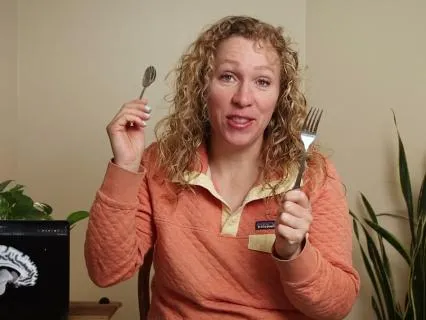
The fork.
Is the father of the spoon.
Now I get that this might not make sense right away,
But I really want you to figure this out.
Why is the fork?
The father of the spoon.
Okay,
And this is important,
So.
.
.
Please pause the video and write in the comments below why you think the fork could be the father of the spoon.
Now this is important.
To understand how your brain works,
We're going to analyze your answer.
Okay.
Thanks for hanging with me.
Okay.
So the fork is not actually the father of the spoon.
A fork is a fork and it did not father anything.
But if you read the comments below,
You'll see that lots of people's brains came up with some kind of connection.
Their brain took two ideas and found a way to connect them.
Your mind is a meaning making machine.
It's constantly taking pieces of information and it's seeking to figure out connections between them.
So for example,
Someone doesn't text you back,
Your mind creates a story about why.
You.
A door slams,
Your brain is instantly generating possible explanations.
The only fact is that the door slammed,
Everything else is meaning that your mind has created just like it may have invented some reason why the fork is the father of the spoon.
This is one of the things that happens with depression.
So if you're feeling really sad,
That's objective,
But then the mind asks,
Why do I feel sad?
I must have caused this.
What have I done to make myself feel this way?
And then the mind makes up those reasons to fill in the blanks.
It might think,
Hmm,
It must be because I'm lazy.
There's something wrong with me.
If I had more willpower,
I wouldn't feel this way.
Your brain takes two ideas.
I feel sad and I must have caused it.
And it's invented all of these reasons to fill in the blank.
Your brain tells you a story and it feels really real.
Self-blame is one of the sneakiest ways that depression distorts your view of reality.
And in this video,
You're going to learn to see the lie for what it is and how to replace it with something healthier.
Okay,
Depression creates a cycle that's difficult to escape.
So you feel depressed,
Then you blame yourself for feeling this way.
I'm so stupid for being depressed.
Then you feel worse because of that self-blame.
And then,
Because your only response to feeling worse is to beat yourself up,
You start to criticize yourself even more.
You might say,
I'm such a loser.
And then that's going to make you feel even more terrible,
And then you continue punishing yourself.
In this cycle,
Every life disappointment or every emotion becomes interpreted as being deserved punishment for your perceived badness.
You think you deserve to be punished.
Depression twists your thinking so thoroughly that you even get depressed about being depressed.
The only tool you have in response to feelings is to blame or to punish yourself.
So even if you get feeling better,
You might feel guilty or uncomfortable about feeling better.
You might think,
I don't deserve it or it'll never last.
This is self-sabotage.
At its finest.
Not only do you blame and punish yourself,
But you believe you deserve it because of who you are.
That there's something about your identity that's broken,
So when random or uncontrollable things happen,
All my fault.
These are meanings that your mind is inventing and then you feel bad and then you think oh if I were a better person I wouldn't be feeling this way.
The more you blame yourself the worse you feel creating a downward spiral.
So Where does this tendency to blame ourselves come from?
Why do we do it?
There's a couple of things that could be going on here.
One is family dynamics.
Maybe you learned this pattern from your family.
If your parents didn't know how to handle their own emotions when they were sad or angry or hurt,
They might've punished you for expressing feelings that made them uncomfortable.
So you might have heard something like,
Stop crying,
You're fine.
Which teaches children that certain emotions are unacceptable.
Okay,
And then you might punish yourself for having those feelings.
Second one is cultural factors.
A lot of cultures emphasize personal responsibility and willpower.
This leads to belief that depression is something that a person should just be able to snap out of.
Messages like,
Oh just choose to be happy or be grateful for what you have are easily twisted into more reasons why you're bad for not being able to do so.
All right,
Another one,
Social pressure.
Society often labels emotional expression as weakness.
You might have heard,
Don't be a crybaby,
And others have it worse.
And these reinforce the idea that struggling with emotions indicates personal failure.
Okay another one false comparisons seeing other people who appear to be handling life better leads to comparisons they can do it they're so happy their life so perfect why can't i write this ignores the fact that everyone faces different circumstances and has different internal and external resources.
Okay,
Lastly,
There's another big reason why we might blame ourselves for feeling depressed.
It's actually kind of self-protective.
So let me ask you this question.
Does blaming yourself help you in any way?
Does it serve some kind of function?
Like even if the benefits don't last,
Even if it punishes you later,
The brain only repeats things that are rewarding in some way.
What are you getting out of blaming yourself or labeling yourself as broken?
I think there's a couple things that could be going on here.
One is an illusion of control.
Blaming yourself gives you a sense of agency.
If it's your fault,
Then you have some control over the situation.
It can feel better,
Strangely,
To believe that I'm the problem than to acknowledge that some aspects of depression or your happiness might be beyond your control.
Okay.
Number two,
It's self protective.
If you label yourself as broken,
Doesn't that feel just a little vindicating?
Like if I'm broken,
At least I can excuse myself for not putting in more effort.
Number three,
It might protect you from the danger of blaming someone else,
Or it might protect you from feeling angry at someone who mistreats you or at someone who provides for you.
Like a parent.
If you internalize that hatred,
Then you can avoid conflict.
So your parent does something,
It hurts you,
You feel angry,
You can't say it.
So you say,
Well,
Man,
I must be bad.
Because I'm feeling this way.
And then you internalize that anger.
Okay,
Lastly,
Sometimes self-blame can draw sympathy or support from others.
Now,
One of the reasons we know that self-blame serves a function,
But not like a lasting healthy function,
But a function anyway,
Is because when therapists or friends try to convince someone that it's not their fault,
People with depression often resist those suggestions.
So when friends try to cheer them up,
They might think,
Oh,
Anyone who really knew me could not possibly say such positive things.
Or how dare you be optimistic when there's no hope.
Blaming yourself can form a heavy sort of armor,
One that you're reluctant to let go of.
Maybe you've hurt so much that you've just shifted into protective mode.
If you let yourself feel happy,
Then it'll just hurt more when the sadness returns.
So you push away.
Any signs that you might be a worthwhile human being,
And this is an attempt to protect yourself from future pain.
Okay,
Depression is a big fat liar.
It's going to tell you that you're a terrible human being for feeling depressed,
That you're weak,
That you should be ashamed,
And that blaming yourself is the correct response.
It's the appropriate way to handle those feelings.
But depression is a type of blindness.
You simply cannot see things clearly when you're depressed.
And unlike a broken leg,
Depression doesn't always have a visible cause.
Without something external to blame,
The mind desperately searches for a connection,
And people turn inward,
They assume they must be the problem.
In the words of Aaron Beck,
This is irrational thinking,
But to a depressed person,
It feels rational,
It seems to make sense.
But it's not rational.
Believing that it's your fault is actually a defining symptom of depression in the DSM.
Excessive self-blame is right here.
People with depression are much more likely to feel excessive guilt guilt that does not make sense to an outsider.
You'll feel like it's your fault that you're lonely,
That you struggle to get out of bed.
You'll berate yourself for feeling sad,
For feeling unmotivated,
For not having perfect relationships,
For being abused,
For being sensitive.
And all this guilt makes you even more depressed and then you blame yourself for being depressed too.
Okay,
There's actually research showing that people with depression have fewer physical connections in brain areas that help regulate There's a disconnect between the part of the brain that overgeneralizes and the part that thinks about oneself.
This gap means that when you feel bad about one thing,
You blame yourself for everything.
When you make one mistake,
You feel like a complete failure.
And interestingly,
I think this is fascinating,
In brain studies,
The blame and guilt centers did not activate,
They did not light up on the scans when other people did something wrong,
Only when a depressed person perceived that they had made a mistake.
Now the good news is that your brain is especially good at rewiring itself in this area,
And we'll talk about some ways to do that later in the video.
We just have to touch on this a little bit longer.
Depression warps your perspective.
It makes neutral things feel negative,
Positive things feel neutral,
And negative things feel awful.
Research shows that people with depression have a bias in the way their brain processes information.
One study had people read a list of words and try to remember them.
The people with depression remembered fewer positive words than negative words.
Depression skews your memory so that you're more likely to remember the negative stuff,
Like,
Oh,
That one time I said something hurtful,
Instead of the 10 times you were kind and grateful.
Now,
This distorted thinking can lead to feelings of self-blame,
Rumination,
And catastrophizing,
And all of that fuels depression.
Depression blinds you to reality and it creates this filter through which all information passes.
Oh,
Someone else messed up.
I'm gonna ignore that.
I made a tiny mistake.
I am gonna dwell on that,
Remember that,
Ruminate on that,
Think about that,
Blame myself for that,
And feel really terrible about it.
To summarize,
One of the core symptoms of depression is excessive self-blame.
It may come from how people treat you,
How you treat yourself,
Or a defense mechanism.
It also can be contributed to by changes in the brain when you're depressed.
Fault,
But there is a lot you can do about it.
Brains are made to rewire themselves.
So,
How do we do it?
First,
Trying to force yourself to feel happy usually backfires.
Beating yourself up for being depressed only makes things worse.
You need to set down the hammer of self-criticism and use some different tools.
Okay so people with depression often arrive there by trying extremely hard with the wrong techniques.
Maybe they're trying to care for everyone else,
Maybe they're suppressing their feelings,
Or they're protecting themselves in ways that ultimately cause self-harm.
But you don't feel this way because you're weak or defective.
It's just because you lack the skills to respond to hurt or disappointment in a healthy way.
And you can learn new ways to respond to your thoughts and feelings.
And the brain's remarkably flexible and it can be rewired.
Instead of spending all this energy blaming yourself or your body.
Or the universe for depression,
You can take action to change depression's brain pathways.
Okay,
So how are we gonna do this?
First thing I would say is like,
Let's see if we can take a broader view.
So depression is gonna make your view very narrow and it's gonna limit a lot of the things you're willing to see and believe.
So if we take a broader view,
We might say,
Well,
What are all the factors here that may have contributed to your feeling depressed?
Maybe it's things like trauma or a physical illness or brain differences or lack of support or high levels of stress or lack of resources or grief or loss or physical exhaustion.
Plus there's biological factors that we still know very little about.
All of these things can contribute to depression.
You cannot blame yourself for all of these things.
Now I've seen some techniques that encourage people to shift the blame from themselves to others,
Like,
Oh,
You should blame your parents for being depressed,
Or you should blame brain chemistry for being depressed.
And the reality is we don't actually know what's causing your individual depression,
But we do know the factors that help you come out of it.
So blame is just not a helpful long-term strategy.
So instead of judgment,
Can you learn to sit with your thoughts and feelings without judging yourself for having them?
And that's how we're gonna.
Kind of get rid of some of these filters.
And I would recommend that you practice mindfulness or willingness.
I've got a bunch of videos on that.
Those can be helpful ways to create some space for you to have those feelings without judging them.
Speaking of judgment,
People with depression often have blind spots when trying to figure out why something happened.
They're more likely to falsely blame themselves while excusing others' behaviors.
So here's the second thing to try.
Practice putting your thoughts in perspective by asking yourself these questions.
If a stranger observed what happened,
Would they blame me entirely?
Why not?
Here's another question.
If a friend had this experience and blamed themselves,
What would I say to them?
Is that how you were talking to yourself?
And then if there's something you've done wrong,
You might ask,
Are there other explanations for this event that I've missed or discounted?
And then another thing you can ask is like,
Oh,
If I did make a mistake,
If I was to blame,
What were my intentions?
Do I always behave in this way?
You can use some of these questions to practice some self-compassion.
So blame rarely solves problems,
But self-compassion can give us the hope.
To face our problems in a healthier way.
So instead of saying like,
I'm weak,
You could try saying,
I'm having a hard time.
Just be a little bit more compassionate toward yourself.
Be descriptive instead of judgmental.
Okay,
Third thing that might help is called diffusion.
It's where you create space between yourself and your thoughts.
And this is probably easier to practice with a therapist or maybe a really wise supportive friend.
So when you have a thought like,
I'm so weak for being depressed,
Try rephrasing it like this.
I'm having the thought that I'm so weak for being depressed.
Or even better,
I'm noticing that I'm having the thought that I'm weak for being depressed.
Depressed.
You do not have to argue with your mind.
You can just say,
Thank you brain for that thought.
You can challenge self blame by asking,
Would I say this to a friend?
If not,
It's probably distorted.
You could catch your brain distorting reality and lying to you.
So instead of asking like,
Oh,
Is this thought true?
Because your depressed mind is going to give you a distorted answer.
It's a lot better to ask this question.
Is this thought helpful?
Has blaming yourself helped you take healthy action or overcome depression?
Okay,
So these are a few ways we can create some space.
We notice our thoughts.
We ask,
Would I say this to a friend?
And then you ask,
Is this thought helpful?
Does this thought help me get better?
Does this thought help me be less depressed?
Then just notice it and be like,
If it's not helpful,
Be like,
Cool,
That thought can be there,
But I'm going to focus on something more helpful.
Okay,
Here's another approach that I think can be helpful when you feel like you need to blame yourself.
A lot of people who blame themselves feel like it's the right thing to do.
They feel like it's justice and it's what they deserve.
So you could ask yourself if you feel that way,
What are the pros and cons?
What are the pros of blaming yourself?
So you might say,
Well,
If I blame myself,
Then it makes me feel like I can do something about it.
But a con would be,
Ugh,
Blaming myself makes me feel more guilty,
More worthless,
And more depressed.
So you could just create a little space from those thoughts by being like,
Huh,
Is this helping me?
Your mind generates countless potential thoughts.
And so you might scan your mind and be like,
Huh,
I wonder if there's any other thoughts that might be more helpful.
And then you can choose to focus on the helpful ones while letting the unhelpful ones just like pass on by,
Leaves on a stream.
Okay,
Number four,
Take one action.
So instead of blame,
Which usually leads to us doing less and less.
Take accountability for progress.
So you could say like,
Oh,
Are my actions fueling depression or health?
It's not your fault that you're depressed,
But there's probably something you can do about it.
You could spend all day blaming yourself for failing at school,
Or you could find a tutor,
Or you could do some studying.
Action is usually a lot more productive than wallowing in self-blame.
Now,
While it's best if the action addresses the problem you're facing,
Like,
Oh,
If you're having a problem in your relationship,
Learn some skills to improve relationships or to communicate better,
Right?
If you can't take action on the problem,
Any positive action is better than none.
So this might look like clean one small area,
Go for a walk,
Reach out to a friend,
Write in a journal.
Any type of activation,
Even small actions,
Can interrupt the cycle of self-blame and create momentum toward positive change.
All right,
Number five,
Get some support.
Therapy,
The community,
Going to a support group,
All of this can help build up your resources that can help you shift your perspective.
So when we're stuck in our own distorted thinking,
Everything we think of can be filtered through that self-blaming lens.
Working with a therapist can help us see things a bit more clearly and develop more effective strategies for managing depression.
Okay,
So you've been using all of your energy to punish yourself instead of to help yourself.
Let's try something new.
Let's break the cycle.
You cannot cast out darkness with darkness.
Only light can do that.
You can't cast out hate with hate.
Only love can do that.
You cannot cast out depression with blame.
Just doesn't work.
Instead,
You can build a new habit where you create a little bit of space from your thoughts.
You say,
Oh man,
My brain is inventing stuff again.
You check your thoughts and say,
Which of these thoughts are helpful?
And then you take an action that lines up with a healthier life.
You can gradually rewire your brain and break free from the cycle of self-blame and depression.
Okay,
Thank you for being here and take care.