Worksheet
Understanding Your Traumatic Birth Story
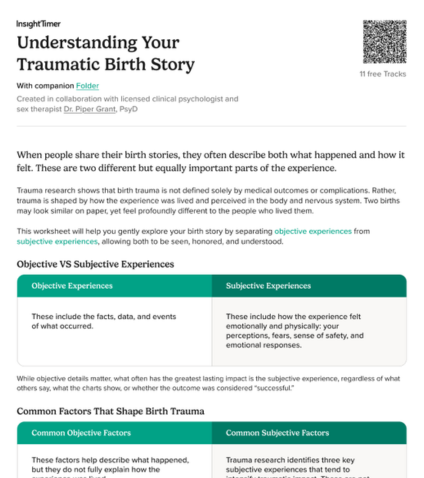
Developed with clinical psychologist Dr. Piper Grant, PsyD, this worksheet looks at birth trauma through a nervous system lens, not just medical charts. It helps you look at how the event was actually lived and felt. This process supports individuals in releasing shame, confronting helplessness, and honoring their healing.

How to Use This Worksheet
Introduce this multi-step narrative and somatic processing exercise during perinatal or trauma-focused therapy sessions. First, instruct the client to write their birth story freely and without chronological constraints to help integrate stored nervous system experiences. Second, guide them to use two separate colors to distinguish objective details (facts, medical events) from subjective elements (fears, physical sensations, perceptions). Finally, walk the client through the reflection phase to evaluate key subjective factors—such as sudden changes, overwhelming helplessness, or perceived danger—while carefully monitoring current bodily sensations.
Who This Worksheet Is For
This guide is for mothers and postpartum individuals dealing with distress, shock, or a loss of control after a difficult delivery. It works as a gentle template for personal reflection, as well as a structured tracking tool for perinatal psychologists, trauma therapists, social workers, and doulas.
Expected Outcomes
- Clearer boundaries between objective medical facts and subjective emotional or physical perceptions.
- Increased insight into how sudden shifts and a loss of choice register as trauma in the body.
- Improved ability to observe heavy memories and delivery fears without judgment.
- Reduction in self-blame by reframing lingering shock as a natural survival response.
Related Topics
References
Porges, S. W. (2011). The Polyvagal Theory: Neurophysiological Foundations of Emotions, Attachment, Communication, and Self-regulation. W. W. Norton & Company. (Applied to the biological framing of birth trauma as a protective nervous system response to feeling trapped, overwhelmed, or unsafe).
Pennebaker, J. W. (1997). Writing to Heal: A Guided Journal for Recovering from Trauma and Emotional Upheaval. Oxford University Press. (Clinical support for using expressive writing to process traumatic memories, integrate objective facts with subjective emotions, and support physiological regulation).
Beck, C. T. (2004). Birth Trauma: In the Eye of the Beholder. Nursing Research, 53(1), 28-35. (Foundational clinical research establishing that birth trauma is defined by the subjective experience of helplessness, shock, and danger rather than objective medical outcomes).
van der Kolk, B. (2014). The Body Keeps the Score: Brain, Mind, and Body in the Healing of Trauma. Viking. (Applied to the core premise that birth trauma is shaped by how the experience was lived and perceived in the body and nervous system, not solely by medical outcomes.)
Soet, J. E., Brack, G. A., & Dilorio, C. (2003). Prevalence and predictors of women's experience of psychological trauma during childbirth. Birth, 30(1), 36–46. (Applied to the three key subjective factors — Sudden, Overwhelming, and Dangerous — identified as intensifying traumatic impact during birth.)

Frequently Asked Questions About Understanding Your Traumatic Birth Story Resources
© Copyright 2026 Insight Network Inc. All rights reserved.
If you are in a crisis or any other person may be in danger - don’t use this site. Use these resources