Worksheet
Traumatic Birth: Mapping Your Losses and Their Impact
Created in collaboration with licensed clinical psychologist and sex therapist Dr. Piper Grant, PsyD, this worksheet targets the unacknowledged, ambiguous losses that frequently follow a traumatic delivery. By externalizing complex grief into emotional, physical, mental, and relational spheres, this tool helps transition vague somatic distress into integrated emotional processing.

by Insight Timer in collaboration with Dr Piper Grant
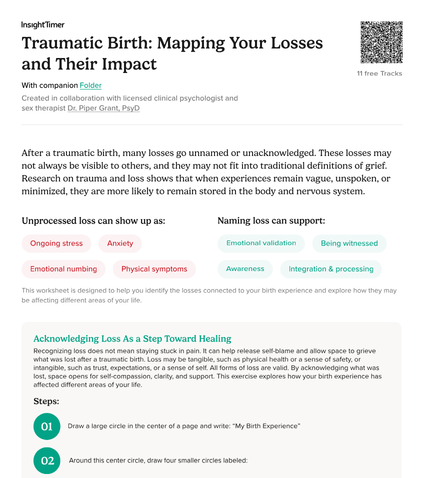
How to Use This Worksheet
This worksheet is designed for flexible clinical and self-directed use. In a therapeutic setting, clinicians can introduce the mapping exercise to safely explore trauma metrics without floods of overwhelm, pacing the integration circle by circle. For independent practice, users should find a quiet space, map out the primary impact spheres, and utilize the provided grounding prompts to observe physical sensations and hidden cognitive patterns without judgment.
Who This Worksheet Is For
This worksheet is uniquely designed for postpartum individuals, parents, and partners recovering from a distressing or medicalized birth experience. It is an invaluable diagnostic and therapeutic aid for perinatal mental health specialists, clinical psychologists, pelvic floor physical therapists, and doulas seeking a non-linear, somatic-mindfulness approach to grief work.
Expected Outcomes
- Reduction in self-blame and unaddressed guilt.
- Increased insight into how somatic trauma alters relational and mental health.
- Greater self-compassion and somatic awareness during triggers.
- Enhanced emotional validation through visual integration.
Related Topics
References
Boss, P. (2006). Loss, Trauma, and Resilience: Therapeutic Work with Ambiguous Loss. W. W. Norton & Company. (Anchors the framework of mapping intangible, unacknowledged losses that lack clear closure).
Levine, P. A. (2010). In an Unspoken Voice: How the Body Releases Trauma and Restores Goodness. North Atlantic Books. (Supports the premise that unspoken trauma remains stored as physical symptoms and physical tension).
Janoff-Bulman, R. (1992). Shattered Assumptions: Towards a New Psychology of Trauma. Free Press. (Underlies the disruption of imagined birth expectations and intrusive processing).
van der Kolk, B. (2014). The Body Keeps the Score: Brain, Mind, and Body in the Healing of Trauma. Viking. (Applied to the concept that unprocessed loss and trauma are more likely to remain stored in the body and nervous system when left unnamed or unacknowledged.)

Frequently Asked Questions About Traumatic Birth: Mapping Your Losses and Their Impact Resources
© Copyright 2026 Insight Network Inc. All rights reserved.
If you are in a crisis or any other person may be in danger - don’t use this site. Use these resources