Worksheet
The Self-Talk Reset: Transforming Negative Thoughts Into Supportive Inner Dialogue
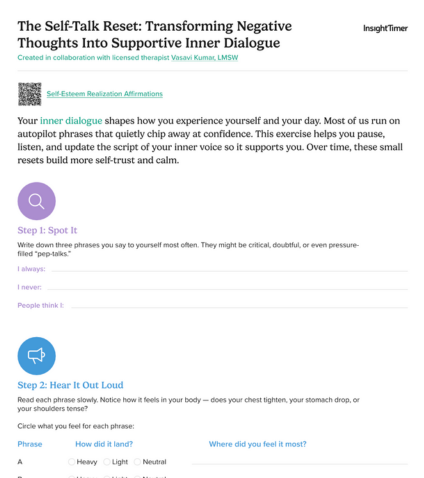
This worksheet helps you pause and examine the phrases you repeat to yourself throughout the day—many of which operate on autopilot and quietly erode self-worth. By identifying your common self-talk, saying it out loud, noticing how it feels in your body, and rewriting it into more compassionate language, you reshape your inner dialogue into one that supports your growth, confidence, and emotional well-being.

How to Use This Worksheet
Start by writing down the three phrases you say to yourself most often. Read each one out loud and observe the physical sensations that arise—tightness, heaviness, neutrality, or relief. Then rewrite each phrase into something kinder, more truthful, and oriented toward growth. Repeat your new phrases aloud three times and choose one reset statement to focus on this week. You may also add a visual “before and after” thought bubble to reinforce the shift.
Who It’s For
This worksheet is ideal for individuals who struggle with harsh self-criticism, negative thinking patterns, or pressure-based self-motivation. It supports anyone wanting to develop a kinder inner voice, strengthen emotional resilience, or practice more compassionate self-talk.
Expected Outcomes
• More awareness of your inner dialogue and autopilot thinking
• Reduced emotional impact of negative self-talk
• Healthier, kinder, and more accurate internal language
• Improved emotional regulation and confidence
• Strengthened self-compassion and self-support
Related Topics
References
Kumar, Vasavi (2023). Say It Out Loud: Using the Power of Your Voice to Listen to Your Deepest Thoughts and Courageously Pursue Your Dreams. New World Library.
Beck, A. T. (1976). Cognitive Therapy and the Emotional Disorders. International Universities Press.
Beck, J. S. (2011). Cognitive Behavior Therapy: Basics and Beyond (2nd ed.). Guilford Press.
Neff, K. (2011). Self-Compassion: The Proven Power of Being Kind to Yourself. William Morrow.
Gilbert, P. (2009). The Compassionate Mind. New Harbinger.
Price, C. J., & Hooven, C. (2018). “Interoceptive Awareness Skills for Emotion Regulation.” Journal of Mindfulness, 9(1), 27–40.
Siegel, D. J. (2012). The Developing Mind: How Relationships and the Brain Interact to Shape Who We Are (2nd ed.). Guilford Press.
Frequently Asked Questions About The Self-Talk Reset: Transforming Negative Thoughts Into Supportive Inner Dialogue Resources
If you are in a crisis or any other person may be in danger - don’t use this site. Use these resources