Worksheet
The Self-Support Statement: Strengthening Self-Trust and Inner Reassurance
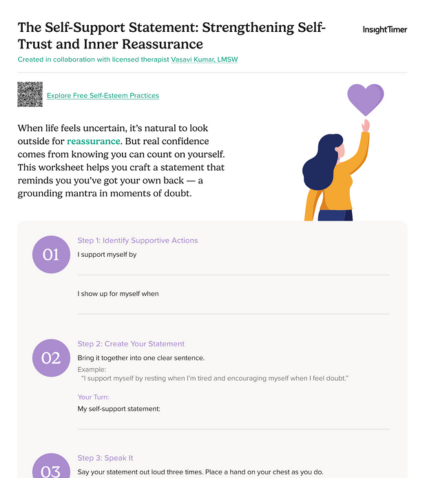
This worksheet helps you cultivate an internal source of reassurance by identifying how you already support yourself and turning that awareness into a clear, empowering self-support statement. When spoken aloud, this statement becomes a grounding reminder that you can rely on your own strength, compassion, and resilience—especially during moments of doubt or uncertainty.

How to Use This Worksheet
Begin by reflecting on the ways you show up for yourself—through rest, encouragement, boundaries, or perseverance. Use the prompts to bring these actions together into one supportive, truthful sentence. Say the statement out loud three times, placing a hand on your chest to anchor it somatically. Notice how your voice feels and reflect on how deeply believing this statement would shift your emotional experience.
Who It’s For
This worksheet is for individuals who rely heavily on external validation, struggle with self-doubt, or feel unsupported during stressful moments. It is also ideal for people working on inner child healing, emotional independence, or confidence-building practices.
Expected Outcomes
• Increased awareness of how you already support yourself
• A personalized grounding statement for moments of stress
• Stronger sense of inner safety and emotional resilience
• Improved self-trust and reduced reliance on external reassurance
• A clearer connection with your own strengths and supportive behaviors
Related Topics
References
Kumar, Vasavi (2023). Say It Out Loud: Using the Power of Your Voice to Listen to Your Deepest Thoughts and Courageously Pursue Your Dreams. New World Library.
Neff, K. D. (2003). “Self-Compassion: An Alternative Conceptualization of a Healthy Attitude Toward Oneself.” Self and Identity, 2(2), 85–101.
Bandura, A. (1997). Self-Efficacy: The Exercise of Control. W. H. Freeman & Company.
Porges, S. W. (2011). The Polyvagal Theory: Neurophysiological Foundations of Emotions, Attachment, Communication, and Self-Regulation. W. W. Norton & Company.
Siegel, D. J. (2012). The Developing Mind: How Relationships and the Brain Interact to Shape Who We Are (2nd ed.). Guilford Press.
Ogden, P., Minton, K., & Pain, C. (2006). Trauma and the Body: A Sensorimotor Approach to Psychotherapy. W. W. Norton & Company.
Frequently Asked Questions About The Self-Support Statement: Strengthening Self-Trust and Inner Reassurance Resources
© Copyright 2026 Insight Network Inc. All rights reserved.
If you are in a crisis or any other person may be in danger - don’t use this site. Use these resources