Worksheet
The 1-2-3 Process: An Emotional Regulation Tool to Navigate Trauma Responses
This clinical resource provides a structured three-step framework to interrupt automatic trauma responses and restore self-connection. Created in collaboration with certified life coach Lisa A. Romano, The Breakthrough Life Coach, this guide combines Polyvagal Theory with emotion-focused processing. By teaching clients to accept their emotional state, track physical sensations, and make intentional choices, the tool breaks reactive habits like fawning, fleeing, fighting, or freezing.

by Insight Timer in collaboration with Lisa Romano
How to Use This Worksheet
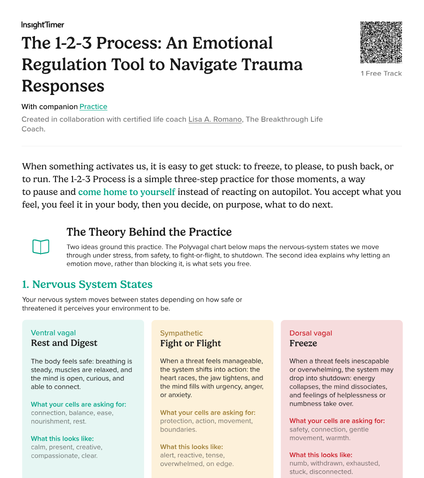
Introduce this three-step protocol during clinical appointments or when clients feel emotionally activated. First, guide them to accept and name their passing emotion without judgment. Second, assist them in feeling physical sensations and identifying their active nervous system state - Ventral Vagal (Rest & Digest), Sympathetic (Fight or Flight), or Dorsal Vagal (Freeze). Third, walk them through the decision questions to separate controllable factors from uncontrollable ones, allowing them to choose a deliberate action that honors their boundaries.
Who This Worksheet Is For
This worksheet is suited for adults navigating trauma responses, chronic reactivity, or codependent patterns, as well as therapists, coaches, and somatic practitioners who want a structured, repeatable tool for in-session regulation. It is especially useful for clients working on nervous system awareness, emotional suppression, or the fawn response, and for practitioners who want a bridge between talk therapy and body-based intervention.
Expected Outcomes
- Reduced reactivity to activating triggers
- Improved ability to name and locate emotions in the body
- Greater tolerance for uncomfortable feelings without suppression
- Reduction in automatic fawn, flight, fight, or freeze responses
- Strengthened capacity to pause before reacting
- Greater self-compassion during emotional activation
Related Topics
References
Gross, J. J. (1998). The emerging field of emotion regulation: An integrative review. Review of General Psychology, 2(3), 271–299.
Porges, S. W. (2011). The Polyvagal Theory: Neurophysiological Foundations of Emotions, Attachment, Communication, and Self-Regulation. W. W. Norton.
Walker, P. (2013). Complex PTSD: From Surviving to Thriving. Azure Coyote Publishing.
Greenberg, L. S. (2004). Emotion-focused therapy. Clinical Psychology & Psychotherapy, 11(1), 3–16.
Flavell, J. H. (1979). Metacognition and cognitive monitoring: A new area of cognitive-developmental inquiry. American Psychologist, 34(10), 906–911.
Romano, L. A. (n.d.). 12 Week Breakthrough Coaching Program: 12-Part Advanced Audio in Codependency Recovery. Lisa A. Romano Breakthrough Life Coaching.
Romano, L. A. (forthcoming). It's Not You: It's Your Programming.

Frequently Asked Questions About The 1-2-3 Process: An Emotional Regulation Tool to Navigate Trauma Responses Resources
© Copyright 2026 Insight Network Inc. All rights reserved.
If you are in a crisis or any other person may be in danger - don’t use this site. Use these resources